Hiring managers kept winging interviews. This gives them a consistent bank to pull from.
The workflow
- Paste the job description
- Ask for questions by competency
- Include a strong and weak answer for each
- Share with the panel
Result: A fair, consistent interview kit per role.
The prompt
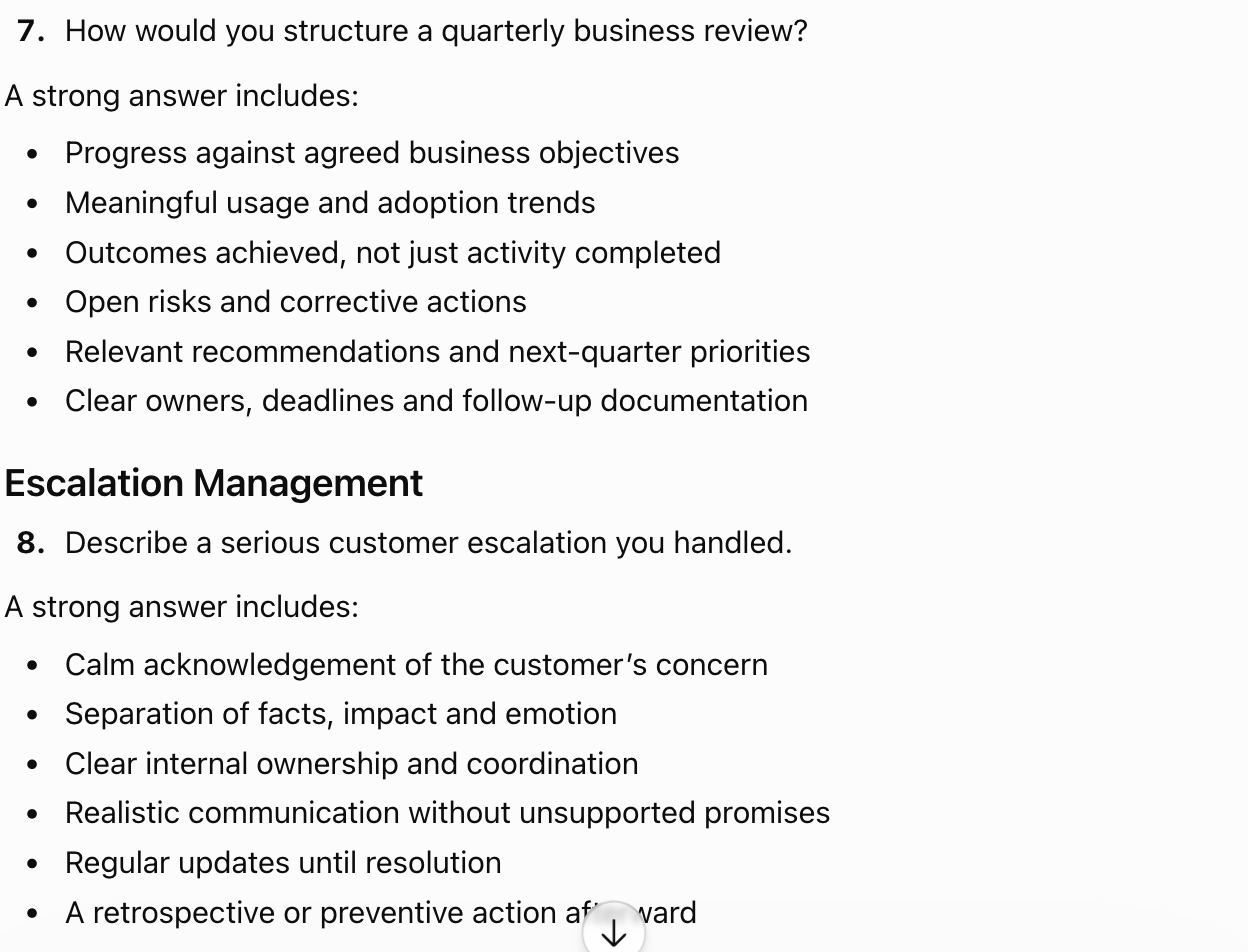
From this JD, generate 10 interview questions grouped by competency. For each, show what a strong answer includes. JD:
[PASTE]
A note on what follows. The workflow, the prompt and the result above come from the member. The notes below (why the prompt works, what to watch for, how to adapt it) were written with AI help.
Why this prompt works
Grouping by competency is what makes the bank usable across a panel. Ten loose questions and three interviewers all drift towards the same two topics, which I know because we did exactly that for a year. Grouped, I can hand one competency to each person. The "what a strong answer includes" part started as a note for me and turned out to matter more for everyone else, because it gives a new interviewer something to score against instead of a gut feeling. It also exposes a weak question fast: if the strong answer reads like a definition, the question is a trivia question and I cut it. I do not use the questions as written. I read them, keep four, and rewrite those in my own words.
What to watch for
- Questions that are illegal or close to it in some jurisdictions, usually around availability, family or health. Read every one before it reaches a panel.
- It mirrors the JD's bias. A JD written for a senior hire produces questions no junior could answer, even when you are open to junior.
- Strong answers written for people who interview well, which is not the same as people who do the job well.
- Competency labels sound distinct but overlap heavily. I usually merge two of them.
How to adapt it
- For structured scoring, add
For each question, give a 1 to 4 rubric with an example answer at each level. - To get past rehearsed answers, add
Each question must ask about a specific past situation, not a hypothetical. - If your JD is vague, paste the last person's actual work instead and add
Base the questions on this work, not on a job description.
What good output looks like
The competencies should map to things the person will do in their first quarter, not to adjectives from the JD. A question is good if a strong candidate and a weak one would answer it differently, and plenty of generic questions fail that. If every strong answer starts with "demonstrates a deep understanding of", I rerun asking for observable behaviour instead.