You're probably staring at a review deadline with a messy mix of calendar notes, Slack praise, half-finished goals, and a vague memory of what each person accomplished over the last few months. This defines the performance review problem. It isn't just writing. It's reconstructing evidence from scattered systems, then turning it into something fair, specific, and useful.
That's why AI for performance reviews has gotten traction so quickly. Managers don't want a robot to judge people. They want help pulling the thread through a year's worth of work so they can spend more time coaching and less time assembling a narrative from fragments.
Used well, AI won't replace your judgment. It will reduce admin drag, surface patterns you might miss, and give you a stronger first draft. Used poorly, it will generate polished nonsense, reinforce gaps in your evidence, and create legal risk. The difference comes down to workflow, prompts, and oversight.
Moving Beyond the Blank Page in Performance Reviews
Most managers don't struggle because they lack opinions. They struggle because review season forces them to convert informal observations into formal language, all at once, under deadline. One direct report is easy. A full team turns into a writing project nobody asked for.
That burden is bigger than many leaders admit. Managers often spend 3 to 6 hours per review gathering notes and writing feedback, according to Windmill's guide to using AI for performance reviews. Multiply that across a team and the administrative cost becomes obvious.
The pattern is familiar. A manager opens the form, stares at the cursor, and starts backfilling memory. They search email for praise, skim project boards, pull up old 1:1 notes, and try to remember whether a rough quarter happened in spring or summer. By the time the draft is done, the hardest part of management has become clerical work.
Practical rule: If you're spending more time reconstructing the year than discussing growth, the process is upside down.
AI helps most at exactly that point. It can gather, sort, summarize, and structure. It can turn raw notes into themes. It can compare comments against goals. It can produce a first draft that's coherent enough to edit instead of creating every sentence from scratch.
That changes the job. You stop acting like a stenographer of the past year and start acting like a manager again. The conversation becomes less about filling in a form and more about confirming what happened, adding context, and deciding what support the employee needs next.
The blank page is the wrong problem to solve manually. The core task is evidence synthesis. That's where AI for performance reviews earns its keep.
What AI Can and Cannot Do in Employee Evaluations
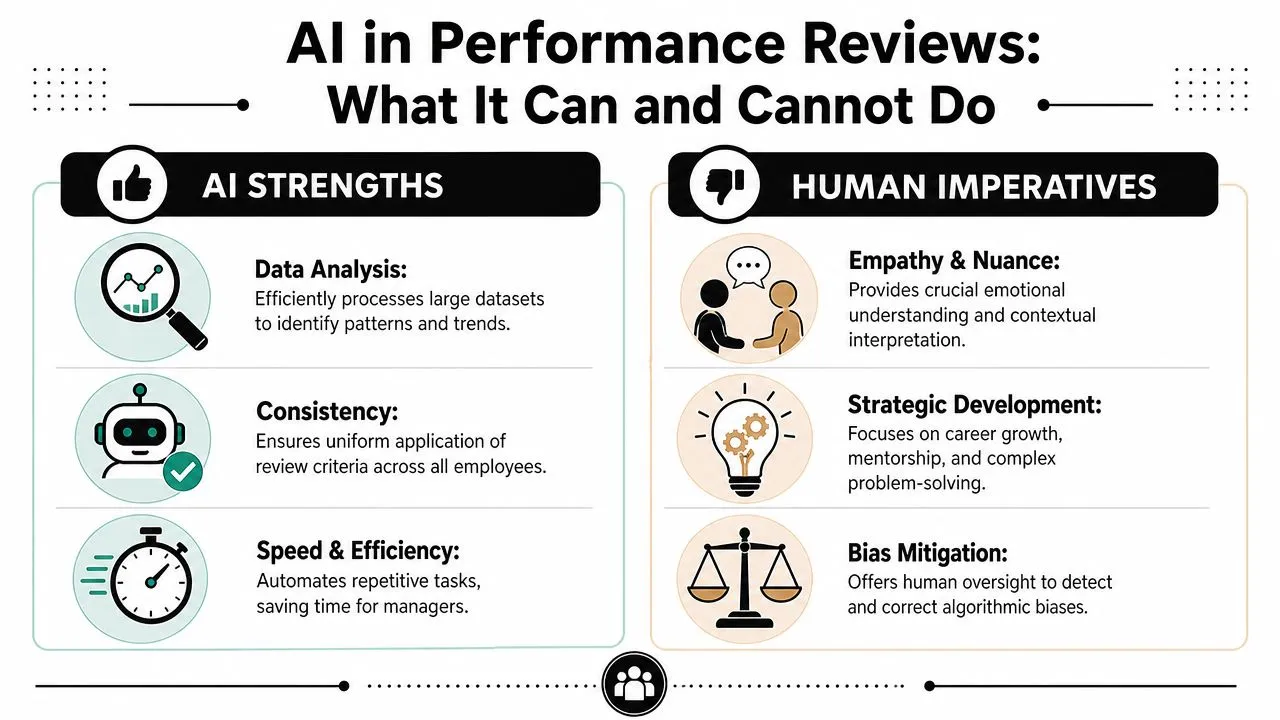
The fastest way to misuse AI is to ask it to do management. It can't. What it can do is reduce the friction around preparation, wording, and consistency.
That distinction matters because many organizations still don't trust their review process. 75% of organizations say their ability to accurately evaluate the value individual employees create is barely or not at all effective, according to AIHR's analysis of AI for performance reviews. That's a process problem, not just a writing problem.
Where AI earns its place
AI is strongest when the work is broad, repetitive, and evidence-heavy. In practice, that usually means:
| Task | What AI does well | What you still check |
|---|---|---|
| Notes synthesis | Pulls themes from 1:1 notes, project updates, and peer comments | Missing context, timing, and accuracy |
| Draft writing | Produces a usable first draft in your review format | Tone, specificity, and fairness |
| Language review | Flags loaded phrasing and overgeneralized statements | Whether the feedback is actually supported |
| Goal tracking | Connects goals to examples and status updates | Whether goals still reflect the role |
If you have review inputs spread across Google Docs, Notion, Jira, Asana, a feedback form, and your own notebook, AI can make that mess readable. It's especially useful for summarizing long comment sets without losing the recurring themes.
It also helps with consistency. Managers often vary in writing skill, structure, and tone. AI can normalize the shape of a review so one employee doesn't get crisp, evidence-based feedback while another gets vague praise because their manager wrote in a hurry.
AI should draft from evidence, not decide from authority.
Where managers still own the work
Some parts of evaluation are not delegable, even if software vendors imply otherwise.
- Final judgment stays human. Ratings, promotion recommendations, and compensation implications require accountability. AI can organize evidence, but it shouldn't make the call.
- Context stays human. A project delay may look like underperformance in a system log. You may know the employee inherited a failing handoff, covered for a teammate, or worked through shifting priorities.
- Delivery stays human. Difficult feedback needs empathy, pacing, and conversation. No generated paragraph can replace a manager who knows how the employee will hear it.
- Development stays human. Career growth requires mentoring, not just pattern detection. AI can suggest next steps. You decide what's realistic and meaningful.
What doesn't work is using AI as a shortcut around observation. If you didn't pay attention during the cycle, AI won't manufacture credibility for you. It will make your weak input sound polished.
The healthiest mental model is simple. AI handles the clerical load and gives you a draft worth editing. You remain responsible for the evidence, the interpretation, and the conversation.
Setting Up Your AI-Assisted Review Workflow
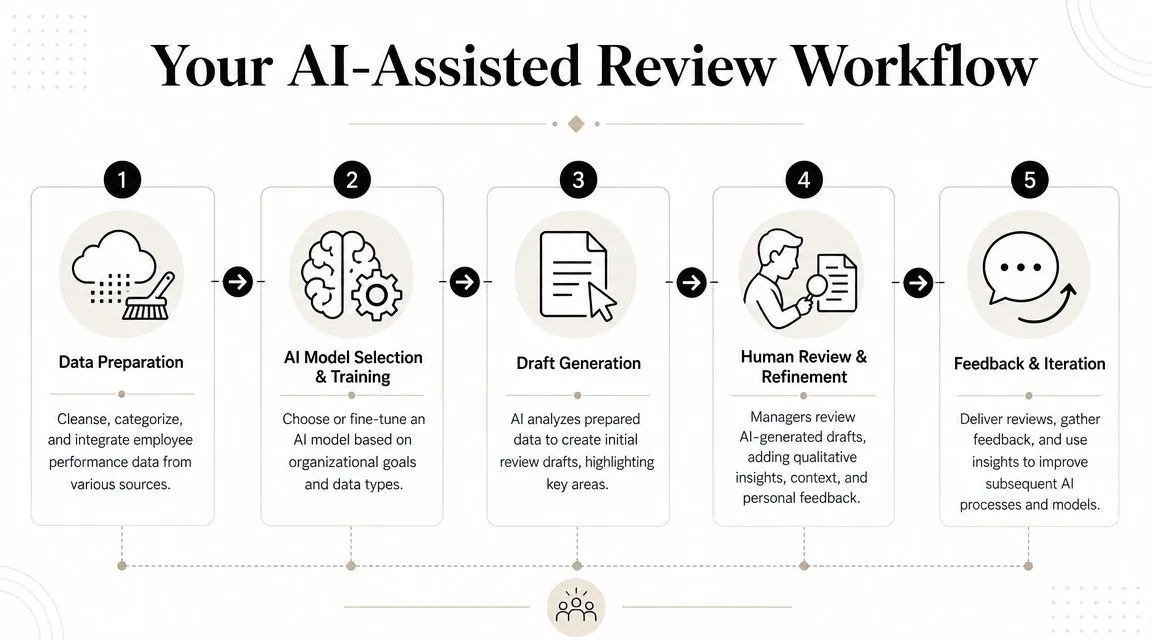
Managers get better results from AI when they stop treating it like a magic textbox and start treating it like part of an operating process. The sequence matters. Strong inputs, the right tool, then a repeatable review routine.
Phase one starts with evidence
The phrase “garbage in, garbage out” applies brutally well to AI for performance reviews. If your source material is thin, biased, or incomplete, the draft will reflect that.
Start by assembling a review packet for each employee. Keep it simple and consistent.
- Manager notes: Pull your 1:1 notes, coaching moments, and major milestones.
- Work artifacts: Add project summaries, deliverables, links, ticket history, or documented outcomes from tools like Jira, Asana, Notion, or your CRM.
- Other perspectives: Include peer feedback, partner comments, and the employee's self-assessment.
- Goals and expectations: Add the original goals, updated priorities, and any role changes during the period.
Don't dump raw data in without cleaning it first. Remove duplicates. Label dates. Separate observation from opinion. If a comment says “great attitude,” that isn't enough on its own. Tie it to behavior or outcome where you can.
A practical prep structure looks like this:
- Chronology first: Put evidence in time order so recency bias doesn't dominate.
- Themes second: Group by execution, collaboration, ownership, communication, or role-specific criteria.
- Gaps last: Mark where evidence is weak instead of letting AI fill silence with confidence.
Phase two picks the right tool for the job
You don't always need a specialized platform. Some teams get solid results by using a secure, approved general-purpose assistant plus a disciplined prompt template. Others prefer built-in features in their HRIS or performance system because the workflow is already integrated.
The right choice depends on your constraints.
| Scenario | Better fit |
|---|---|
| You need fast experimentation | General-purpose AI assistant in an approved environment |
| You want review data to stay inside the HR stack | HRIS or performance-management feature |
| You need manager enablement more than technical depth | Template-driven workflow with clear instructions |
| You have strict privacy rules | Enterprise-approved tool with legal and IT review |
If your team is early in adoption, don't overengineer the tooling. A copy-paste workflow can work well if managers use a common template and a clear review checklist. For teams that want hands-on practical training in HR use cases, AI for HR training resources can help managers learn the workflow side, not just the feature list.
Phase three builds a repeatable manager workflow
What works in live teams is rarely complicated. It's disciplined.
A solid manager workflow looks like this:
- Step one gathers inputs into one review packet per employee.
- Step two prompts AI to summarize evidence by strengths, risks, and goal progress.
- Step three asks for a draft in the company's actual review format.
- Step four edits aggressively for specificity, tone, and anything the model overstated.
- Step five prepares the meeting by turning the written review into talking points and questions.
If the AI draft sounds cleaner than your memory of the employee's year, pause and inspect the evidence.
Two habits separate good use from sloppy use. First, managers review the raw source material before they review the generated draft. Second, they annotate what the AI got wrong. Over time, that makes prompts better and reviews sharper.
What doesn't work is letting every manager invent their own process. One person uses AI for summaries, another for ratings language, another pastes in half a year of Slack messages and hopes for the best. Standardization matters. Not because AI needs it, but because employees do.
Crafting Effective Prompts and Using Templates
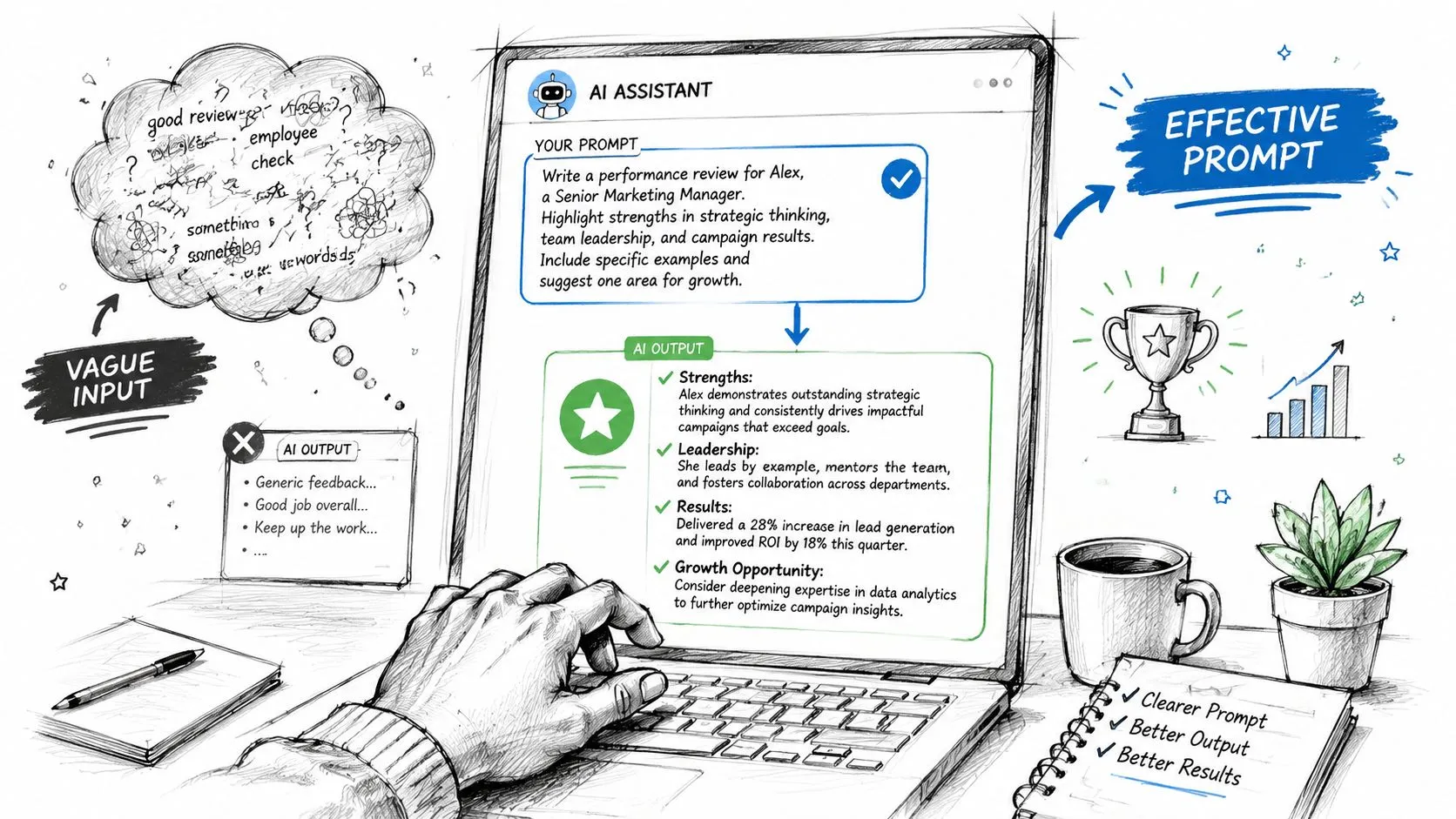
Most bad AI outputs come from bad instructions. If you type “write a review for Sarah,” you'll get something generic, flattering, and mostly useless.
Why vague prompts fail
A vague prompt forces the model to guess. It guesses the role, the standards, the tone, the review format, and what counts as strong performance. That's how you end up with empty phrases like “demonstrates dedication” or “continues to grow as a team player.”
A stronger prompt gives the model constraints.
For example, this is weak:
Write a performance review for a product manager named Alex.
This is much better:
Draft a performance review for Alex, a product manager, covering the last review period. Use only the evidence provided below. Organize the review into strengths, impact on team goals, development areas, and next-period focus. Keep the tone direct and constructive. Do not invent examples. If evidence is missing, say that the record is incomplete. Here are the role expectations, goals, self-assessment, peer comments, and manager notes: [paste material]
That one change does three useful things. It narrows the task. It reduces hallucinated detail. It gives you a draft you can edit instead of rewrite.
A practical prompt template managers can use
Managers usually need more than one prompt. They need a small prompt set for different moments in the workflow. If you want examples to adapt, this collection of ChatGPT prompts for performance reviews is useful because it's built around practical HR tasks rather than novelty prompting.
Here are three reliable prompt formats.
For evidence synthesis
Review the notes below and identify the main performance themes. Separate confirmed evidence from opinion. Group findings into strengths, risks, collaboration patterns, and goal progress. Flag where the evidence is thin or inconsistent.
For first-draft writing
Using only the material below, draft a performance review in plain business language. Include specific examples where supported. Avoid exaggerated praise, legal conclusions, or personality judgments. Keep the review balanced and focused on observable work.
For development planning
Based on the evidence below, propose development priorities for the next review period. Suggest practical actions, support needed from the manager, and goals that are realistic for the employee's role.
The best templates also tell the AI what not to do. Add instructions like “do not infer motivation,” “do not mention personal traits unless directly relevant to work behavior,” and “do not convert limited evidence into broad conclusions.”
Templates work best when your review form is stable
If your company changes review questions every cycle, managers will keep rebuilding prompts from scratch. Stability helps. A standard form lets you build one strong template and reuse it with minor edits.
If your team needs a practical structure before you even get to prompting, a well-built 2026 performance review template can help normalize the categories managers are writing against. That's often the missing link. Prompt quality improves fast when the destination format is clear.
Video walkthroughs can also help managers see what “good prompting” looks like in practice:
One more rule matters here. Never accept the first draft because it sounds polished. Read for missing evidence, overconfident wording, and whether the output actually sounds like your standards, not just a smooth paragraph generator.
Navigating Bias, Legal Risks, and Ethical Safeguards
The cleanest AI draft can still produce the wrong review. That's why governance matters more than output quality.
One risk gets underestimated in hybrid and distributed teams. AI may amplify measurement gaps when managers don't have enough direct observation. Tools that rely on digital traces can miss informal contributions, invisible coordination work, and context that never makes it into systems, as discussed in Charter's reporting on how companies are using AI in performance reviews.
The biggest risk is weak evidence dressed up as certainty
Managers often assume bias means hostile language or unfair ratings. Sometimes it does. More often, it starts earlier. The evidence set is incomplete, skewed toward visible work, or overly dependent on systems that capture output but not support work.
A few examples show how this happens:
- Remote visibility gaps: The employee who resolves conflicts discreetly or unblocks teammates may leave less digital residue than the person who posts frequent updates.
- Uneven note-taking: One manager documents every coaching conversation. Another keeps almost nothing. AI can't normalize missing discipline.
- Role mismatch: A sales dashboard captures individual activity cleanly. An operations or chief-of-staff role may contribute through coordination, judgment, and cross-functional rescue work that leaves weaker artifacts.
A biased input set doesn't become fair because the summary sounds objective.
Legal risk follows quickly when managers treat AI output as evidence rather than as a draft derived from evidence. If the review affects compensation, promotion, performance plans, or termination decisions, human accountability isn't optional.
If your team is assessing tools and process controls, AuditReady's HR software guide is a useful resource for thinking through software selection with governance in mind, especially where documentation and compliance matter.
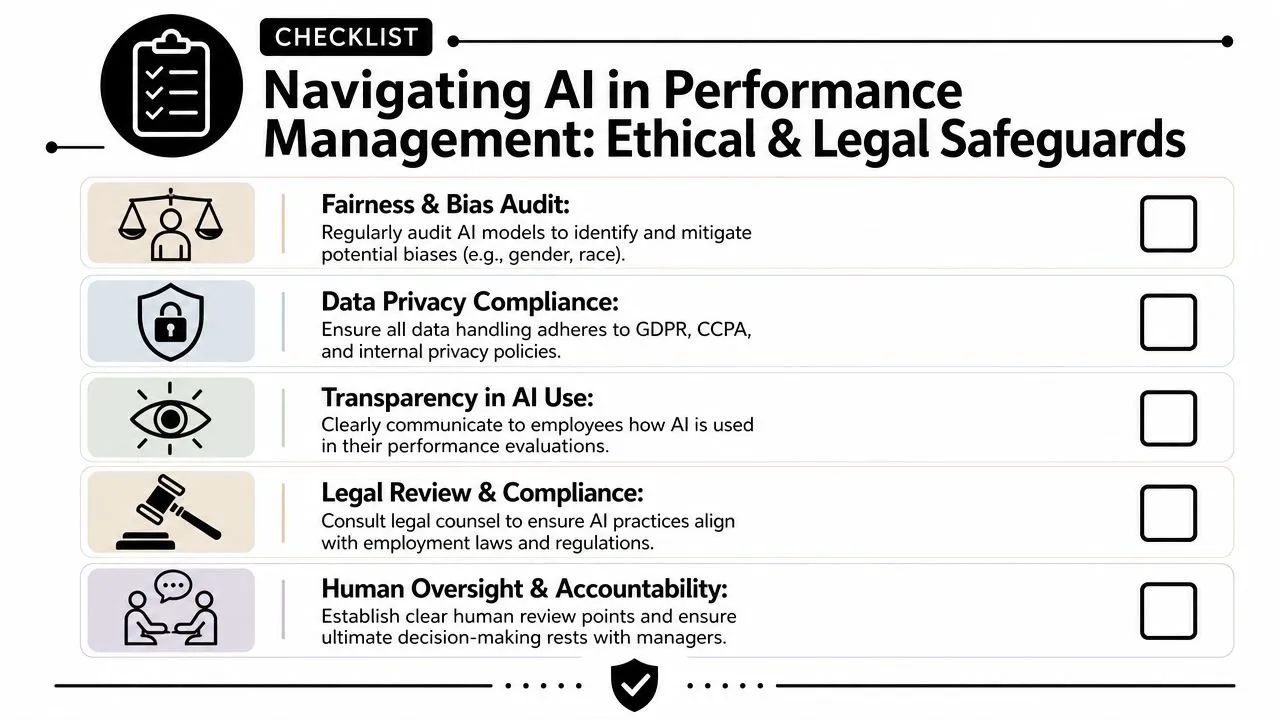
A safeguard checklist that managers can actually use
The right policy is one managers will follow under deadline. Keep it concrete.
- Define approved inputs. State what managers can use, such as review notes, self-assessments, goal records, and documented peer feedback.
- Ban unsupported inference. Managers should remove claims about attitude, motivation, or potential unless they can point to behavior and examples.
- Require human editing. No AI-generated text should go directly into the final review without review by the manager.
- Separate drafting from decisions. AI may help summarize or draft. Final ratings and employment decisions remain with people.
- Tell employees how AI is used. Transparency reduces suspicion and sets expectations about what the tool does and doesn't do.
- Review privacy rules before rollout. Sensitive employee data shouldn't be pasted into unapproved systems.
For teams formalizing these controls, AI policy training for HR teams can help convert broad principles into usable policies and manager guidance.
Trust but verify is the right standard here. Not because AI is uniquely dangerous, but because review processes already contain bias, inconsistency, and weak documentation. AI can help. It can also make those flaws easier to miss.
Driving Adoption and Measuring Real Success
Rolling out AI for performance reviews isn't a software launch. It's a manager behavior change project. If the process feels complicated, unclear, or risky, people will revert to old habits and finish reviews the night before they're due.
Start smaller than you think
The best adoption pattern is usually a pilot. Pick a manageable manager group, use one common prompt pack, and limit the first cycle to a few use cases. Draft summaries. Evidence organization. Tone cleanup. That's enough to prove value without creating confusion.
Busy managers adopt new tools when the payoff is obvious. Best practices for AI-enabled review programs recommend tracking active usage rate, feature utilization, time to adoption, task completion velocity, and quality improvements, while also evaluating financial, internal-process, customer, and learning dimensions at 25% each, according to Worklytics on AI usage and performance review best practices. The same source notes that 94% of employees are familiar with generative AI tools and employees are three times more likely to use AI for a meaningful share of their work when the value is clear.
That last point matters. Don't sell this internally as “modernizing HR.” Sell it as “less time wrestling with forms, more time giving better feedback.”
Measure impact, not novelty
A rollout fails when leadership tracks logins and calls it success. Usage matters, but it isn't the outcome.
What you want to know is:
- Are managers finishing reviews faster?
- Are reviews more specific and evidence-based?
- Are employees getting clearer development priorities?
- Are managers using AI in the same approved way, or improvising risky workarounds?
A short calibration review after the cycle is often more useful than a dashboard alone. Read a sample of final reviews. Check whether claims are supported. Look for stronger developmental feedback, not just cleaner prose.
If you're refining the broader process, MyCulture.ai's approach to performance offers a useful perspective on performance-management design beyond the tooling itself.
The companies that get value from AI-assisted reviews don't aim for perfect automation. They build a practical system managers can repeat, audit, and improve. That's what turns AI from a novelty into infrastructure.
AI Academy helps professionals learn practical AI skills they can use immediately at work, including workflows for drafting, analysis, automation, and prompt design across tools like ChatGPT and Claude. If you want step-by-step lessons, real templates, and fast training built for non-technical teams, explore AI Academy.