
You've probably already had the idea. A body in a locked studio. A missing spouse who came home dry during a storm. A detective who notices the one detail nobody else does. Then you open a blank document and hit the main problem.
Mystery isn't hard because the premise is hard. It's hard because readers expect a trick, a logic puzzle, an emotional payoff, and a clean ending that doesn't feel cheap. If you hide too much, they feel cheated. If you show too much, they solve it early and coast.
That tension is the whole game when you're learning how to write mystery. The good news is that mystery is teachable. You don't need genius twists. You need a method, disciplined clue placement, and characters with secrets worth exposing. AI can help with the labor-intensive parts too, especially when you need suspect matrices, timeline checks, motive stress tests, or alternate reveal paths.
Forging Your Core Mystery Concept
Start with the reader promise
A mystery makes a specific promise. It tells the reader there is a hidden truth, the truth matters, and the story will earn the answer.
That promise is bigger than “who killed him?” The stronger question is usually more loaded. Who killed him, and why does proving it ruin the detective's marriage? Who's lying about the disappearance, and what happens if the wrong person gets blamed? The puzzle pulls readers in, but the stakes keep them reading after chapter two.
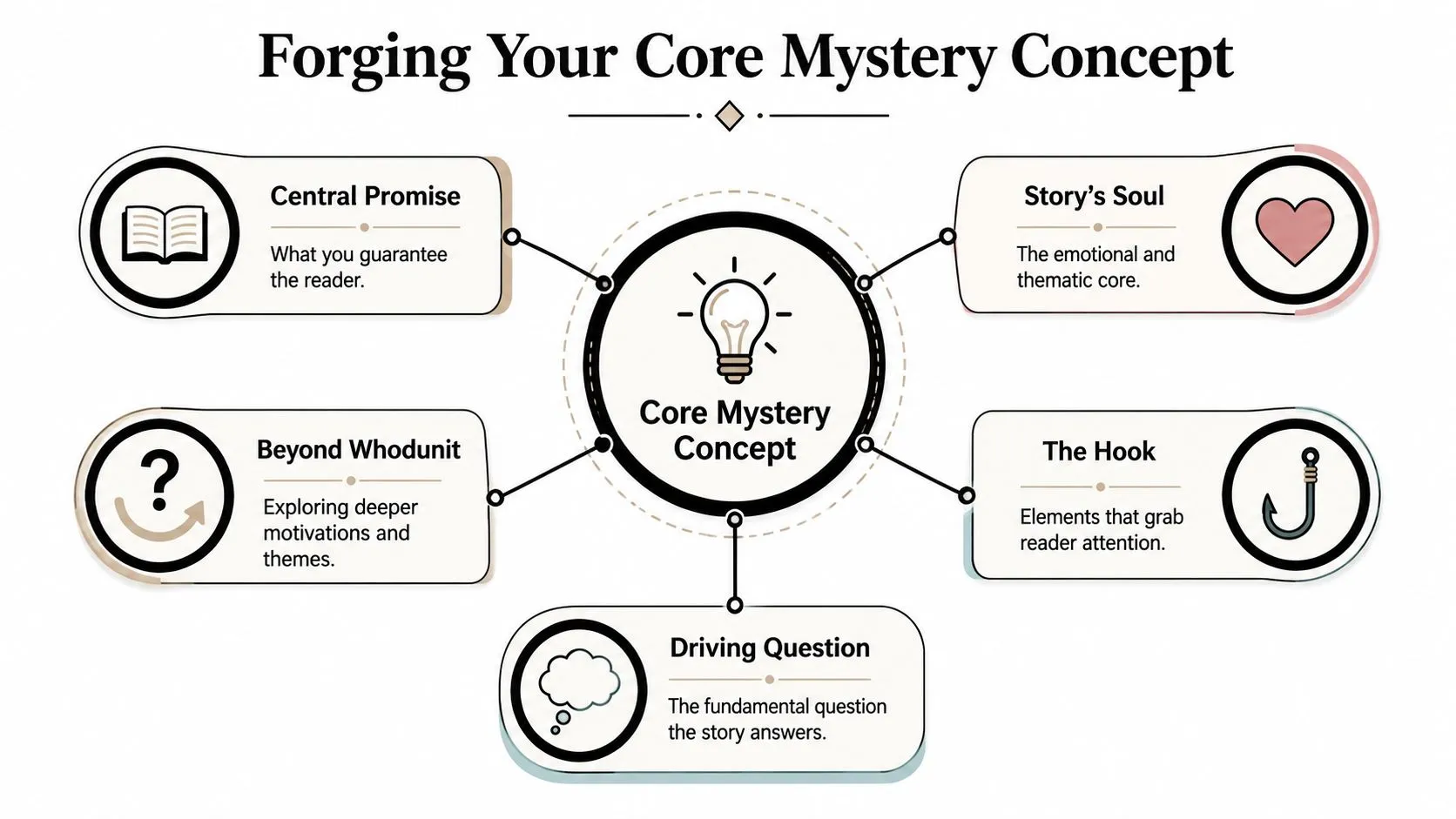
Here's the simplest test I know for a core concept:
- Name the crime or central disturbance. Murder is common, but blackmail, disappearance, sabotage, fraud, or a buried past can work if they create pressure.
- Name the person who must solve it. Why this detective, amateur sleuth, journalist, heir, spouse, or cop?
- Name the cost of failure. If the answer doesn't matter, the mystery will sag.
- Name the tonal contract. Cozy, procedural, noir, suspense, or hybrid.
- Name the hidden wound in the story. Good mysteries are about grief, guilt, class, family, obsession, shame, or power.
Practical rule: If your concept only gives you a crime and a culprit, you have a puzzle. If it also gives you pressure, consequence, and emotional fallout, you have a novel.
Decide what kind of mystery you are writing
Subgenre controls almost every craft decision that follows. A cozy invites charm, community, and lower on-page brutality. A noir lets you push moral compromise. A procedural needs investigative texture. A suspense mystery often relies on threat, urgency, and reversals.
New writers often mash these together without deciding which flavor leads. That's when tone breaks. A whimsical village baker can solve a murder. The same character can't suddenly speak like a burnt-out hardboiled detective without the story wobbling.
If your structure feels loose, it helps to review a broader plotting framework before you tailor it to mystery. BarkerBooks' guide to novel structure is useful because it shows where major turns belong even before you place clues.
Know the killer or discover the killer
Many drafts stall when grappling with the culprit's identity. Some writers need the culprit locked in before chapter one. Others discover the killer while drafting and then panic when earlier scenes stop making sense.
That isn't just a small issue. An estimated 60% of new mystery authors are unsure how to maintain narrative consistency when the killer is discovered organically during drafting, and one recommended solution is to reverse-engineer the plot from the reveal backward according to Reedsy's mystery-writing guidance.
Both methods work. What doesn't work is drifting.
- If you know the killer early, map motive, method, access, and concealment before drafting scenes.
- If you don't know the killer early, draft a discovery version fast, then rebuild the story backward from the reveal.
- If you're between options, choose the ending first. Once you know the final accusation scene, the earlier clues become easier to place.
Don't ask, “Can I write without knowing?” Ask, “How soon will I rebuild the logic?”
Use AI before you draft
AI is most useful at the concept stage when you need controlled variation, not finished prose. Use it to generate alternatives, not answers.
Prompt it like a development partner. Ask for ten plausible motives for the same crime in the same setting. Ask it to list what changes if the victim was beloved instead of hated. Ask it to suggest three versions of the same premise in cozy, procedural, and psychological suspense modes.
A good prompt library speeds this up. If you want raw material to riff on, the fiction-writing prompt collection is a practical starting point for premise generation.
Try prompts like these:
- Premise stress test: “Give me five ways this mystery premise could become more personal for the detective without changing the victim.”
- Stake expansion: “List non-legal consequences if the case remains unsolved.”
- Subgenre shift: “Rewrite this premise as a cozy, then as noir, then as domestic suspense.”
- Reverse-engineering aid: “If the killer is the least obvious suspect, what clues must appear by the first third so the reveal feels earned?”
Designing Your Detective and Suspects
A mystery lives or dies on the cast. I've seen clever plots collapse because every suspect felt like a cardboard placeholder waiting to be cleared. I've also seen thin premises survive because the detective and suspects generated tension every time they entered a room.
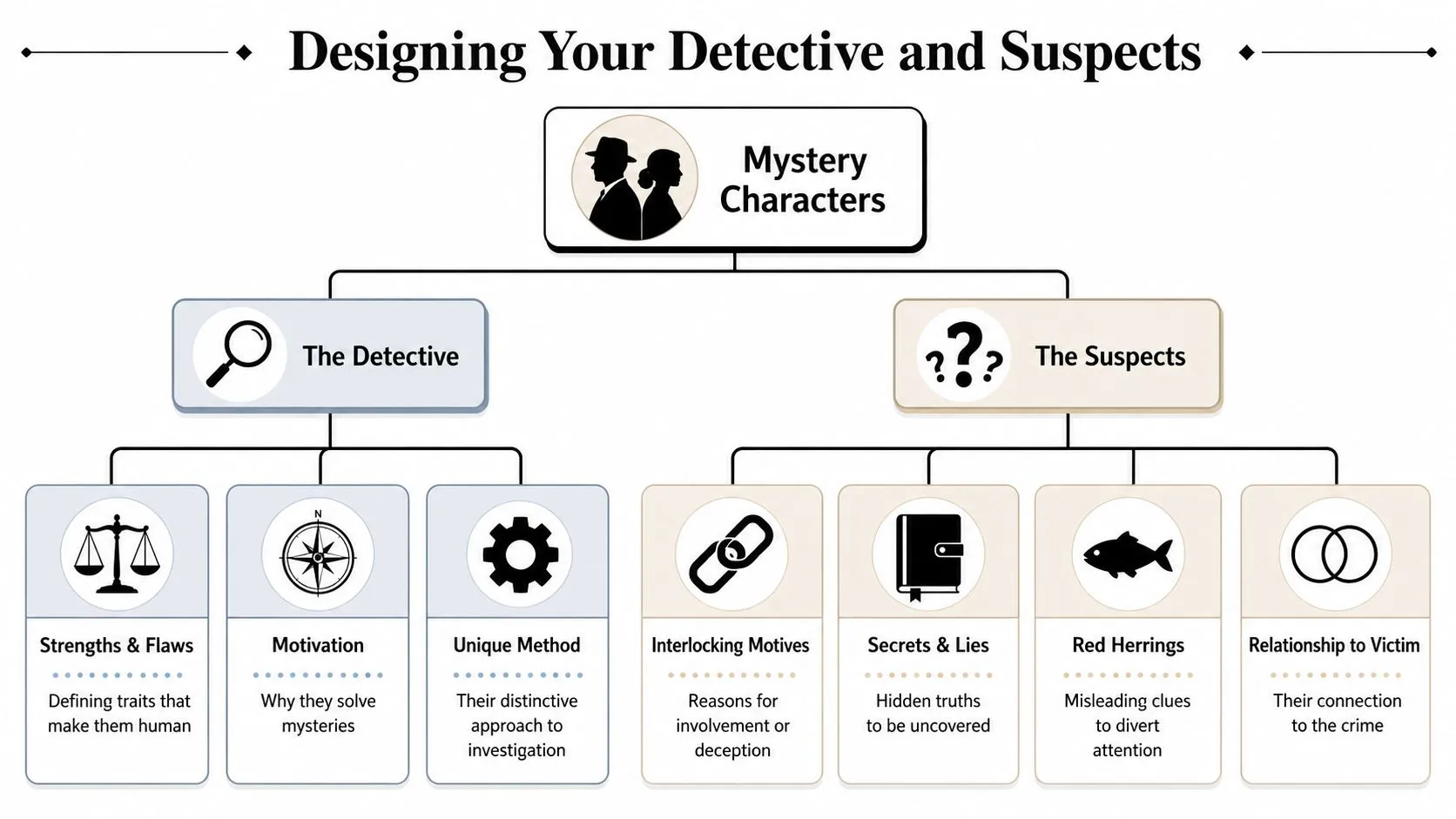
The detective doesn't need to be flashy. They need friction. A strong mystery protagonist is good at something the case requires and bad at something the case exposes. Maybe she notices language shifts but misses emotional subtext. Maybe he's relentless with facts but terrible at trust. That mismatch creates scenes.
Build a detective with friction
Think in terms of usable contradiction.
A retired accountant who hates confrontation is interesting if the case forces him into interviews with people who bully him. A homicide detective with perfect recall is interesting if the murder mirrors a case she got wrong years ago. Competence alone isn't enough. Competence under strain is what readers remember.
Give your detective three anchors:
- A method: What do they do better than others? Read rooms, spot lies, recall timelines, understand systems, charm witnesses?
- A flaw: What repeatedly skews their judgment?
- A private stake: Why can't they walk away?
The best detective trait is one that solves one problem and creates another.
A scene from a draft often improves the moment I stop asking, “What clue do they find?” and ask, “How does this person's method distort the clue they find?”
Later in the process, visual references can help with voice and presentation. This video is useful when you're thinking about mystery character dynamics and genre feel:
Give every suspect a secret that matters
Suspects shouldn't exist only to be innocent. They need to actively resist scrutiny for reasons of their own.
The easiest way to build them is not “Who could be the killer?” It's “What does each person desperately need hidden right now?” One suspect is covering an affair. Another stole from the victim. Another lied about where she was. Another isn't guilty of murder but is guilty of something adjacent and panics under questioning.
That creates layered deception. Readers don't need every suspect to be equally likely in a mechanical way. They need every suspect to be capable of lying convincingly.
Statistical analysis of published mystery fiction found that an estimated 80% of novels feature a male murderer, while only 40% include a female murderer, which makes gender expectation a useful lever for subversion if you handle it deliberately, as discussed in Sharon Lohr's analysis of mystery statistics.
That doesn't mean “make the killer female” as a gimmick. It means examine the assumptions your cast invites. If readers expect one kind of threat from one kind of body, status level, or relationship role, your suspect pool should exploit that expectation deftly.
A quick suspect test:
| Suspect | Public face | Hidden secret | Why they look guilty | Why they might be innocent |
|---|---|---|---|---|
| Business partner | Loyal fixer | Embezzlement | Money motive | Needed victim alive to keep fraud hidden |
| Ex-spouse | Bitter and broke | Custody panic | Open conflict | Has a stronger emotional arc if innocent |
| Family friend | Helpful insider | Illicit affair | Access and knowledge | Knows too much because they were close |
Use AI to pressure-test your cast
AI is excellent at generating contradiction grids and interview simulations. Use it to deepen the cast before they hit the page.
Ask for:
- Mock interrogations: “Interview this suspect as if they're hiding an affair but not the murder.”
- Secret ladders: “Give me three escalating secrets for each suspect. One embarrassing, one damaging, one ruinous.”
- Motive matrix: “Compare which suspect benefits emotionally, financially, and socially from the victim's death.”
- Voice separation: “Write five short answers to the same question in five distinct suspect voices.”
If you want ready-made patterns for this, the ChatGPT prompts for character design are useful for building backstory, contradiction, and dialogue texture without flattening everyone into the same voice.
Weaving a Web of Clues and Red Herrings
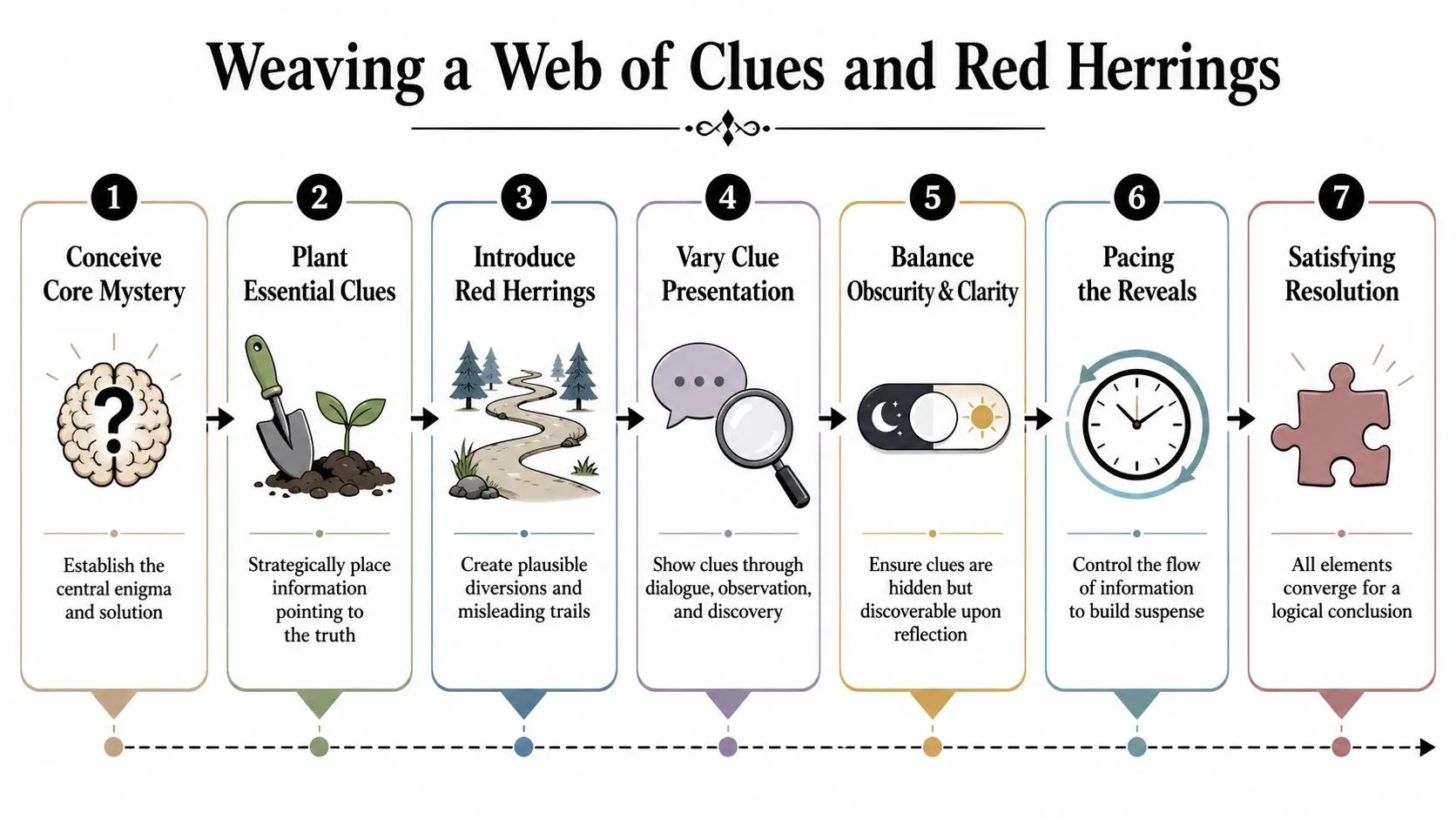
This is the technical center of how to write mystery. Characters draw readers in, but clue logic is what earns their trust.
The old standard still holds. In 1929, Ronald Knox's rules for detective fiction established the fair play principle, including the line “The detective must not light on any clues which are not instantly produced for the inspection of the reader”, as summarized by Writer's Digest in its guide to writing a murder mystery. If the detective solves the case with hidden information, the ending may shock the reader, but it won't satisfy them.
Play fair or lose the reader
Fair play doesn't mean making the answer obvious. It means the evidence is on the page.
A fair mystery gives the reader access to the same core material the detective has, while controlling emphasis, interpretation, and timing. You can hide a clue in banter, setting detail, a witness contradiction, or a throwaway object. You just can't invent it in the last chapter.
Use three categories of clues:
- Physical clues such as objects, marks, timing details, missing items, or environmental anomalies.
- Verbal clues such as slips, repeated phrases, evasions, false certainty, or conflicting testimony.
- Psychological clues such as overreaction, selective memory, inappropriate calm, or misdirected fear.
A strong clue usually does two jobs. It moves the investigation forward and says something about character. A muddy shoeprint is serviceable. A spotless shoe in a muddy garden is better if it tells you someone prepared a lie.
What counts as a good clue
Writers often confuse clues with information. Not all information has investigative value.
Good clues create a chain of inference. Weak clues only decorate the scene.
Here's the difference:
- Weak: The victim owns a rare fountain pen.
- Better: The pen is missing after the murder.
- Stronger: Two suspects claim they never entered the study, but one later uses ink from that pen brand on a forged note.
A clue should change what the detective believes, not just what the reader knows.
When plotting, assign each clue a function. Does it narrow the suspect pool, expose a lie, reverse a prior assumption, or reveal method? If it does none of those, it may be atmosphere rather than evidence.
For craft study, it helps to look at masterful examples of misdirection in stories that divert attention without violating reader trust.
Red herrings should misdirect not irritate
A red herring works when it has its own logic. A bad one exists only because the author wants to stall.
The classic mistake is overloading the middle of the book with fake leads that all scream importance. Readers stop investing when every chapter introduces another suspicious gesture that leads nowhere. In practice, the best red herrings usually grow out of real character problems. Shame, betrayal, addiction, debt, jealousy, old crimes, and damaged loyalties all generate misleading behavior.
The rule I use is simple: every red herring must pay off even when it isn't the murder solution. If the affair isn't the motive for murder, it should still break a marriage, change an alibi, alter an alliance, or expose a witness as unreliable.
Clue and Red Herring Tracker
A tracker saves mystery drafts. Don't trust memory once multiple suspects and timelines start crossing.
| Information/Object | Type (Clue/Red Herring) | Scene Discovered | Who Discovers It | What It Implies (True Meaning vs. Misdirection) |
|---|---|---|---|---|
| Burned receipt | Clue | Chapter 2 kitchen search | Detective | True meaning: victim met killer earlier. Misdirection: looks like financial motive only |
| Hidden phone | Red Herring | Chapter 4 bedroom search | Sister | True meaning: secret affair. Misdirection: suggests blackmail tied to murder |
| Incorrect watch time | Clue | Chapter 6 interview | Detective | True meaning: suspect staged timeline. Misdirection: seems like panic after finding body |
| Broken cufflink | Red Herring | Chapter 7 garden path | Officer | True meaning: prior confrontation. Misdirection: implies presence at time of murder |
Use AI as a continuity editor
This is one place AI earns its keep. Feed it your scene list, clue list, and suspect alibis. Then ask it to find contradictions, underused clues, or suspects who vanish for too long.
Useful prompts include:
- Timeline audit: “List each suspect's claimed movements scene by scene and flag overlaps or impossible timing.”
- Fair-play check: “Identify any conclusion the detective makes that has not been supported by an on-page clue.”
- Red-herring quality check: “Which misleading clues feel arbitrary rather than character-driven?”
- Suspicion pacing: “Track who appears most guilty in each chapter and tell me if one suspect dominates too early.”
The mystery-writing prompt library is handy when you need prompts designed for clue placement, alibis, and twist development instead of generic creative writing help.
Crafting Scenes and Controlling Information
Plotting gives you the architecture. Scene work determines whether readers feel discovery or explanation.
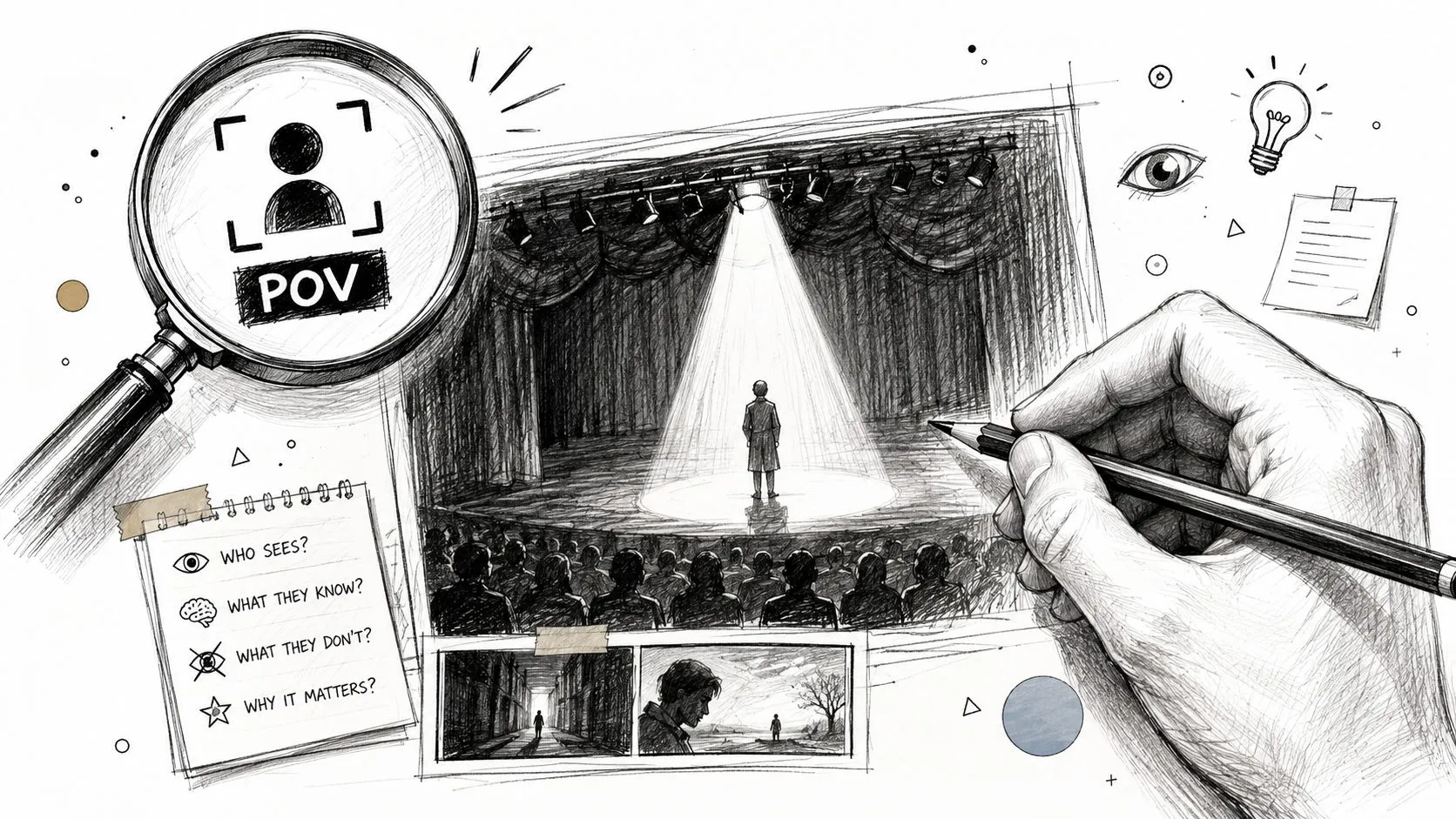
Choose a point of view that matches the trick
Point of view is a concealment tool. First person gives you intimacy and strong voice, but you're locked inside one mind. Third-person limited gives slightly more flexibility while preserving uncertainty. Multiple viewpoints can broaden the world, but they also increase the risk of accidental cheating if one viewpoint would logically know too much.
Choose POV based on what kind of mystery effect you want.
- First person works well when the detective's interpretation is as important as the facts.
- Third-person limited suits writers who want closeness without sounding confessional.
- Multiple POVs help when the story depends on pressure across several locations, but every viewpoint must earn its place.
A common mistake is using internal monologue to hide obvious truths in unnatural ways. If the narrator is the killer, for example, you can't let them think like a press release designed to fool the audience. Their thoughts still need human shape. They can avoid naming the act. They can rationalize. They can focus on logistics. They can't become vague only when specifics would be inconvenient.
If a character would naturally think the truth in that moment, and you suppress it only to protect the twist, the reader will feel the cheat.
Write interrogation scenes with moving power
Interrogation scenes get dull when they become static Q and A. Good ones are mini battles.
Power should keep shifting. A suspect begins defensive, then gains control by exposing the detective's weak point. Another seems cooperative until one ordinary question lands too close to the underlying secret. The scene turns not when someone answers, but when someone refuses, deflects, bargains, or attacks.
To sharpen an interview scene, build around these pressures:
- Conflicting goals: The detective wants clarity. The suspect wants safety, status, or distance.
- Changing dynamics: New evidence, a relationship revelation, or a witness interruption alters the balance.
- Behavior under stress: A pause, joke, correction, or unnecessary detail can matter more than the answer itself.
Drip information instead of dumping it
Mystery scenes improve when information arrives slant. A detective notices the family portrait has been taken down before anyone mentions the divorce. A witness keeps using the present tense for someone presumed dead. A suspect volunteers an alibi before being accused.
That's better than stopping the novel so characters can explain the situation.
Compare these approaches:
| Weak reveal | Strong reveal |
|---|---|
| A suspect explains their financial trouble in one speech | The detective spots overdue notices, then hears the suspect lie about travel plans |
| The detective summarizes the whole theory at once | The detective tests one part of the theory in scene and revises after resistance |
| A witness provides a neat backstory dump | The witness gives partial answers that expose resentment and fear |
When you learn how to write mystery scenes well, you stop asking, “What do I need the reader to know?” and start asking, “What can this character reveal accidentally while trying not to?”
The Reveal Resolution and Revision
A mystery ending has to do two things at once. It must answer the puzzle and justify the time the reader spent paying attention.
The reveal works best when it feels both surprising and inevitable. Surprising because the final pattern clicks into place. Inevitable because the clues were there and the characters could not have ended anywhere else. If you want a few outside examples of twist construction, crafting impactful reveals is useful for studying how reversals land without feeling random.
Make the ending surprising and inevitable
You have options for form. The classic drawing-room reveal still works when the pleasure comes from deduction and social pressure. A confrontation scene works when the culprit is dangerous and the story has built toward physical or emotional collision. Some mysteries use a document, recording, public accusation, or private confession.
Whatever form you choose, the reveal should do four jobs:
- Name the culprit clearly.
- Walk through the logic cleanly.
- Explain motive in human terms.
- Resolve the detective's personal stake.
Don't overload the final explanation with every minor thread. Hit the core chain of proof. Then let the aftermath carry the rest.
Finish the emotional story too
Many endings fail because the author solves the case and exits. Readers want to know what the truth costs.
That matters even more now because character depth has become a bigger part of reader expectation. A common pitfall is red herring overload, which can make readers feel tricked, and Atmosphere Press notes that emotional mystery is gaining traction. It also reports that 45% of debut mysteries fail to retain readers past Chapter 3 due to poor balance between puzzle complexity and emotional stakes in its discussion of how to write a mystery novel.
So after the reveal, give the reader consequences. Who grieves differently now? Who was wrong? Who must live with having accused the innocent? How has the detective changed?
Solve the crime, then settle the moral debt.
A revision checklist for mystery writers
Mystery revision is less about polishing sentences and more about stress-testing logic.
Use this checklist on every draft:
- Clue visibility: Can the reader see every clue needed for the solution on the page?
- Motive strength: Is the killer's motive strong enough to support the risk they took?
- Suspect viability: Does each major suspect have a believable reason to conceal something?
- Timeline integrity: Do travel, access, and scene order work?
- Scene utility: Does each investigation scene change suspicion, reveal character, or tighten stakes?
- Red-herring payoff: Does each misdirection matter even when it isn't the answer?
- Reveal fairness: Does the ending depend on hidden information, withheld thought, or an implausible coincidence?
- Emotional closure: Does the aftermath land, or does the book stop the moment the culprit is named?
AI is valuable here too. Ask it to build character timelines, compare alibis, summarize every clue by chapter, or identify scenes where the detective's reasoning jumps too far too fast.
If you want practical ways to use ChatGPT and other AI tools for plotting, character work, revision, and consistency checks, AI Academy is a strong next step. It's built for working professionals, not technical specialists, and the lessons stay focused on workflows you can use. For a mystery writer, that means faster brainstorming, cleaner structure, better prompt templates, and fewer hours lost untangling a messy draft.