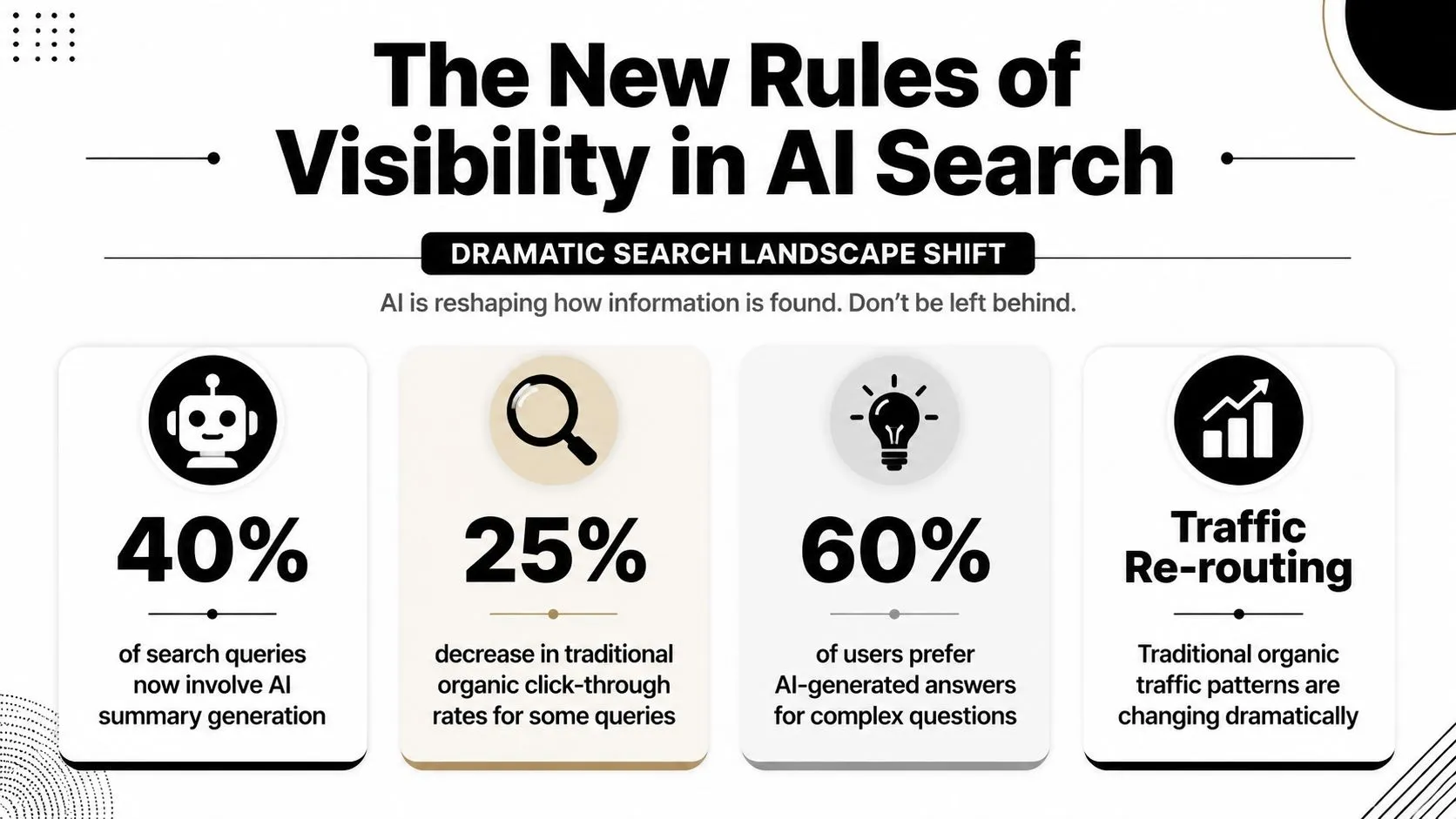
AI search optimization moved from optional experiment to operating requirement the moment AI summaries started intercepting roughly 60% of clicks on informational queries, creating a zero-click environment where people get the answer without visiting the source page, according to 2026 AI SEO statistics.
That changes the job. You're not only trying to rank a page anymore. You're trying to become the page an AI system chooses to cite, summarize, or borrow language from when a buyer asks a question.
For marketers and analysts, this is good news if you act quickly. The work is more practical than often assumed. You don't need to become a machine learning engineer. You need pages that load cleanly, answer real questions directly, define what you do in plain language, and give AI systems something trustworthy to reference.
The New Rules of Visibility in AI Search
The biggest mistake I still see is teams treating AI search like a side channel while they keep running a classic SEO playbook built around blue-link clicks. That approach leaves good content stranded because answer engines reward pages they can quote, summarize, and trust quickly.
Visibility now depends on retrieval, extraction, and citation. A page can still rank in organic search and get skipped in AI results if the answer is buried under throat-clearing intros, brand language, or loose claims. I see this all the time on otherwise solid sites. The topic coverage is there, but the page never gives the model a clean passage to use.
Ranking is no longer the whole job
Rank still matters. It just no longer explains the full outcome.
If an AI Overview, chatbot, or answer engine resolves the question before the click, your page has to do more than sit on page one with a decent title tag. It needs a clear answer near the top, plain-language definitions, support for key claims, and a structure that makes extraction easy. Pages written like sales copy underperform here. So do blog posts that spend 300 words warming up before saying anything useful.
Practical rule: In AI search, visibility often goes to the page that answers the question most directly, not the page that uses the keyword most often.
That changes the brief for content teams. The job is no longer "cover the keyword." The job is "publish the passage an answer engine wants to reuse."
What winning teams do differently
The teams getting traction build pages for citation from the start. In practice, that usually looks like this:
- One clear job per page: Each page should answer one primary question and the handful of follow-ups a user would ask next.
- Direct openings: The first paragraph should define the topic or answer the question without brand filler.
- Evidence in a usable format: Comparison tables, step lists, short FAQs, examples, and specific claims are easier for both readers and AI systems to use.
- Tight scope with enough depth: Cover the full decision or task, but cut the generic commentary that adds length without adding an answer.
For marketers who need a fast way to find those question clusters, this walkthrough on using ChatGPT for keyword research is a practical starting point.
One trade-off is worth stating plainly. Pages built for AI visibility can feel less "brand rich" in the opening screen. That is usually the right call. Brand voice still matters, but clarity has to come first if you want your content pulled into answer surfaces.
If you need a broader planning model, this 2026 AI search strategy is a useful companion read because it maps the shift from rank tracking to answer-surface visibility.
Traditional SEO still contributes plenty of value. It just no longer protects visibility on its own.
Building the Foundation for AI Visibility
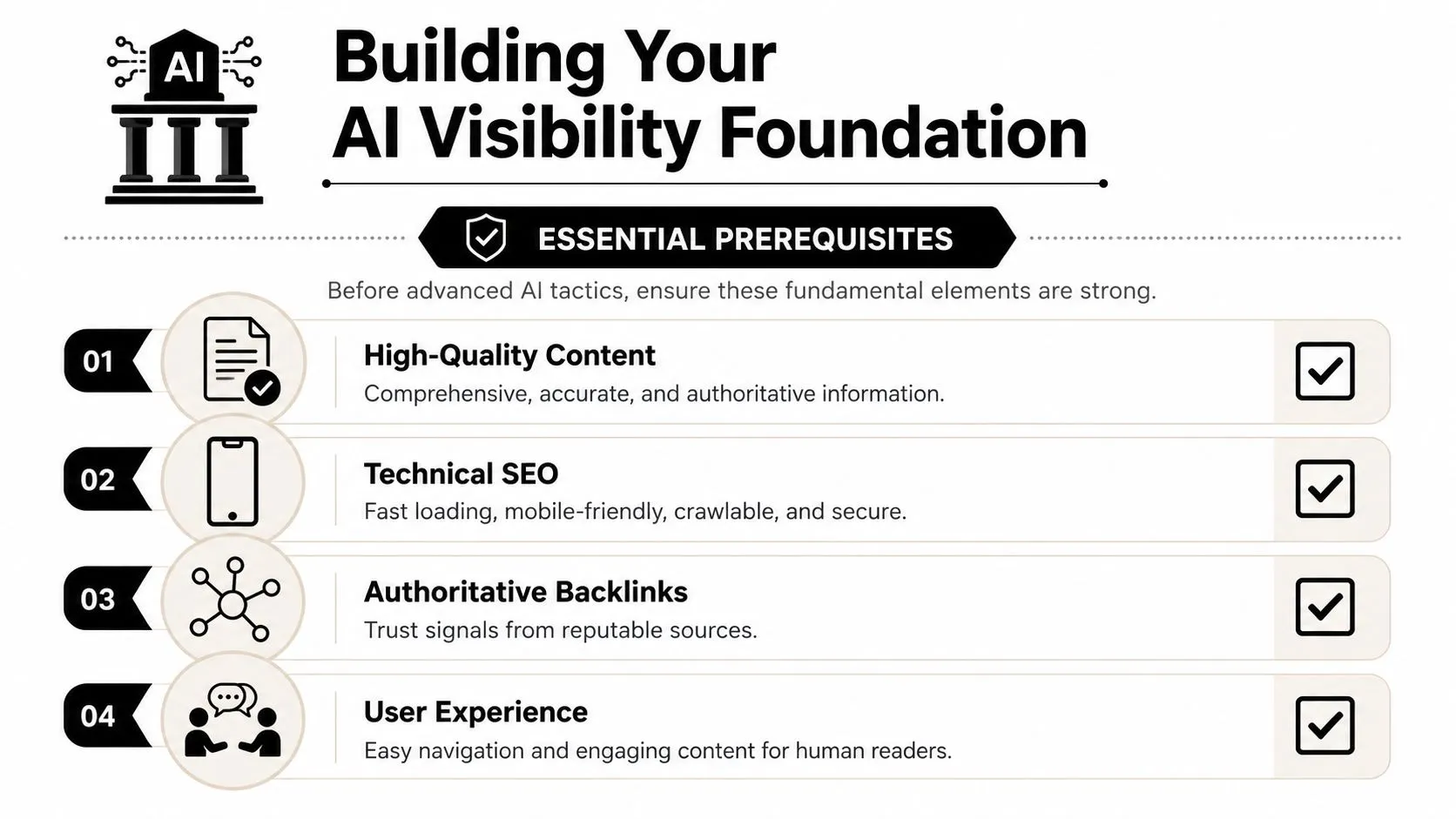
Most AI search wins still sit on top of boring fundamentals. That's frustrating for teams hoping for a shortcut, but it's also useful because the first improvements are usually straightforward.
Two technical requirements matter immediately. Pages should target load times under 3 seconds and enable browser caching, because AI systems prioritize technically sound content, according to MonsterInsights' AI search optimization guide. The same source notes that 46% of documents cited in AI Overviews already ranked in the top organic search results, which tells you the foundation still matters.
The checklist to give your technical team
Don't ask your developer to “make it AI-friendly.” Ask for specific outcomes.
- Improve load speed: Get priority pages below the three-second threshold. If a page is image-heavy, ask for WebP or AVIF compression and lighter page templates.
- Turn on browser caching: Repeat visitors and crawlers should get a faster, cleaner experience.
- Clean up schema markup: FAQ and Article schema help machines interpret what a page contains. Think of schema as a translator for your content, not a magic ranking trick.
- Protect crawlability: Important pages shouldn't be buried behind weak internal linking or messy page architecture.
If your team needs help learning how AI can support discovery and topic work upstream, this course on using ChatGPT for keyword research is a practical way to build better inputs before content production starts.
What marketers should fix without waiting on engineering
Not every foundation task requires a sprint ticket. Marketers can tighten a lot on their own.
Start with page purpose. Every page should answer a clear search intent. If the page tries to rank for a broad topic but doesn't resolve the question, it usually won't get cited. AI systems prefer pages that complete the thought.
Then look at formatting:
| Foundation item | What it means in practice | Why it helps AI visibility |
|---|---|---|
| Page focus | One topic cluster per page | Easier extraction and citation |
| Heading structure | Question-led H2s and H3s | Makes answers easier to parse |
| Media handling | Smaller images and helpful captions | Reduces friction and adds context |
| Internal links | Point to definitions, comparisons, and service pages | Helps systems understand relationships |
Clean structure beats clever writing. A fast, plain page with obvious answers will usually outperform a slow page full of brand language.
The waste of time here is chasing “AI tricks” while your site is still hard to load, hard to crawl, or hard to interpret. Fix the basics first. They still carry more weight than many might want to admit.
Your AI Search Optimization Toolkit
You don't need a giant software stack for AI search optimization. You need a small set of tools that answer four operational questions:
- What are people asking?
- Does our content answer it clearly?
- Are we being cited or mentioned in AI results?
- What should we update next?
That's the stack. Everything else is optional.
The categories that actually matter
Some teams burn time testing flashy AI SEO platforms before they've built a repeatable workflow. I'd rather start with tool categories and selection criteria. That gives you a stack that survives vendor churn.
| Tool Category | Primary Function | Key Feature to Look For |
|---|---|---|
| Query research tools | Surface real customer questions and comparison phrases | Ability to cluster questions by intent |
| Content optimization tools | Evaluate whether a page is answerable and well-structured | Guidance on headings, direct answers, and content gaps |
| AI visibility tracking tools | Monitor mentions, citations, and appearances in generative answers | Query-level tracking across multiple AI surfaces |
| Analytics platforms | Separate AI referral traffic from other acquisition channels | Source and landing-page visibility |
| Prompt workflow tools | Standardize briefs, rewrites, and QA prompts for content teams | Reusable templates and shared prompt libraries |
| Knowledge management tools | Store definitions, product facts, proof points, and approved language | Easy access for writers and analysts |
What good tool decisions look like
A research tool should help you collect language buyers already use. That's more useful than giving you a giant keyword export with no context. In practice, you want to know the exact phrasing around “how,” “vs,” “best for,” “cost,” “implementation,” and “alternatives.”
A content optimizer should tell you whether the page is readable and extractable. If the software only scores keyword usage, it's behind the market. The better question is: could an AI system lift a clear answer from this page without rewriting the whole thing?
An AI visibility tracker should help you spot patterns, not just screenshots. If your brand appears for some prompts but disappears for adjacent ones, the tool should make that obvious. You're looking for consistency across important query sets.
Buy tools that support decisions, not dashboards. If the platform doesn't help a marketer decide what to rewrite this week, it's noise.
A lean workflow for marketers and analysts
A simple, durable setup looks like this:
- Research layer: Use one tool to collect customer questions, sales call phrases, and comparison queries.
- Content layer: Use one editor or optimization platform to turn those questions into structured pages.
- Tracking layer: Use one monitoring system plus your analytics package to see whether AI visibility is improving.
- Prompt layer: Keep approved prompts for rewriting intros, generating FAQs, summarizing product details, and checking clarity.
What doesn't work is treating prompts as the strategy. Prompts help. Process wins. The toolkit matters because it makes the process repeatable across pages, writers, and reporting cycles.
How to Write for Generative Engines
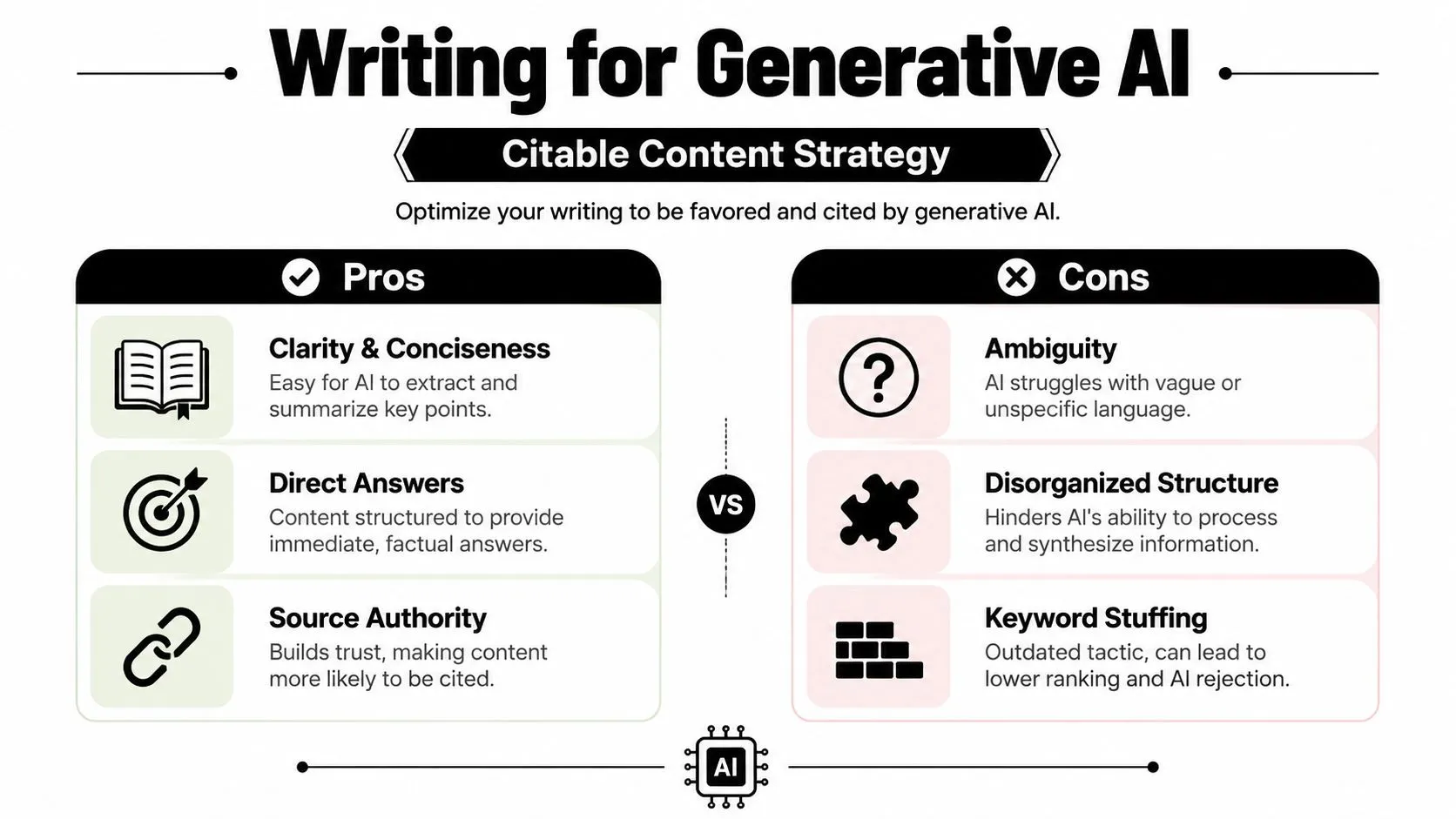
The biggest content mistake in AI search optimization is writing as if the reader must scroll to discover the answer. Generative engines don't have that patience. They want the answer early, the proof nearby, and the structure obvious.
The second mistake is sounding polished but saying nothing concrete. AI systems can summarize fluff, but they don't have much reason to cite it.
Start with answer blocks
A strong page usually opens each major section with a direct answer in two or three sentences. After that, it expands with examples, steps, comparisons, or caveats.
That doesn't mean every page should sound robotic. It means every section should contain a clean takeaway that can stand on its own.
For practical inspiration on this style, Content That Gets Cited by AI is useful because it aligns with how answer-focused content needs to read in real workflows, not just in theory.
A simple writing pattern works well:
- Question heading: Use the customer's phrasing where possible.
- Direct answer: Give the clearest answer immediately.
- Context paragraph: Add nuance, constraints, or trade-offs.
- Proof section: Include examples, steps, definitions, or supporting details.
- Next-step link: Point to a deeper page, service page, or related resource.
If you want to sharpen the way you instruct AI during drafting and revision, this explainer on what prompt engineering is helps non-technical teams build better prompts without turning the process into jargon.
Define entities like a database would
AI systems work better with content that clearly defines the “thing” being discussed. That could be a product category, a service, a methodology, a customer segment, or a feature.
Weak content says, “Our platform helps modern teams realize efficiency.”
Citable content says, “A customer data platform centralizes customer information from multiple sources so marketing and analytics teams can build unified audiences and measure campaign performance.”
The second version gives the model something stable to work with. It identifies the entity, the job it does, and who uses it.
If a sentence could fit on any competitor's site, it probably won't earn citations.
This is also where many brand pages fall apart. They're written to sound differentiated before they've established what the company is. For AI search, clarity has to come before persuasion.
A before and after example
Here's the kind of paragraph I'd rewrite immediately.
Before
We help ambitious organizations transform digital performance through powerful solutions that align teams, streamline execution, and drive growth across the customer journey.
The problem isn't tone. The problem is extractability. An AI system can't do much with that besides paraphrase it into another vague sentence.
After
Our demand generation consulting service helps B2B marketing teams improve campaign planning, conversion tracking, and lead handoff between marketing and sales. It's designed for companies that need clearer reporting, tighter execution, and a more consistent path from content to pipeline.
Now the page defines the service, the users, and the outcome areas. That's far more citable.
A few content formats consistently perform well for AI readability:
- FAQs: Strong for direct, repeated customer questions.
- Comparison tables: Useful for “X vs Y” and “best for” queries.
- Glossaries: Good for entity definitions and terminology control.
- Step-by-step guides: Best for implementation and process questions.
- Use-case pages: Strong when buyers ask whether a solution fits their industry or team.
The video below is worth watching if you want a quick visual walkthrough of structural improvements that make content easier to parse and summarize.
What to cut from your drafts
I usually remove the same things first:
- Long scene-setting intros: Get to the answer faster.
- Stacked synonyms: Repeating variants of the same keyword makes the copy worse.
- Unsupported superlatives: “Leading,” “best-in-class,” don't help if the page doesn't explain why.
- Mixed intent pages: Don't combine a definition, a pricing pitch, and a thought leadership essay on one URL.
Good AI search writing feels almost plain on first read. That's often a sign it's working.
Measuring What Matters in AI Search
Most marketing teams still measure search success as if the click is the only meaningful event. That's the wrong frame for AI search optimization.
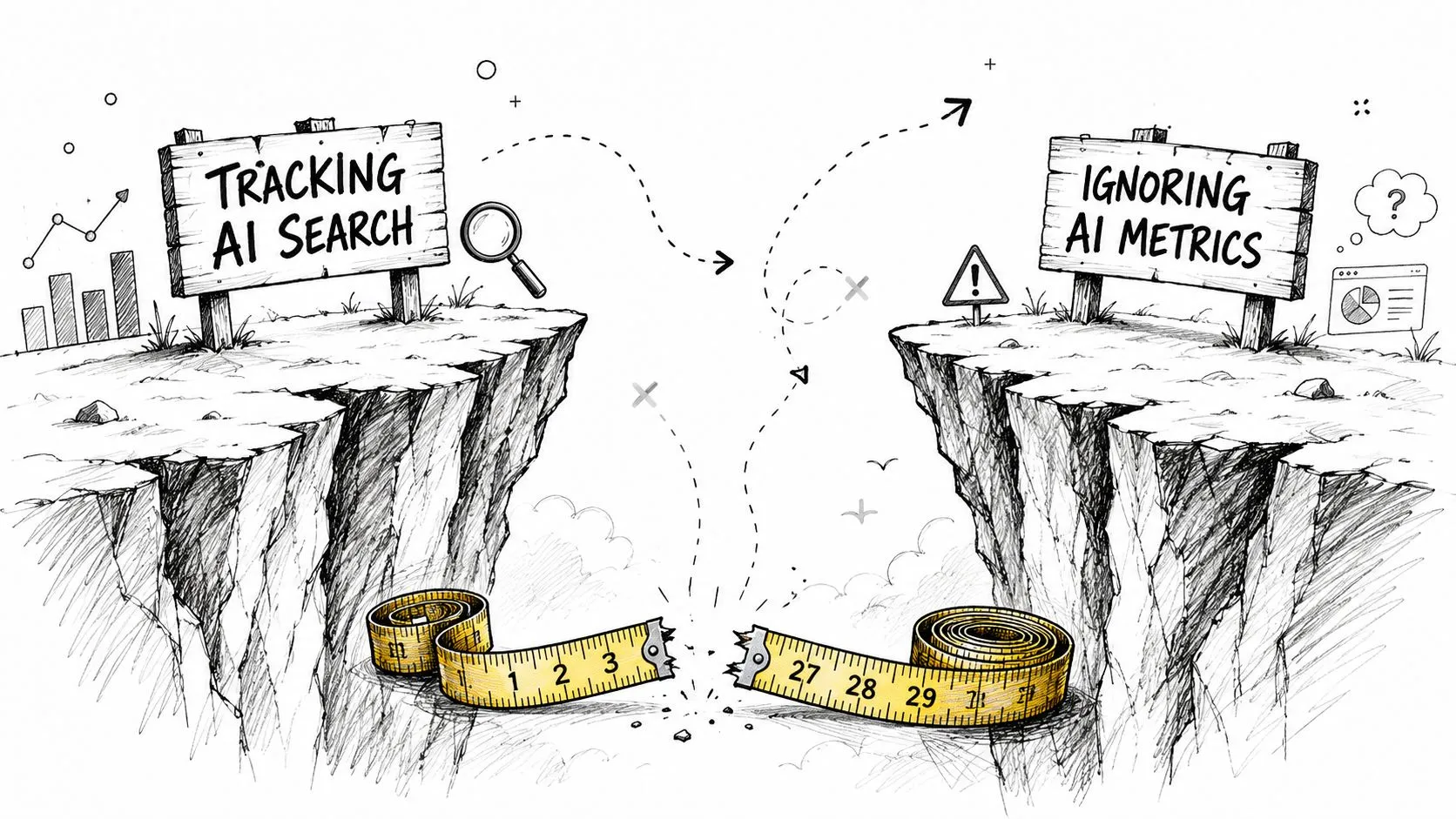
The more useful question is whether your brand influenced the answer. That means your reporting needs to include appearances, citations, mentions, and AI-assisted referral traffic, not just rankings and organic sessions.
According to Olive & Company's AI search optimization analysis, only 16% of brands systematically track AI search performance. The same source says early adopters report 35%+ improvements in AI visibility within six months and should prioritize first-party citations by increasing their own website's visibility in AI answers.
What to track instead of obsessing over rank alone
Traditional SEO metrics still matter. They just don't tell the whole story anymore.
I'd add these working KPIs to every AI search dashboard:
| KPI | What it tells you | How to review it |
|---|---|---|
| Citation rate | How often your pages are referenced in relevant AI answers | Check core prompts weekly |
| Share of voice in AI | Whether competitors appear more often than you do | Compare branded and non-branded query sets |
| AI referral traffic | Whether answer-surface visibility leads to visits | Review source and landing page together |
| First-party citation coverage | Whether AI systems cite your own domain instead of third-party summaries | Audit prompt results manually |
| Prompt win rate | How many priority prompts mention your brand or page | Track month over month |
A page can lose clicks and still gain influence. If your content becomes the source AI systems trust, that influence often shows up later in branded search, direct traffic, and sales conversations.
A simple reporting workflow
This doesn't need a complicated data warehouse. Start with a manual process that your team can sustain.
- Pick a fixed query set: Use your most important commercial, comparison, and implementation questions.
- Run the same prompts on a schedule: Weekly is generally sufficient.
- Log the outcome: Was your brand cited, linked, summarized, or ignored?
- Map prompt outcomes to pages: If one page wins repeatedly, study its structure. If another never appears, rewrite it.
- Review referral patterns: Look for landing pages that attract traffic from AI systems or chat tools.
I also recommend storing screenshots or text captures of AI answers. They give you valuable context that a spreadsheet row won't. You'll notice patterns such as competitor pages being cited because they define the category more clearly, or your own page appearing only when the query includes a specific modifier.
What doesn't work is waiting for perfect tooling before you measure anything. The gap is still wide enough that even a disciplined spreadsheet beats no system at all.
Your First AI Search Optimization Projects
Many organizations stall because the topic feels bigger than it is. Don't start with a sitewide overhaul. Start with a handful of pages and a repeatable workflow.
Project one rewrites the pages you already own
Pick your top five educational or commercial pages. For each one:
- Rewrite the introduction so it answers the primary query immediately.
- Turn vague subheads into real questions.
- Add one short FAQ block near the end.
- Replace generic claims with concrete definitions, examples, or process details.
This project works because it upgrades existing assets instead of waiting on net-new content.
Project two builds a true customer-question hub
Ask sales, customer success, and account managers for the questions they answer repeatedly. Then create one FAQ or resource hub page that responds to those questions in plain English.
Don't overdesign it. Keep each answer short, useful, and linked to the deeper page that expands on the topic. That format gives AI systems clean extractable text and gives buyers a logical next click.
Project three runs a lightweight AI-assisted content audit
Use ChatGPT or Claude to review a set of pages for clarity, missing questions, weak definitions, and extractability. A practical next step is learning how to run a structured audit with Claude, which this guide on finding and fixing technical SEO issues by doing a site audit using Claude can support.
For each page, ask:
- What question does this page answer best
- What answer is missing from the first screen
- What terms need clearer definitions
- Which sections feel promotional instead of informative
Those three projects are enough to start generating signal. You'll learn which page templates get cited, which topics need expansion, and where your current content is too vague to compete in AI search.
If you want hands-on help building these workflows, AI Academy is a practical place to learn. It's built for marketers, analysts, managers, and consultants who need fast, non-technical tutorials on ChatGPT, Claude, Perplexity, prompt workflows, reporting, and real job-to-be-done use cases.