You ask ChatGPT, Claude, or Gemini for a quick briefing before a meeting. The answer comes back polished, confident, and packed with facts. It even includes citations. At first glance, it looks ready to paste into a deck.
Then you notice one odd detail. A company name is slightly wrong. A quote sounds too neat. A number has no obvious source. Now you're stuck with the question that defines modern knowledge work: Can I trust this?
That question sits at the center of AI fact checking. In plain language, AI fact checking means using a mix of tools, prompts, and human review to verify whether an AI-generated statement matches reliable evidence. It isn't just about catching obvious fake claims. It's about checking the subtle mistakes that slip through because the writing sounds authoritative.
For managers, analysts, marketers, and consultants, this is no longer a niche skill. It's a daily operating skill. AI now acts like a supercharged research assistant. It can summarize, draft, compare, and explain. But it can also blend accurate information with errors, outdated context, and invented detail. The output may look finished long before it is safe to use.
If you're already using question answering tools to search across documents, reports, or internal knowledge bases, it helps to understand the mechanics behind them. This guide on question answering technology gives useful background on how AI systems retrieve and present answers from source material.
The practical shift is simple. Treat AI output as a starting point, not a final authority. Once you do that, fact checking stops feeling like a chore and starts feeling like quality control.
Introduction The Double-Edged Sword of AI Answers
A lot of workplace AI risk starts with something that looks helpful.
A content lead asks for a competitor analysis. A sales manager requests a one-page market summary. An analyst wants a fast overview of regulation changes. The model returns something clean and persuasive in seconds. Nobody sees the drafting struggle, so the answer feels more certain than it should.
That false sense of certainty is why AI fact checking matters. The danger isn't only that AI can be wrong. The danger is that it can be wrong in a useful-looking format. It gives you the confidence of a finished memo, even when the underlying facts still need inspection.
Many smart teams become confused, believing fact checking means looking for fake headlines or obvious nonsense. In practice, the harder problem is more boring and more common. AI often gets the headline roughly right while missing dates, overstating certainty, mixing sources, or inventing support around a real idea.
Practical rule: If an AI answer would be expensive, embarrassing, or hard to reverse if wrong, verify it before reuse.
That applies to client decks, leadership updates, policy summaries, medical or legal overviews, recruiting briefs, investor notes, and performance comparisons. It also applies to internal work. An incorrect summary shared inside a company can spread just as fast as an external mistake.
The good news is that you don't need to become a technical fact-checker. You need a repeatable habit: isolate the claim, trace the source, compare with outside evidence, and decide whether the statement is safe enough to use.
How AI Fact Checking Actually Works
Most non-technical users interact with AI fact checking as a feature. A bot cites sources, highlights claims, or gives a verdict. Under the hood, the process is more structured than it appears.
A simple mental model
Think of an AI fact-checking system as a very fast junior researcher with four jobs. According to a Gemini-based implementation described by Google, a structured pipeline breaks the task into factual statement extraction, verification question generation, evidence retrieval from external sources, and final verdict classification such as accurate, misleading, or false, while separating claim detection from verification for easier auditing and review in production workflows (Google AI fact-checker project).
That structure matters because AI shouldn't judge a paragraph as a whole blob of text. It should first pull out the specific factual claims hiding inside it. For example:
- "The company launched in 2018."
- "Its revenue doubled after the new pricing plan."
- "The CEO previously worked at a competitor."
Each claim can then be checked on its own.
After that, the system turns each claim into verification questions. Instead of asking a vague question like "Is this paragraph true?", it asks narrower questions such as "When was the company founded?" or "Do reliable records show the CEO worked at that firm?"
Then comes retrieval. This is the most important stage for practical users because it's where the system goes outside its own memory and looks for evidence.
A good fact-checking tool doesn't just answer. It shows how it got there.
Some tools rely heavily on retrieval from a knowledge base or the web. Others lean more on the model's internal knowledge. That's why two products can give very different answers to the same prompt.
For professionals who want better outputs from research-oriented systems, training on structured prompts and source-led workflows helps. A practical starting point is this lesson on deep research with ChatGPT, which focuses on getting more traceable, evidence-based results.
Comparison of AI Fact-Checking Approaches
| Approach | How It Works | Best For |
|---|---|---|
| Retrieval-based checking | Pulls evidence from selected documents, websites, or databases before judging the claim | Policy summaries, internal knowledge bases, regulated content |
| LLM-native verification | Uses the model's built-in knowledge to assess plausibility without strong source retrieval | Early triage, brainstorming, spotting risky claims to review |
| Citation tracing | Follows the AI's cited references back to their original source and checks whether the citation actually supports the claim | Auditing AI-written reports, decks, and market summaries |
A simple way to remember the difference is this: retrieval asks, "What evidence can I find?" Internal verification asks, "Does this sound right?" Citation tracing asks, "Did the source say that?"
Only one of those is close to enough on its own.
The Strengths and Limitations of Automated Verification
AI can be a strong assistant for verification work. It can also fail in ways that look credible. Both things are true at once.
Where AI helps immediately
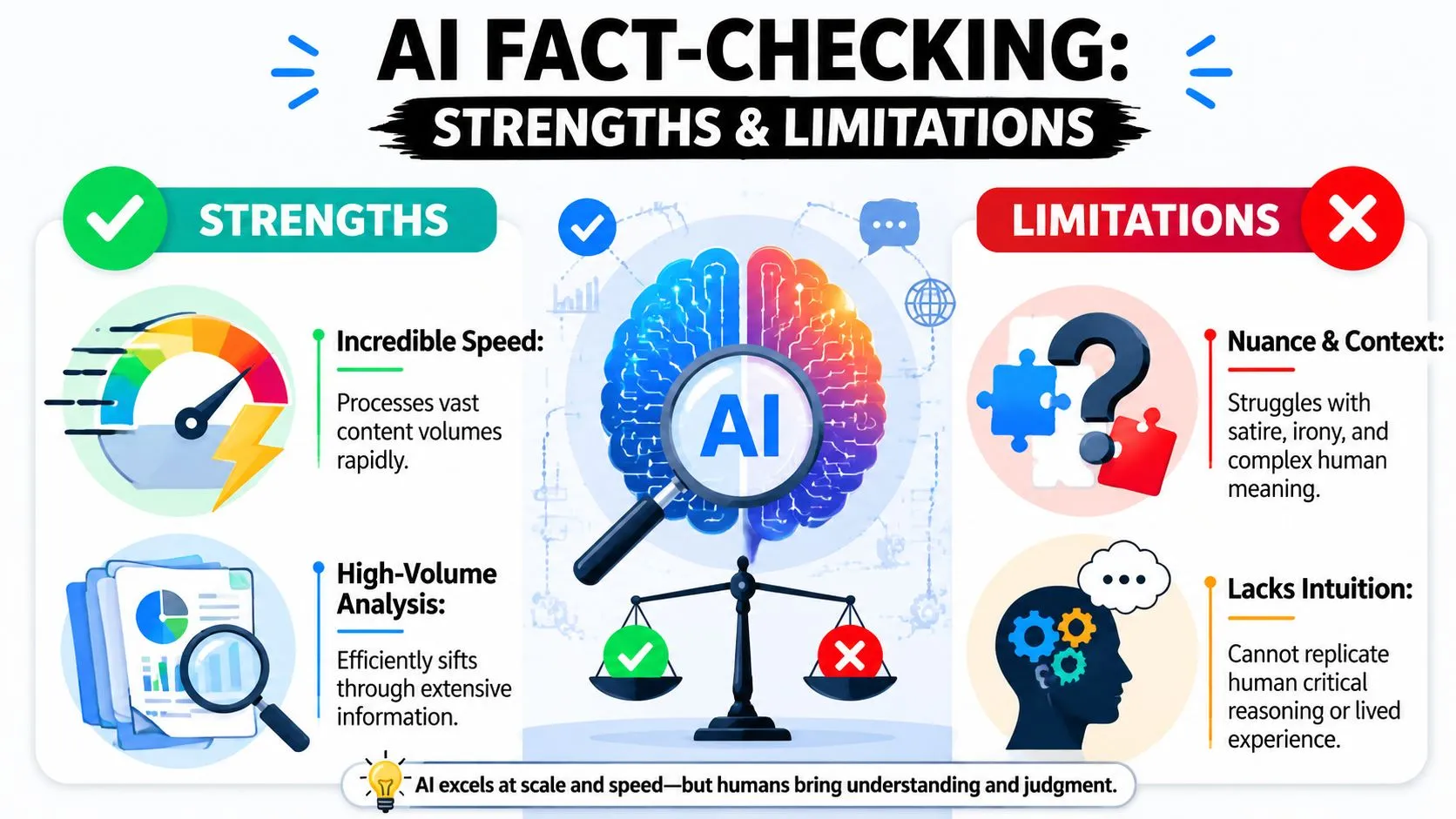
The biggest advantage is speed. AI can scan a long report, pull out check-worthy claims, and surface likely trouble spots much faster than a person starting from a blank page. That makes it useful for triage.
It's also good at repetitive verification support. If you have a batch of product descriptions, press releases, meeting notes, or analyst summaries, AI can flag factual statements, cluster similar claims, and help your team decide what deserves manual review first.
This support role matters at scale. The broader fact-checking field itself has become large and organized. As of May 2025, there were 457 active fact-checking organisations worldwide, and the University of Pennsylvania notes that large language models can help with tasks such as identifying check-worthy claims, matching claims to previously fact-checked material, summarisation, transcription, and multilingual support, showing how AI is increasingly used to support rather than replace human judgment in verification workflows (University of Pennsylvania on the global fact-checking ecosystem).
Where it breaks down
The main weakness is judgment.
AI can detect a claim. It can summarize evidence. It can even produce a plausible verdict. But it often struggles with context, sarcasm, cultural references, legal nuance, and the messy question of whether a source is merely available or actually trustworthy.
That weakness becomes sharper outside well-covered English-language topics. Reuters Institute notes that generative AI is already helping fact-checkers but is proving less useful in small languages, which highlights a real equity gap for teams working in lower-resource language contexts where local sources and cultural cues matter even more (Reuters Institute on AI fact-checking in small languages).
Here are the practical limits managers should keep in mind:
- Nuance problems: AI often misses when a statement is technically true but misleading in context.
- Source quality confusion: It may treat a polished page as credible without understanding who published it or why.
- Detail drift: It can preserve the main idea while changing the supporting specifics.
- Overconfidence: It often sounds equally sure when right and wrong.
Use AI to narrow the search space. Don't use it to outsource judgment.
If you think of automated verification as a screening layer, you'll use it well. If you think of it as a final arbiter, you'll eventually ship a mistake.
A Practical Workflow for Verifying AI Content
The safest way to use AI for fact checking is to treat the model's answer as a draft hypothesis. Then you test it. The workflow below is simple enough for non-technical teams and strict enough for client-facing work.
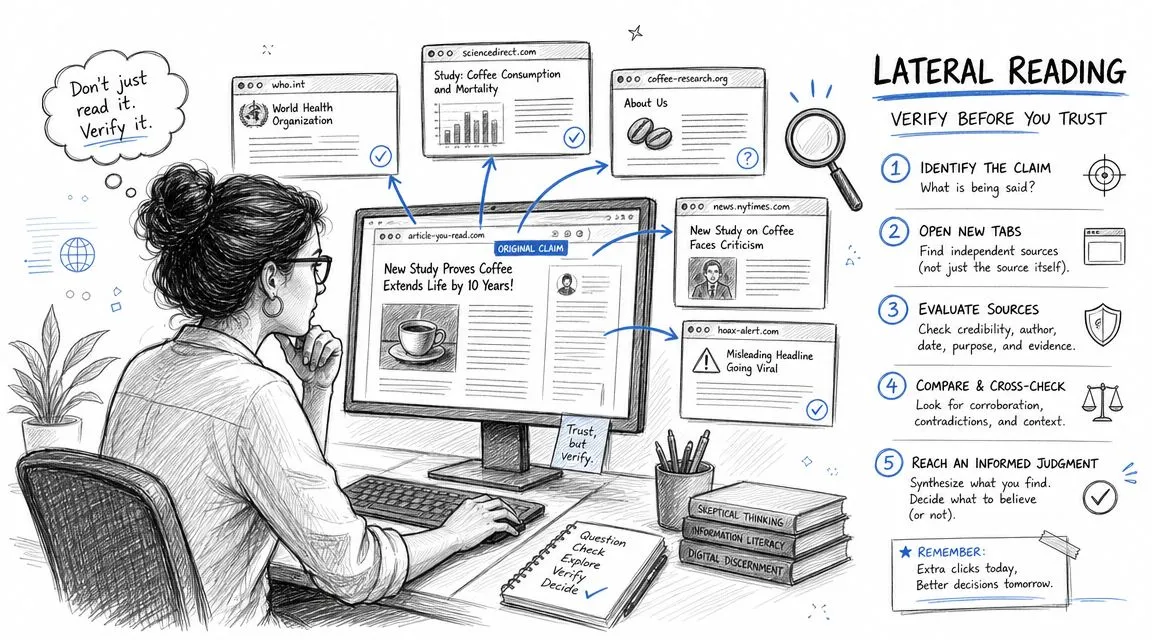
A useful phrase here is lateral reading. Instead of staying inside the AI answer, you leave it and compare what it says against multiple outside sources. That matters because AI can sound convincing while still omitting context or fabricating support. Guidance on lateral reading for AI also notes that professionals often judge LLM-generated fact-checks as less useful than human-written ones even when they seem accurate, because the outputs often lack the transparency and context needed for real decisions (Texas A&M University-Corpus Christi guide to lateral reading with AI).
Step 1 through Step 3
-
Pull out the exact factual claims
Don't verify a whole page at once. Highlight each concrete statement.
Prompt template:
Extract every factual claim from the text below. List them as separate bullet points. Do not evaluate them yet.
-
Rank claims by risk
Not every sentence deserves the same effort. Start with the claims that could change a business decision, harm credibility, or create compliance trouble.
A simple triage lens:
- High risk: statistics, legal claims, medical claims, financial statements, attributed quotes
- Medium risk: historical background, competitor descriptions, market summaries
- Lower risk: generic definitions, broad explanations, obvious common knowledge
-
Ask for independent verification
Use a separate tool, browser, or fresh AI session. The goal is to avoid letting the same model grade its own paper.
Prompt template:
Find independent sources that verify or contradict this claim: [paste claim]. Summarize the evidence and note any uncertainty.
Verification habit: Separate generation from review. One AI can draft. Another workflow should challenge it.
A similar logic applies outside text. If you're reviewing suspicious visuals, altered media, or synthetic creative work, these AI art detection methods are a useful example of what evidence-based checking looks like in another medium.
Step 4 through Step 6
-
Force the search for disagreement
Many users ask AI, "Is this true?" and stop at the first supportive answer. That's too narrow. You want contradictory evidence on purpose.
Prompt template:
What are the strongest counterarguments, conflicting sources, or missing context related to this claim? Prioritize reputable disagreements.
-
Open and inspect the cited sources
A citation is not proof. Check whether the source exists, whether it says what the AI claims, and whether the statement is current.
Use this mini-checklist:
- Match: Does the source support the sentence?
- Date: Is the information current enough for your use case?
- Origin: Who published it?
- Scope: Is the AI stretching a narrow finding into a broad conclusion?
If your team is working on reducing made-up claims at the source, this resource on reducing ChatGPT hallucinations and incorrect outputs is a practical complement to the review process.
-
Rewrite with evidence attached
Once you've verified a claim, don't paste the original AI wording back unchanged. Rewrite it so the certainty matches the evidence.
Example:
- Risky version: "This policy eliminates customer churn."
- Safer version: "The policy is associated with improved retention in the sources reviewed, but the evidence should be checked against your own customer data."
For a quick visual walkthrough of how to question AI outputs instead of accepting them at face value, this short clip is a helpful companion:
If you adopt only one habit from this article, make it this one: verify the claims that carry consequences, not the sentences that merely sound impressive.
How to Evaluate an AI-Powered Fact Check
An AI-generated fact check can look solid while still being weak. The verdict alone doesn't tell you enough. You need a way to judge the quality of the check itself.
A manager-friendly scorecard
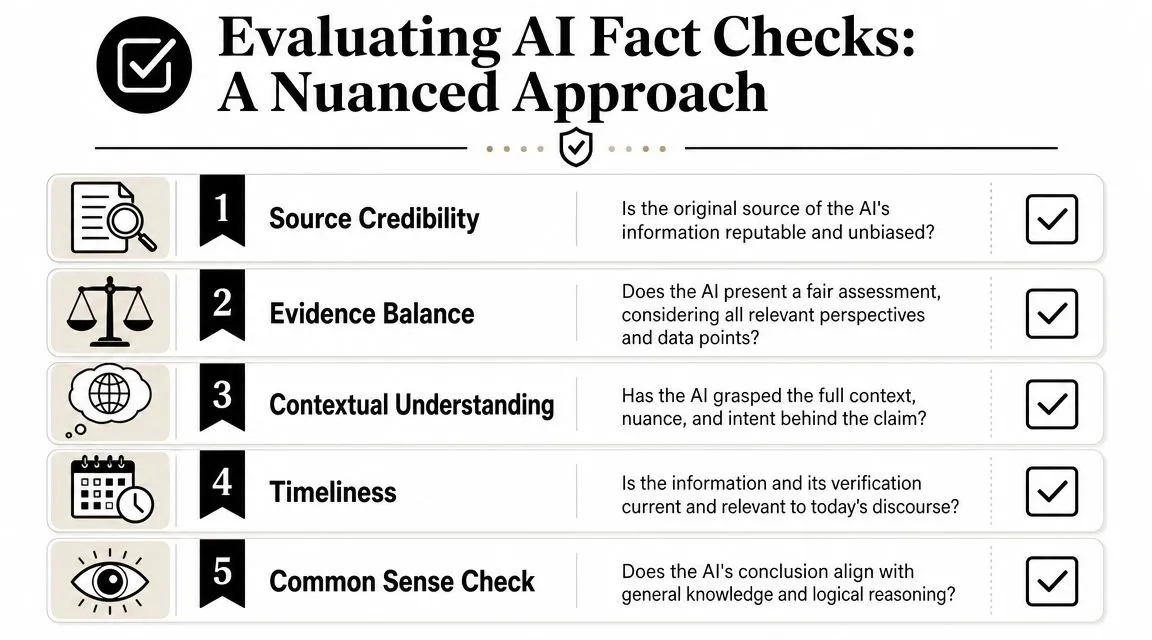
Use five questions.
- Attribution: Does the fact check point to specific sources you can inspect?
- Context: Does it explain why the claim is accurate, misleading, or unsupported?
- Balance: Does it mention uncertainty, exceptions, or competing evidence?
- Verifiability: Can you reproduce the check without special access or hidden logic?
- Common-sense fit: Does the conclusion line up with what the evidence supports?
User trust is fragile. In one experimental study, when participants were told an automated fact-checker had about 67% accuracy, belief correction weakened. A more accurate system significantly reduced post-correction endorsement of misinformation, with b = -0.51, t(1055) = -4.85, p < .001, and r = .15, showing that verified accuracy changes whether people update their beliefs (study on AI fact-checker accuracy and belief correction).
In other words, people don't just respond to the existence of a fact check. They respond to whether the tool seems accurate enough to trust.
What good looks like
A weak AI fact check says, "False. This claim is inaccurate."
A useful AI fact check says something closer to this:
The claim conflicts with the cited source on the date, uses broader wording than the source supports, and omits a key exception. The verdict is misleading rather than simply false.
That difference is operationally huge. It helps a reviewer edit the sentence, explain the issue to a stakeholder, and document why the claim shouldn't be used as written.
If your workflow includes transcripts, interviews, or meeting recordings, source fidelity matters before fact checking even begins. This practical guide on how to achieve flawless transcription is useful because transcription errors often become the first factual errors in downstream AI summaries.
A simple policy helps: don't accept binary verdicts without evidence trails. If the system can't show its work, treat the output as low confidence.
Adopting AI Fact Checking in Your Organization
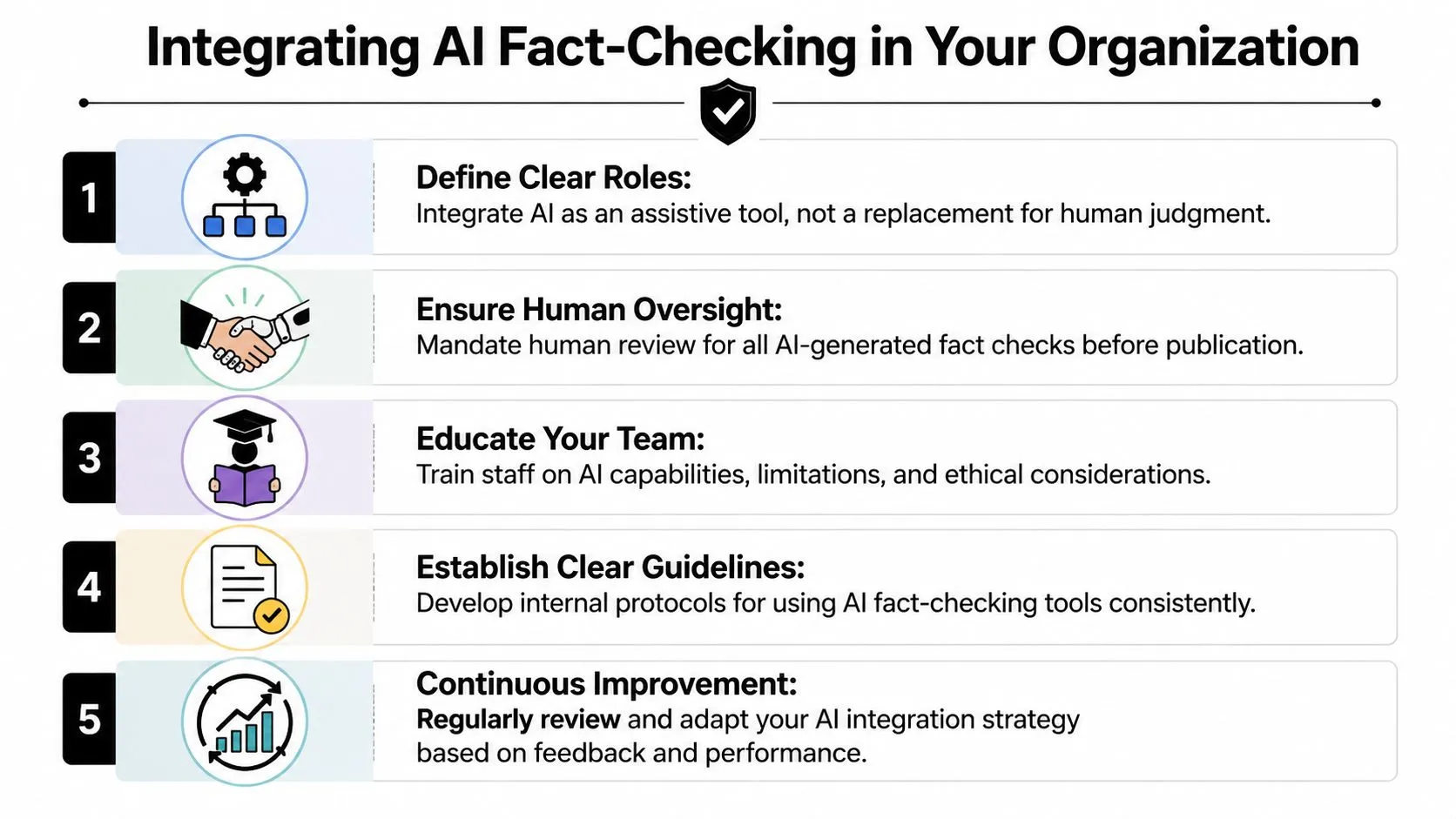
Individuals can fact-check ad hoc. Teams need rules.
Build rules before scale
The most common failure pattern isn't bad technology. It's vague responsibility. Someone assumes the model checked itself. Someone else assumes the citations are real. The content moves forward because it looks finished.
A better approach is to assign clear roles:
- Draft owner: Uses AI to produce the first pass.
- Verifier: Checks high-risk claims, citations, and wording.
- Approver: Signs off before external use.
Create a few simple rules your team can remember:
- No unverified statistics in external materials: If AI provides a number, a human has to confirm it against the original source.
- No fabricated quotations: Every quote must be checked against a real, accessible source.
- No source laundering: A citation copied from AI isn't accepted until someone opens it.
Structured knowledge systems are helpful in this context. If your company is already organizing internal documents, policies, and research, this guide to AI for knowledge management is a helpful way to think about connecting verification to the broader flow of information inside a team.
Small team examples
A marketing team can use AI to scan competitor claims, identify which statements sound testable, and draft a comparison sheet. A human reviewer still checks the pricing pages, product docs, and current language before anything reaches sales.
A research team can use AI to summarize a large pile of documents, extract factual claims, and build a first-pass evidence map. A human analyst then reviews the primary materials and decides what belongs in the final memo.
A customer success team can use AI to draft help center updates from internal notes. Someone on the product or support side then confirms dates, feature names, and policy language.
Put AI where speed matters. Put humans where accountability matters.
That model aligns with how the broader verification field is evolving. As noted earlier in the fact-checking ecosystem, there are 457 active fact-checking organisations worldwide as of May 2025, and AI is increasingly used to support human workflows such as claim identification and summarization rather than replace human judgment outright.
When teams adopt AI fact checking this way, the tool becomes less of a gamble and more of a controlled advantage.
Conclusion Your Role in the Age of Automated Information
AI fact checking isn't about distrusting every answer. It's about matching confidence to evidence.
AI is excellent at speed, coverage, and first-pass analysis. It can pull claims from messy text, surface possible problems, and help teams review more material than they could manually. But it still needs supervision where facts carry risk.
The professionals who use AI well won't be the ones who accept the fastest answer. They'll be the ones who build reliable habits around verification, source checking, and clear accountability. That's what turns AI from a clever assistant into a trustworthy part of work.
Your role doesn't disappear in an automated environment. It becomes more valuable. You are still the person responsible for deciding what is safe to believe, safe to share, and safe to act on.
If you want to build these habits with practical lessons instead of theory, AI Academy is a strong place to learn. It's built for working professionals who want clear tutorials, useful prompt templates, and fast training on the AI tools they use on the job.