The number that should reset your view of AI for consultants is this: the AI consulting services market is estimated at USD 11.07 billion in 2025 and projected to reach USD 90.99 billion by 2035, an 8.2x expansion at a projected 23.4% CAGR according to Future Market Insights. That isn't a side trend. It's a service-line shift.
Most consultants still approach AI too narrowly. They use ChatGPT to draft proposals faster, clean up workshop notes, or summarize research. Useful, yes. Sellable, not by itself. Clients rarely pay a premium because you got your own work done faster. They pay when you help them change how their teams operate, how decisions get made, and how value gets measured.
That's the core opportunity in AI for consultants. Not personal productivity. Service redesign. If you can package AI into a repeatable offer, scope it cleanly, govern it responsibly, and prove business value without making sloppy promises, you stop looking like another freelancer with a prompt library and start looking like a modern advisory partner.
The Unignorable Shift to AI Consulting
The AI consulting market is expanding fast. As noted earlier, analysts project a steep rise over the next decade, and that growth is already changing what clients expect to buy.
The important shift is not that more firms want to experiment with AI. It is that buyers are starting to fund AI as a service line with clear operational goals. They are not asking for inspiration. They are asking for workflow redesign, implementation choices, review controls, team adoption, and proof that the work improved a metric they care about.
That changes the consultant's job.
A few years ago, an AI conversation could end with a strategy deck and a shortlist of tools. Now the work has to survive procurement, legal review, team training, and day-to-day use inside an existing process. The consultants who win are the ones who can turn AI into a sellable offer with a defined scope, a delivery method, and a measurable outcome.
Why this shift matters in practice
Budget follows business cases. Clients typically approve AI work when it answers questions like these:
- Which workflow should we redesign first
- Where will AI improve speed, quality, or decision support
- What needs human review and what can run with light oversight
- How will the team use it without creating security or quality problems
- How will we measure results after rollout
Those are service design questions, not just technology questions. They affect how you package the work, how you price it, and how you defend the engagement six weeks later when a client asks what changed.
Consultants who want to stay relevant need more than prompt-writing skill. They need a point of view on delivery. That usually means productizing a narrow use case, setting boundaries on where AI is allowed to act, and building simple reporting around time saved, output quality, cycle time, or adoption. For consultants still building that capability, this guide on learning AI for business use cases and delivery is a useful starting point.
Practical rule: If your AI offer cannot be sold as a business outcome with a defined delivery process, it is still an experiment.
What works now
The strongest offers usually combine three things: domain knowledge, a recurring client problem, and a workflow where AI improves throughput without removing judgment.
That last part matters. Many clients do not want full automation. They want faster analysis, better first drafts, stronger research coverage, cleaner handoffs, or fewer repetitive steps. Sell that well and AI stops being a feature you tack onto an existing engagement. It becomes a service the client can understand, buy again, and recommend internally.
Find Your Niche in the AI Gold Rush
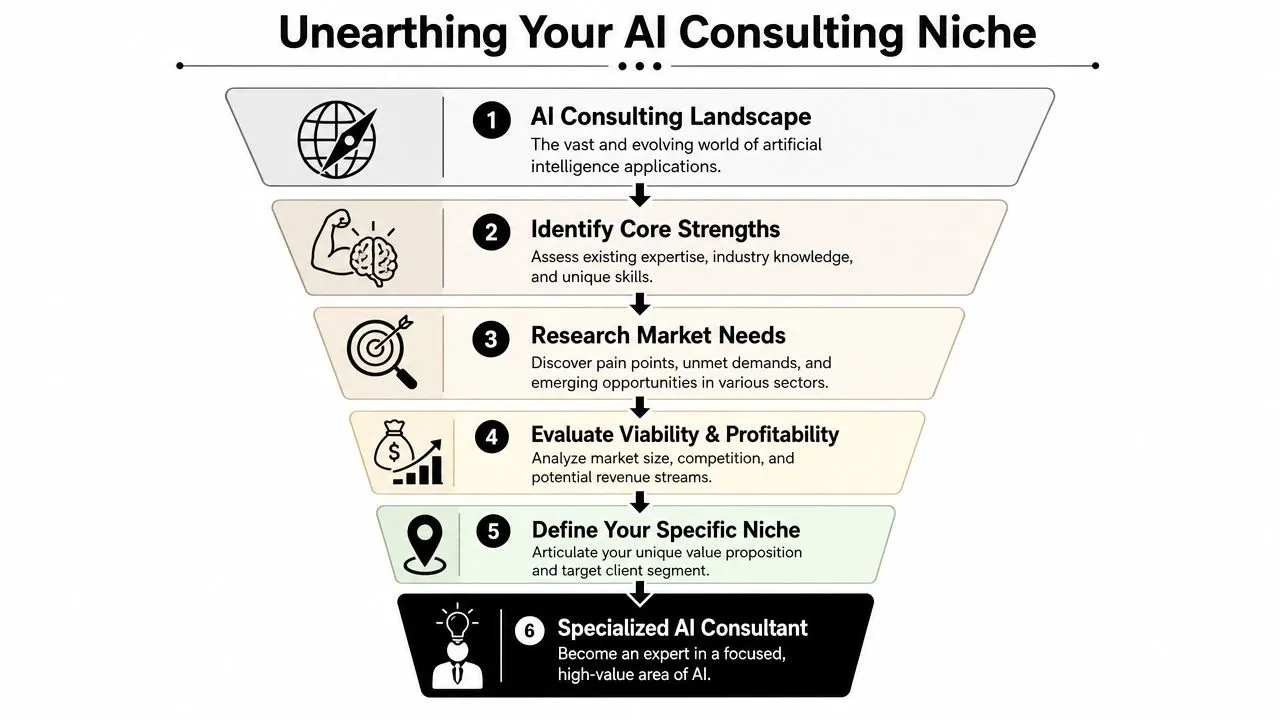
Being an “AI consultant” is too broad to be useful. Buyers don't wake up wanting AI. They want a faster reporting cycle, better market intelligence, less admin work, cleaner decisions, stronger enablement, or fewer delays in execution. Your niche starts there.
Deloitte's 2026 enterprise AI report found that 66% of organizations said AI improved productivity and efficiency, 53% reported better insights and decision-making, and the AI skills gap was seen as the biggest barrier to integration. Deloitte also found that education became the top talent strategy adjustment tied to AI adoption in its State of AI in the Enterprise reporting. That tells consultants where buyers are most likely to spend: productivity, decision support, deployment help, and capability building.
Generic AI positioning doesn't sell
A broad label creates three problems.
First, it makes you sound interchangeable. Second, it attracts poorly scoped inquiries from buyers who want “something with AI” but haven't defined the business problem. Third, it forces you into education-heavy sales calls that don't convert well.
A sharper position sounds like this:
- AI workflow design for B2B marketing teams
- AI-assisted research systems for boutique strategy firms
- Prompt libraries and team training for recruiting leaders
- Competitive intelligence automation for SaaS operators
- Knowledge-base search and summarization for client service teams
Those are easier to understand, easier to scope, and easier to price.
A practical niche filter
Use a four-part filter before you build anything.
-
Start with a problem you already know
Don't start with the model. Start with a recurring client issue you've seen enough times to recognize patterns. If you've spent years in sales ops, compliance, HR, product marketing, finance, or research, begin there. -
Find the workflow inside the problem
“Improve productivity” is too vague. “Reduce time spent compiling weekly competitor updates” is a workflow. “Help managers draft better hiring scorecards” is a workflow. “Turn customer interview notes into usable themes” is a workflow. -
Identify the human bottleneck
Good AI services don't replace expertise. They remove repetitive effort around the expertise. Look for manual synthesis, first-draft writing, categorization, research collection, or formatting work that slows a capable team down. -
Define the buyer and the user separately
The person with budget isn't always the daily user. A department head may buy the service. Analysts, marketers, recruiters, or managers may use it. If you blur that distinction, your offer gets muddy.
The most bankable AI offers usually solve a narrow problem for a known team with a defined workflow and an obvious owner.
A simple worksheet helps. Write one sentence for each line:
| Filter | Your answer |
|---|---|
| Existing expertise | Industry or function you already understand |
| Target client | Specific company type or team |
| Pain point | Recurring business problem |
| Workflow | Repeatable process inside that problem |
| AI role | Drafting, synthesis, classification, retrieval, automation |
| Human role | Review, judgment, escalation, storytelling |
If you want to sharpen your commercial instinct before choosing a niche, studying how others learn AI for business in practical roles can help you spot which use cases become real offers and which ones stay as internal experiments.
Build Your Repeatable AI Service Stack
Most consultants pick tools the wrong way. They collect apps first and invent an offer around them later. That creates fragile delivery. A better approach is to design a service stack around the result you need to deliver repeatedly.
Think in layers, not apps
A reliable AI stack usually has three layers.
Foundational models sit at the base. Examples include tools like GPT-4 or Claude, which handle drafting, synthesis, extraction, reasoning, and transformation. You don't need every leading model. You need one or two that your team knows well enough to use predictably.
Automation platforms connect steps. Make and Zapier are the common starting points because they move information between forms, spreadsheets, CRMs, knowledge bases, email, and internal docs without a big engineering project.
Specialized applications handle edge tasks. That could include Perplexity for research support, Midjourney for concept visuals, Notion AI for workspace drafting, or dedicated transcription and meeting tools. These aren't the core of the service. They support it.
Here's how to view it:
| Layer | Job in the stack | Typical tools |
|---|---|---|
| Foundational | Generate, summarize, transform | GPT-4, Claude |
| Automation | Move data and trigger steps | Make, Zapier |
| Specialized | Support research, visuals, notes, knowledge | Perplexity, Notion AI, Midjourney |
Choose tools by delivery risk
The right stack for AI for consultants isn't the most impressive stack. It's the one you can defend in front of a client operations lead, legal reviewer, or department head.
Use these criteria when you evaluate tools:
-
Reliability under repetition
A tool that looks brilliant once but produces inconsistent outputs on routine work will crush margins later. Repeatability matters more than novelty. -
Data handling fit
Some projects can run on sanitized or public information. Others involve sensitive internal material. Your tool choice has to match the client's comfort level and governance requirements. -
Ease of handoff
If the client can't maintain the workflow without you, decide whether that's intentional. For advisory retainers, that may be fine. For operational enablement projects, it creates friction. -
Integration friction
A stack with too many moving parts becomes a support burden. Fewer hops usually means fewer failures. -
Commercial fit
Don't build an expensive stack for a small pilot unless the client already has strategic commitment. Keep early delivery lean.
For firms that want something purpose-built rather than a loose patchwork of apps, a platform framed as a solution for AI consultants can be useful to review because it pushes you to think in terms of delivery workflows, client management, and repeatable service operations rather than isolated prompts.
Build around one service, not ten ideas
A strong first stack supports one signature offer. For example:
- a research-heavy stack for market scans
- a documentation stack for internal knowledge retrieval
- a workflow stack for team enablement and prompt libraries
That discipline matters. Consultants who build one stack around one repeatable service usually learn faster than those who try to offer agents, automations, training, strategy, implementation, and analytics all at once.
If you plan to move beyond simple assistants and into multi-step execution, it's worth getting familiar with practical AI agents training and examples. Not because every client needs agents right away, but because consultants need to understand where automation ends and governed orchestration begins.
Design Your First AI-Powered Deliverable
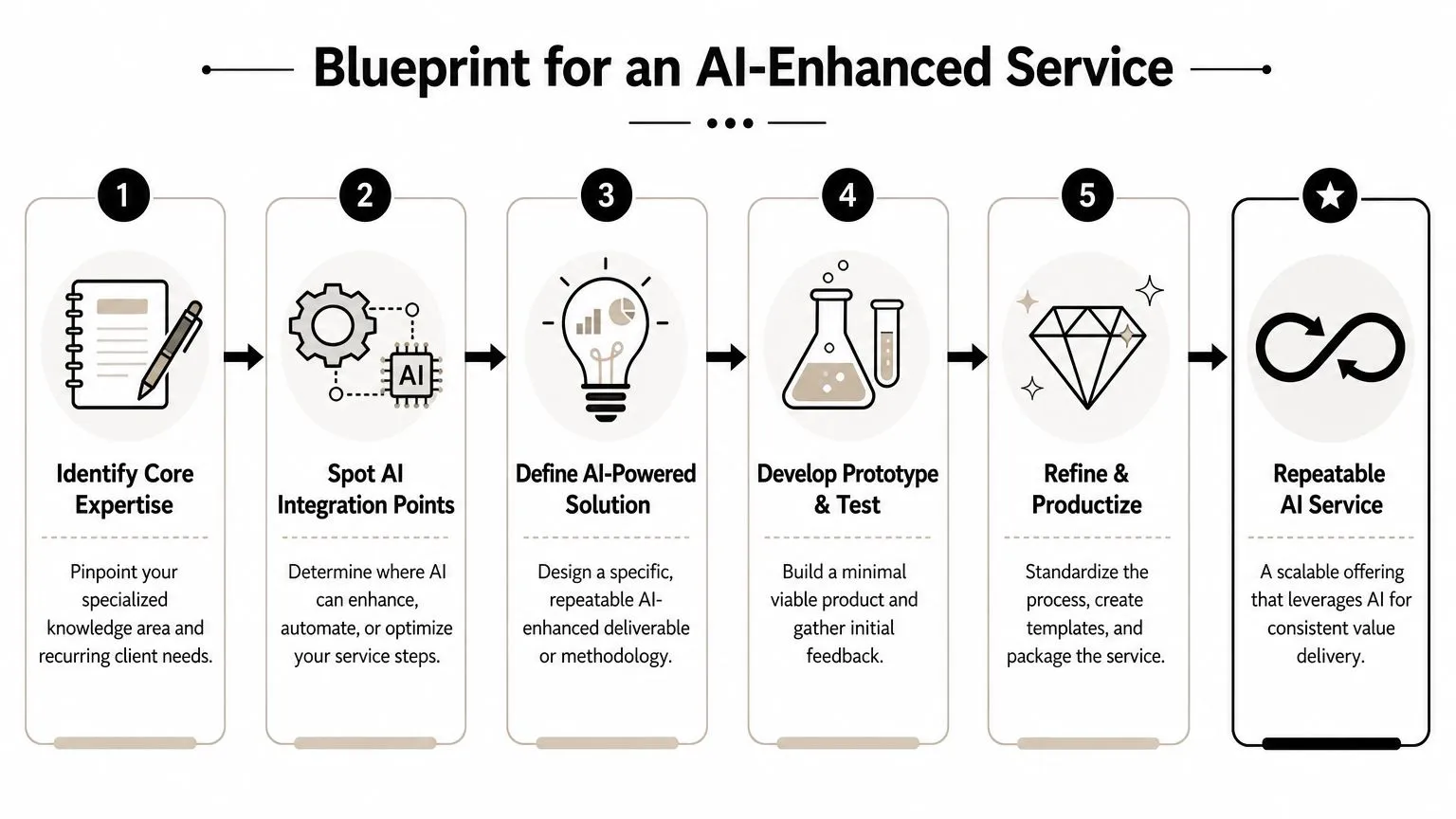
Your first AI offer shouldn't be a vague transformation promise. It should be a deliverable clients already understand, enhanced by a better production method. That's how you reduce sales friction.
A good starting example is a Quarterly Market Opportunity Report for a niche client segment. Many businesses already buy some version of market analysis, competitor tracking, customer signal interpretation, or executive briefing support. AI helps you produce that faster and more consistently, but the deliverable still makes sense to the buyer.
In a controlled experiment at a top-3 consulting firm, consultants using GPT-4 were measured at 33% higher productivity and 40% higher quality than peers without AI, with the strongest gains among lower-performing consultants, whose performance improved 43% versus 17% for top-half performers, as summarized in this analysis of the GPT-4 consulting experiment. For service design, the point isn't just speed. It's that AI can help standardize output quality across a team when you combine it with strong review.
Start with a deliverable clients already buy
Take the report example. Break it into stages:
-
Input collection
Gather earnings calls, public announcements, internal notes, interview transcripts, CRM themes, product launches, and relevant market signals. -
Source organization
Classify material by competitor, topic, region, customer segment, or strategic theme. -
First-pass synthesis
Use AI to summarize source material, extract recurring patterns, compare changes over time, and flag contradictions. -
Analyst interpretation
This is your work. You decide what matters, what's noise, which signals connect, and what the client should do next. -
Client-ready output
Turn the analysis into a briefing memo, slide narrative, workshop discussion guide, or action list.
That workflow is attractive because AI handles the messy middle. You still own the insight.
Build prompts like operating procedures
Most prompt advice for consultants is too casual. If the output matters to a client, prompts should behave more like operating documents than chat messages.
A reusable prompt should specify:
- Role
What the model is acting as - Task
What output you need - Input boundaries
What material it may use - Output structure
The required format - Exclusions
What it must not do - Quality check
How it should flag uncertainty
Here's a practical pattern:
Review the attached source set and identify the five most significant market shifts affecting [client type]. Use only the provided material. For each shift, include evidence from the sources, explain why it matters commercially, note any conflicting signals, and end with one implication for executive decision-making. If the evidence is thin, say so clearly.
That kind of prompt is reusable because it constrains behavior.
Where the quality actually comes from
AI doesn't make the service premium. Your review process does.
The strongest consulting workflows I've seen treat AI as the first-pass engine for collection, compression, and structured synthesis. Humans then handle four things that clients value:
- Judgment about what matters
- Validation of claims and references
- Prioritization of recommendations
- Narrative control so the output fits the audience
Don't sell “AI-generated reports.” Sell analyst-led decisions supported by AI-accelerated research and synthesis.
A useful internal checklist for every deliverable:
| Review gate | What to check |
|---|---|
| Factual accuracy | Did the model invent claims or overstate certainty |
| Source fidelity | Is every insight grounded in supplied material |
| Commercial relevance | Does the output connect to a business decision |
| Readability | Would an executive understand the implication quickly |
| Actionability | Does the client know what to do next |
Once this works for one deliverable, you can productize it. Build templates, standard prompts, a fixed intake form, a review rubric, and a named package. That's when AI for consultants stops being a personal habit and becomes a real service line.
How to Price and Package Your AI Services
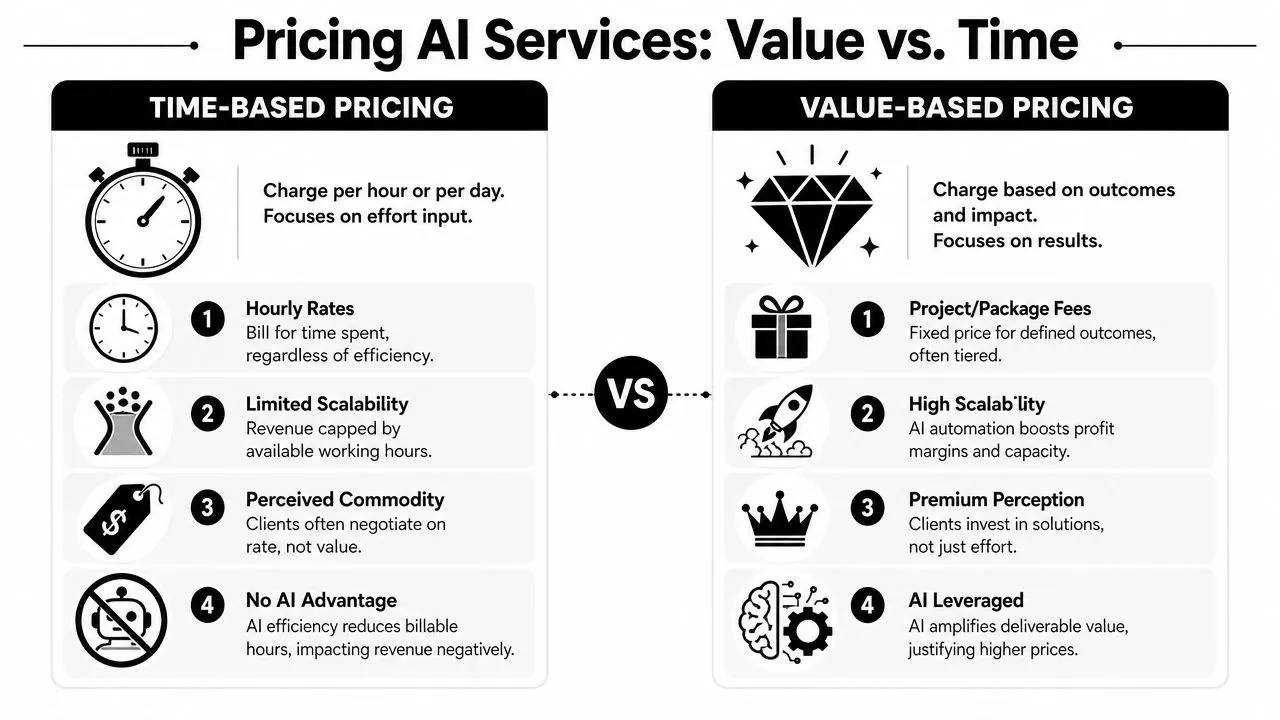
The biggest pricing mistake consultants make with AI is charging as if the old effort model still applies. If AI reduces drafting and research time, hourly billing turns your efficiency into a penalty. You get faster, and your invoice shrinks.
That model doesn't hold when the client is buying a result.
A more durable way to think about pricing comes from a hard truth about delivery risk. Research discussed by Iternal on AI consulting notes that more than 80% of AI projects fail, which is exactly why clear ROI thinking, disciplined scoping, data readiness, and governance matter so much. If failure risk is high, your pricing has to reflect business-case clarity, not just implementation effort.
A simple comparison helps frame the choice.
Hourly billing breaks fast
Hourly billing still works for ambiguous advisory support, narrow troubleshooting, or interim specialist help. It fails when AI allows you to compress delivery while increasing client value.
Three problems show up quickly:
-
Efficiency becomes harder to monetize
The better your system gets, the fewer hours you log. -
Clients compare rate cards, not outcomes
That pushes you toward procurement logic instead of strategic buying logic. -
You hide your real advantage
A good AI-enabled method is intellectual property. Hourly billing treats it like labor.
Later in the sales process, this short video is often a helpful framing device for clients who still think in old consulting economics:
Three packaging models that hold up
1. Fixed-fee diagnostic
This is the cleanest entry point. Sell an AI readiness assessment, workflow audit, use-case prioritization sprint, or prompt and process review. The deliverable is defined. The buyer gets clarity. You get a paid discovery phase instead of free consulting in the proposal process.
2. Pilot-to-retainer path
This is often the strongest structure for AI work because clients want proof before scale. Start with a single workflow, team, or deliverable. If it works, convert into an ongoing advisory retainer that covers optimization, governance, training, and iteration.
3. Subscription advisory
This works when the client needs a standing AI partner. Common inclusions are office hours, prompt library maintenance, workflow updates, vendor evaluation, internal training, and governance support.
Here's a simple packaging view:
| Package type | Best for | What you include |
|---|---|---|
| Diagnostic | New clients with unclear needs | Assessment, roadmap, priority use cases |
| Pilot | Clients testing one workflow | Build, validate, document, train |
| Retainer | Clients moving into broader adoption | Ongoing optimization, support, governance |
How to prove value without overpromising
Value-based pricing only works if you can explain value in plain business terms.
Start every offer with an ROI thesis, not a promise. That means defining:
- the current workflow problem
- the affected team
- the cost of friction
- the target improvement area
- the measurement approach
- the stop condition if results don't show up
That last point matters. Serious consultants are willing to say, “If this pilot doesn't change the agreed indicators, we shouldn't scale it.” That builds trust faster than inflated claims.
Commercial test: If your proposal can't explain what will be measured, who will own adoption, and when the client should stop, the price will feel arbitrary.
Also, package the human work explicitly. Clients aren't just buying prompts. They're buying problem framing, workflow redesign, review logic, training, governance, and decision support. Put those into the scope so the offer looks like a service, not a software demo.
Onboard Clients and Govern AI Projects
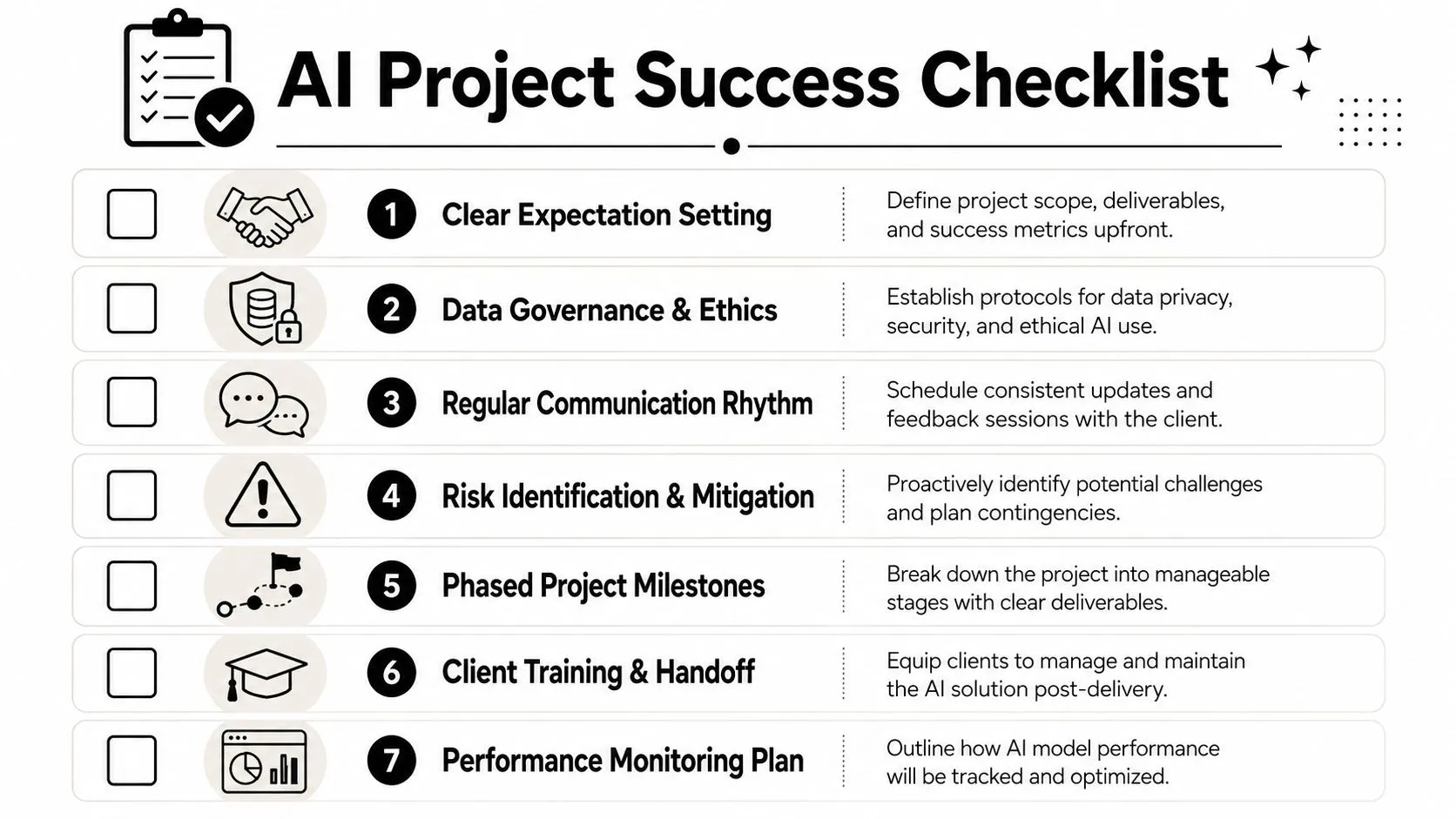
A lot of AI projects don't fail because the model is weak. They fail because the client kickoff was loose, expectations were sloppy, and no one defined what human review would look like.
Governance starts on day one. Not after the first error.
BCG-referenced evidence cited in independent industry coverage found that consultants using GenAI for data-science tasks improved accuracy by 13 to 49 percentage points, which is why a structured workflow of model-assisted analysis followed by human verification matters so much, as noted in this industry write-up on AI consultants for mid-sized companies. The lesson for consultants is straightforward: better output comes from controlled workflows, not blind trust in a model.
The kickoff conversation that prevents future friction
A strong onboarding call covers more than scope. It needs operating rules.
Use a checklist like this:
-
Success definition
Agree on what the pilot is supposed to improve and how that will be judged in business terms. -
Data boundaries
Clarify what information can be used, what must be masked, and what should stay out of external tools entirely. -
Human review points
Decide where AI output is draft-only and where a subject-matter expert must validate before anything reaches end users. -
Ownership
Name the buyer, project lead, daily user, and final approver. AI projects wobble when accountability is vague. -
Adoption plan
A workflow no one uses is not a successful implementation. Training and usage expectations should be part of onboarding, not an afterthought.
For teams that need a lightweight refresher on guardrails and operational habits, these AI best practices for real work are a useful complement to a formal kickoff checklist.
A governance model clients can trust
You don't need a giant governance committee for every project. You do need a clear review chain.
A practical model looks like this:
| Stage | AI role | Human role |
|---|---|---|
| Input | Organize and preprocess material | Approve data sources and boundaries |
| Draft | Generate summaries, patterns, first-pass analysis | Check logic and missing context |
| Review | Flag uncertainty or inconsistencies | Validate claims and adjust conclusions |
| Delivery | Format output for use | Approve final recommendation |
This approach solves two common client fears. One is that AI will introduce hidden errors. The other is that the project will become a black box no one can explain later.
Good governance is visible. A client should be able to see where the model helped, where people reviewed, and where final accountability sits.
That visibility also protects your reputation. If a project gets challenged, you can point to the workflow, the controls, and the approval chain. That's much stronger than saying the model “usually does a good job.”
Your Future as an AI-Centric Consultant
The consultants who do best over the next few years won't be the ones who use AI in the background. They'll be the ones who redesign their value proposition around it.
That doesn't mean becoming a full-time model specialist. It means operating differently. You choose a narrow problem, build a repeatable offer, create a delivery stack around it, package the work around outcomes, and run projects with visible governance. That combination is what makes AI for consultants commercially durable.
Most of the advantage comes from disciplined basics. Better intake. Better prompts. Better review gates. Better packaging. Better measurement. That sounds less exciting than talking about autonomous agents, but it's what clients ultimately buy.
What to do next
Pick one service you already know how to deliver without AI. Then rebuild it.
Maybe it's a research report, a team training offer, a workflow audit, a recruiting scorecard system, a knowledge-base redesign, or a competitive monitoring service. Don't launch five offers. Launch one. Name it. Scope it. Write the intake questions. Build the prompts. Define review gates. Decide how you'll measure whether it worked.
Then improve it with live client feedback.
Why this gets more interesting, not less
As AI tooling matures, consultants will have more room to design services that mix analysis, automation, and controlled execution. That includes work touching workflows that previously sat outside classic advisory boundaries. If you want a glimpse of where commercial models may evolve as software agents take on more operational tasks, Suby on agentic payments is worth reading because it highlights how business processes themselves are changing, not just the interfaces around them.
The key point is simple. The future consultant isn't just faster. They're more structured, more productized, and more accountable for measurable change. That's a better business than selling hours.
If you want hands-on help building these skills, AI Academy is a practical place to learn the tools, prompts, and workflows that working consultants use. It's built for professionals who want fast, applied lessons instead of bloated theory, so you can turn AI from a curiosity into a service capability.