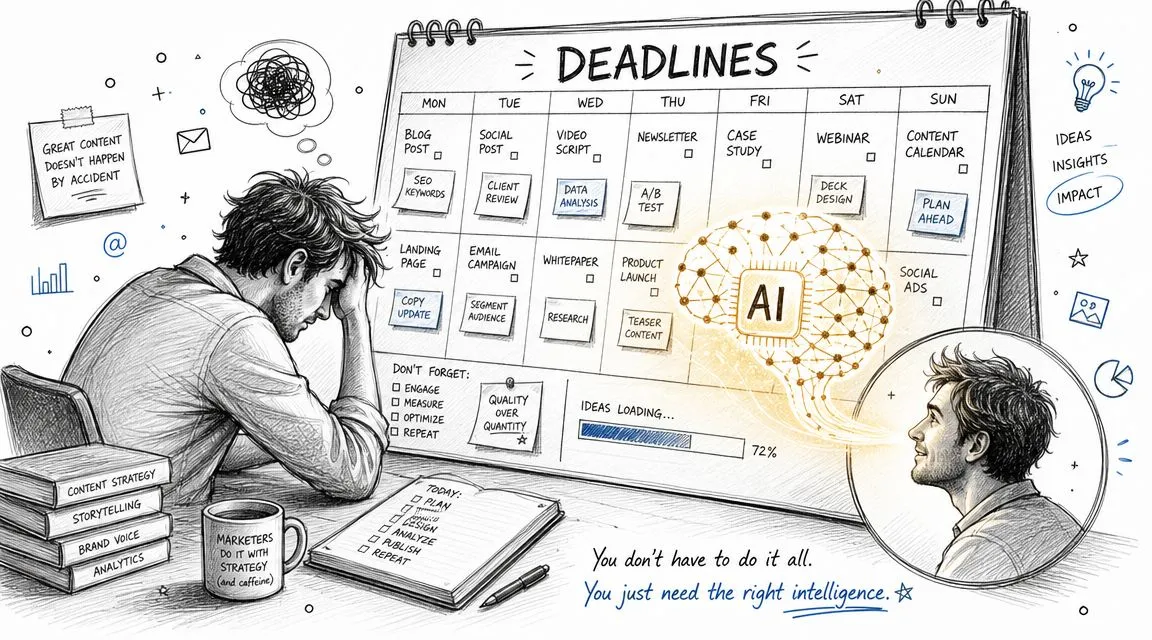
You're probably dealing with some version of the same problem most content teams face now. The calendar is full. The channels keep multiplying. One campaign needs paid social variants, another needs landing page copy, sales wants email rewrites, and someone still expects a blog post by Friday.
That's where AI for copywriting becomes useful. Not as a magic button, and not as a substitute for judgment, but as an operational system for getting more quality work out the door without grinding your team down. The teams getting real value from it aren't just asking a chatbot to “write me an ad.” They're building repeatable workflows for ideation, briefing, drafting, editing, testing, and review.
The New Reality of Content Creation
Content production used to bottleneck around drafting. Now it bottlenecks around coordination, revision, and speed of testing. Teams aren't short on ideas as much as they're short on time to turn those ideas into channel-specific copy that's usable.
That's why AI for copywriting moved so quickly from curiosity to standard operating tool. The category itself reflects that shift. The AI copywriting tool market was valued at approximately USD 1.5 billion in 2023 and is projected to reach USD 5.6 billion by 2032, according to Dataintelo's AI copywriting market report. That matters because software categories don't grow like that unless teams are using them to solve a real production problem.
The pressure changed before the tools did
A modern marketer rarely writes one piece of copy and ships it unchanged. You need versions for different audiences, intent stages, channels, and offers. Even small teams now manage a content load that used to require a larger bench of writers, editors, and channel specialists.
AI helps because it can remove the slowest part of the process. Starting from zero.
Practical rule: Use AI to reduce blank-page time, not to reduce editorial standards.
What this means for working marketers
The skill isn't “using AI.” The skill is directing AI inside a real workflow. Teams that do this well know when to use it for first-pass ideation, when to force structure into the prompt, when to rewrite by hand, and when to test multiple variants instead of debating copy in a meeting.
That shift also changes what good copywriters do day to day. Less time gets spent producing rough draft volume. More time goes to message clarity, offer positioning, factual accuracy, audience nuance, and final polish.
How AI Copywriting Actually Works
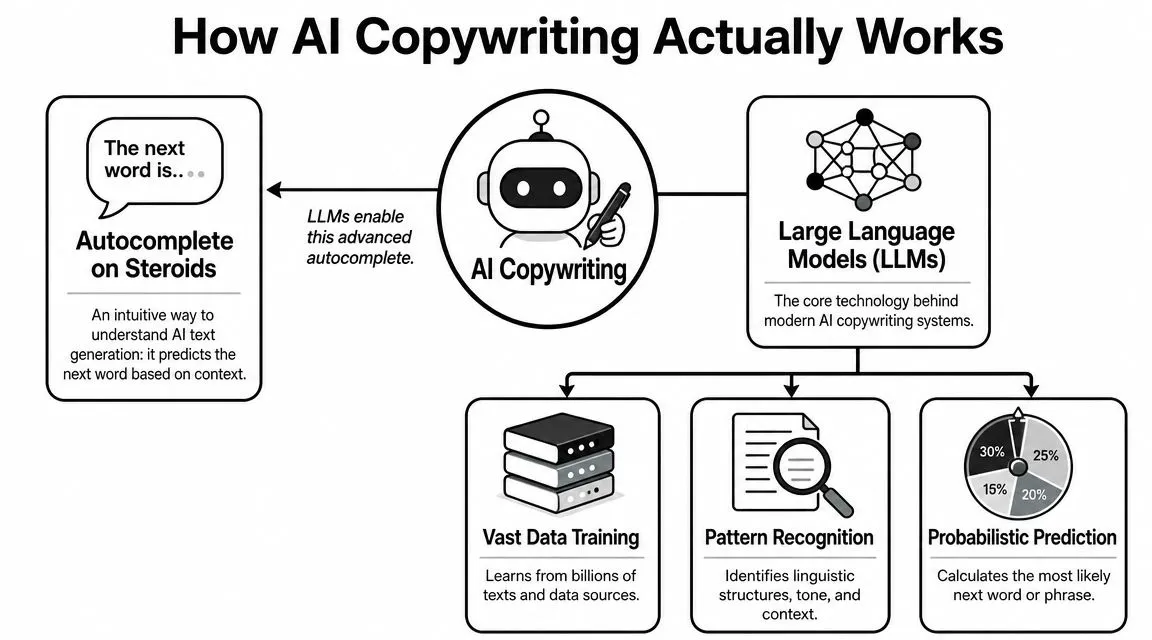
The easiest mental model is this: AI copywriting is autocomplete on steroids. You give the model a prompt, and it predicts what text should come next based on patterns it has learned from large amounts of language.
That's why it can sound fluent so quickly. It's not “thinking” like a strategist in your team meeting. It's generating likely language based on context, sequence, and probability.
What modern tools do differently
Older writing tools mostly worked as assistants. They corrected grammar, flagged awkward phrasing, or suggested cleaner sentences. Useful, but narrow.
Modern generative systems do something broader. They can produce headline options, reshape tone, expand bullet points into body copy, compress long text into email snippets, and generate multiple creative directions from a short brief. That's the leap. They don't just improve existing text. They generate new text from instructions.
Why prompts matter so much
The model only knows what you tell it and what it can infer. If you give it a thin request like “write a landing page,” it fills in the missing detail with generic assumptions. If you supply audience, objections, offer details, tone rules, proof points, exclusions, and format constraints, the copy gets sharper.
According to SiteW's overview of AI for copywriting, AI systems perform best when given dense, structured context, including product details, brand voice, audience, and constraints. That matches what practitioners see every day. Vague prompts produce average copy. Detailed prompts produce workable drafts.
AI is usually strongest when the job is clear and the context is rich.
What the model is good at, and what it misses
It's good at:
- Patterned formats like ads, email variations, headlines, outlines, and summaries
- Rapid expansion from notes into readable draft copy
- Variation generation when you need multiple angles fast
It often misses:
- Factual certainty
- Subtle brand judgment
- Original insight tied to actual customer reality
That's why smart teams treat AI as a text generation engine, not an authority. It can produce language. It can't take ownership of accuracy, positioning, or consequences.
The Real Benefits and Practical Limitations
The strongest case for AI for copywriting isn't philosophical. It's operational. Teams use it because it improves speed and lowers production cost when the workflow is designed well.
Dataforest's review of AI tools for copywriters reports that AI tools can cut content creation costs by 30% to 50% for many firms. The same source notes that 51% of marketing teams already use AI to optimize content, making optimization the leading use case.
Where the gains actually show up
The biggest win usually isn't one perfect draft. It's the ability to create more usable options in less time.
That helps in common situations like:
- Channel adaptation: Turn one campaign message into ad, email, social, and landing page variants
- Revision speed: Rework copy for a different tone or segment without rewriting from scratch
- Content operations: Move from idea to testable draft faster when launch timelines are tight
For a working team, that changes output planning. Instead of protecting writer time for every first draft, you can reserve human effort for the tasks that matter most: strategy, differentiation, review, and final decision-making.
Where teams get burned
The failure points are consistent.
First, hallucinations. AI can state something cleanly and confidently without it being true. That's dangerous in product marketing, regulated industries, comparison pages, and any copy tied to claims.
Second, brand flattening. If the prompt is generic, the output usually is too. The copy may be grammatically fine but still sound like it could belong to any competitor.
Third, hidden editing load. Teams sometimes assume AI saves time automatically. It doesn't if the output needs major repair because the brief was weak.
The fastest workflow is rarely “generate and publish.” It's “brief well, generate fast, edit hard.”
Set expectations correctly
AI works best when you assign it the right role. It's strong at speed, coverage, and variation. It's weak at accountability.
If you expect it to replace strategic writing judgment, you'll be disappointed. If you use it to compress the path from brief to testable draft, it becomes one of the most useful production tools in the stack.
A Practical Workflow for AI-Assisted Copy
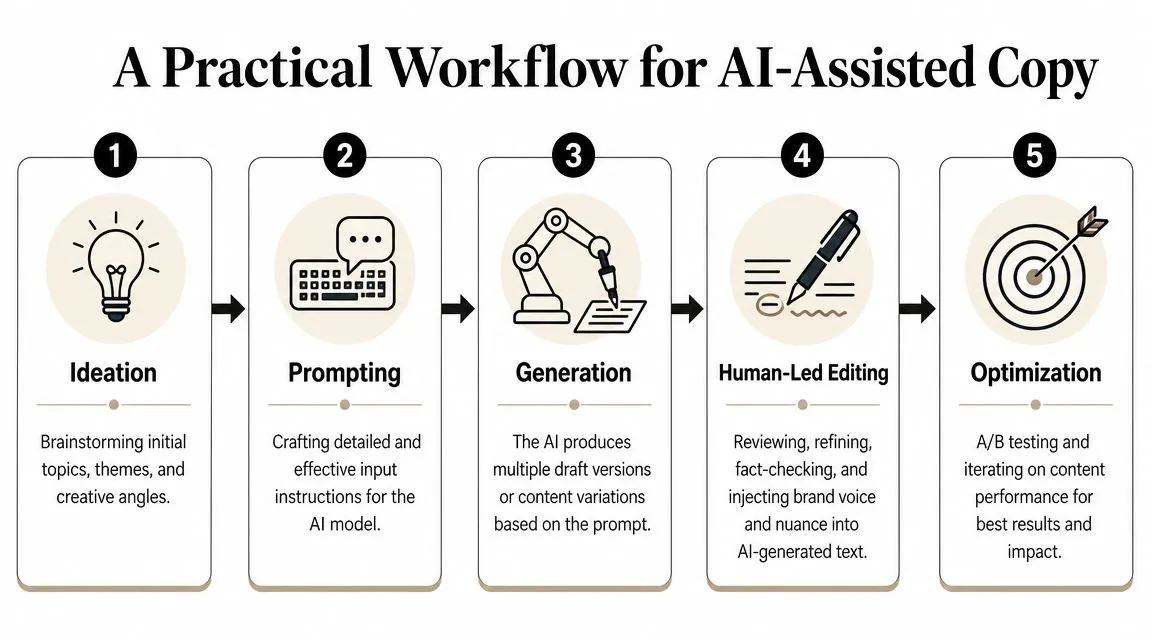
The teams that get steady value from AI don't treat it like a vending machine. They use a workflow. Mine has five stages: ideation, prompting, generation, human-led editing, and optimization.
Stage 1 and 2 start before drafting
Ideation is where AI earns its keep early. Ask for multiple campaign angles, objections, hooks, framing options, and headline territories before you ask for full copy. This avoids locking onto the first decent idea.
Then comes prompting. Many teams rush at this stage, creating their own editing burden. A useful prompt includes the audience, offer, product facts, desired action, voice rules, prohibited phrases, formatting instructions, and examples of what good sounds like.
Try a prompt skeleton like this:
- Role: “Act as a senior B2B SaaS copywriter.”
- Task: “Write five homepage hero options.”
- Context: “Audience is operations leaders at mid-sized logistics firms. Product reduces manual reporting workload.”
- Format: “Each option needs a headline, subhead, and CTA.”
- Constraints: “Avoid hype, avoid unverifiable claims, keep the tone direct.”
This kind of structure is much closer to how a creative lead briefs a writer. That's the point.
A good walkthrough of building a specialized assistant for content teams appears in this Grok 4 content writing assistant course, especially if you want a non-technical setup your team can reuse.
Stage 3 through 5 turn drafts into assets
After the prompt is solid, move into generation. Ask for several distinct versions, not one polished answer. For strategic copy, AI is most effective as a high-volume ideation and variant-generation engine, while human fact-checking and post-editing remain essential, as discussed in this expert video on AI copy workflows.
Embed this only after your team understands the process:
Then comes human-led editing. This process ensures the draft becomes brand-safe and market-aware. Good editors don't just fix grammar. They remove soft claims, sharpen the promise, align the language with actual customer pain, and verify every factual statement.
My editing checklist usually includes:
- Claim review: Remove or verify anything that sounds quantified, comparative, or absolute
- Voice alignment: Replace generic phrasing with language the brand would use
- Offer clarity: Make sure the reader understands what's being sold and why it matters
- Friction removal: Cut filler, redundancy, and awkward transitions
Finally, optimization. Don't treat the first approved draft as the winner. Put variants into market where possible and compare actual response. Good teams use AI to increase the number of informed tests they can run, not to avoid testing altogether.
Prompts That Generate Great First Drafts
The difference between weak and strong AI copy usually starts in the prompt. Most bad outputs come from bad instructions, not from a bad model.
When people say AI writes generic copy, they're often feeding it generic inputs. If you want strong first drafts, you need to brief the model the way you'd brief a sharp freelancer on a deadline.
Use a simple prompt structure
I like a five-part framework because teams can remember it and reuse it.
Role
Tell the model who it is supposed to be in that moment.
Examples:
- Senior ecommerce copywriter
- Demand gen manager writing LinkedIn ads
- Lifecycle marketer rewriting onboarding emails
Task
State the deliverable clearly. One prompt should usually ask for one job.
Examples:
- Write six subject lines
- Draft a landing page hero section
- Rewrite this product description for busy buyers
Context
This is the part often underwritten. Include product details, audience, objections, awareness level, use case, and what differentiates the offer.
Format
Specify the output structure so you don't waste time reshaping it later.
Examples:
- Table format
- Bullet list
- Headline plus subhead plus CTA
- Three versions ranked from safest to boldest
Constraints
At this point, quality jumps. Tell the model what to avoid and what to preserve.
Examples:
- Don't use jargon
- Don't mention features the customer can't see
- Keep the reading level plain
- Use a confident but not flashy tone
For a practical library of reusable ideas, this copywriting prompt collection for marketers is a useful shortcut when your team wants starting points instead of writing every prompt from scratch.
More context usually beats more cleverness.
Copy-Paste Prompt Templates for Marketers
| Copywriting Task | Prompt Template |
|---|---|
| Social ad variations | “Act as a paid social copywriter for a [industry] brand. Write 10 ad variations for [product/offer]. Audience: [audience]. Their main pain points are [pain points]. Brand voice: [voice traits]. Goal: [clicks/leads/sales]. Constraints: avoid [phrases/claims]. Format each version with primary text, headline, and CTA.” |
| Email subject lines | “Act as an email marketer. Generate 20 subject line options for an email promoting [offer]. Audience: [audience]. Tone: [tone]. The email's main promise is [promise]. Avoid spammy wording and exaggerated claims. Group the subject lines into curiosity-driven, benefit-driven, and direct categories.” |
| Landing page hero copy | “Act as a conversion copywriter. Write 5 hero section options for a landing page selling [product]. Audience: [audience]. They currently struggle with [problem]. Product helps by [solution]. Include a headline, subheadline, and CTA for each option. Keep the tone [tone] and avoid generic startup language.” |
| Product description rewrite | “Rewrite this product description for [audience] who care most about [priority]. Use a [tone] voice. Keep the copy clear, concrete, and skimmable. Do not invent features. Format with a short intro, 3 bullet benefits, and a closing CTA.” |
| LinkedIn post draft | “Act as a B2B content marketer. Draft 3 LinkedIn post options about [topic]. Audience: [job title or industry]. Goal: [engagement/leads/authority]. Include a strong opening line, useful insight, and a soft CTA. Avoid cliches and corporate filler.” |
| Sales email opener | “Write 8 opening paragraphs for a cold email to [audience]. Offer: [offer]. Problem addressed: [problem]. Tone should feel direct and respectful, not aggressive. Do not use fake personalization. Keep each opener under a short paragraph.” |
A final rule matters more than any template. Never ask for “the final version” too early. Ask for options, then choose a direction, then refine.
Measuring Success and Navigating Ethical Issues
A lot of teams measure AI output the wrong way. They count drafts, words, or turnaround time and call that success. Those are workflow metrics, not business outcomes.
The better question is simpler. Did AI-assisted copy help the team produce stronger marketing results through faster testing and better iteration? Effective teams test AI-generated copy in the wild and rely on real-life feedback because the business value comes from experimentation cycles, not from assuming the first draft is right, as discussed in this expert discussion on testing AI copy in live environments.
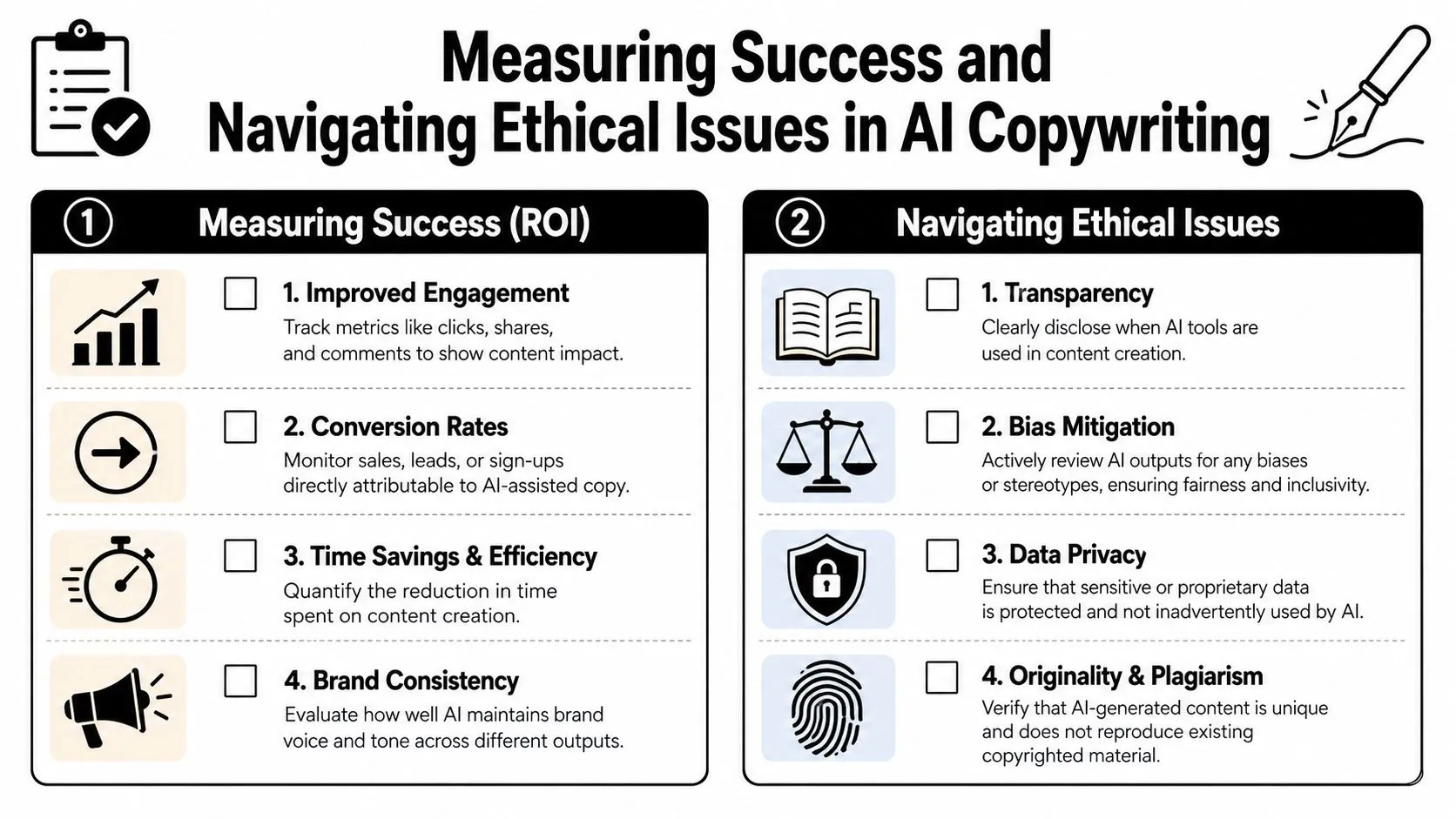
What to measure instead of output volume
Useful teams look at performance by asset type and workflow stage.
A practical scorecard includes:
- Engagement signals: Did people click, reply, read, or share more?
- Conversion behavior: Did the copy increase demo requests, sign-ups, purchases, or qualified leads?
- Revision burden: Did editors spend less time fixing weak drafts?
- Brand consistency: Did the final outputs sound like the company, or did they need heavy rewriting?
This keeps the focus where it belongs. Copy exists to move readers, not to prove that a tool was used.
An editorial ethics checklist
The ethics side matters because AI can introduce problems unnoticed. Good teams don't wait for a public mistake to create a review process.
Use a simple pre-publication checklist:
- Accuracy: Verify claims, names, product details, and comparisons
- Bias review: Check whether the wording leans on stereotypes or excludes part of the audience
- Originality: Make sure the copy doesn't feel derivative or too close to familiar language in the category
- Data hygiene: Don't paste sensitive customer or company information into tools without approved policy
- Transparency: Decide internally when AI use should be disclosed and who owns that decision
If a human wouldn't sign their name to the copy after review, it isn't ready.
The strongest ethical posture is practical. Keep a human accountable for every published asset.
Choosing Tools and Adopting AI on Your Team
Tool selection gets too much attention. Adoption discipline matters more. A strong tool in a vague process creates messy output faster.
What to look for in a tool
Choose based on the team's actual workflow, not on feature sprawl.
Priority criteria usually include:
- Prompt reuse: Can the team save and standardize good prompts?
- Collaboration: Can writers, editors, and managers review outputs without copy-paste chaos?
- Voice control: Can you preserve brand guidance, examples, and tone preferences?
- Workflow fit: Does it support the channels your team produces most often?
- Ease of use: Non-technical marketers should be able to work with it without extra setup
If your team wants help building reusable style systems, this brand twin course for writing in your style with Claude is relevant for creating more consistent outputs.
How to roll it out without chaos
Start small. Pick one content type, one team, and one approval path.
Then formalize a few basics:
- Create approved prompt templates: Don't make every writer reinvent the process
- Define editing ownership: Someone must be responsible for accuracy and voice
- Document bad outputs: Keep examples of what failed and why
- Review performance regularly: Keep the best prompts and retire weak ones
The healthiest adoption model treats AI like any other production system. Train people. Set standards. Review results. Improve the process.
AI tools are moving fast, but most professionals don't need more hype. They need practical training that shows what to do on Monday morning. AI Academy is built for that. It helps non-technical teams learn real workflows for writing, research, automation, prompting, and day-to-day execution with focused lessons that are easy to apply at work.