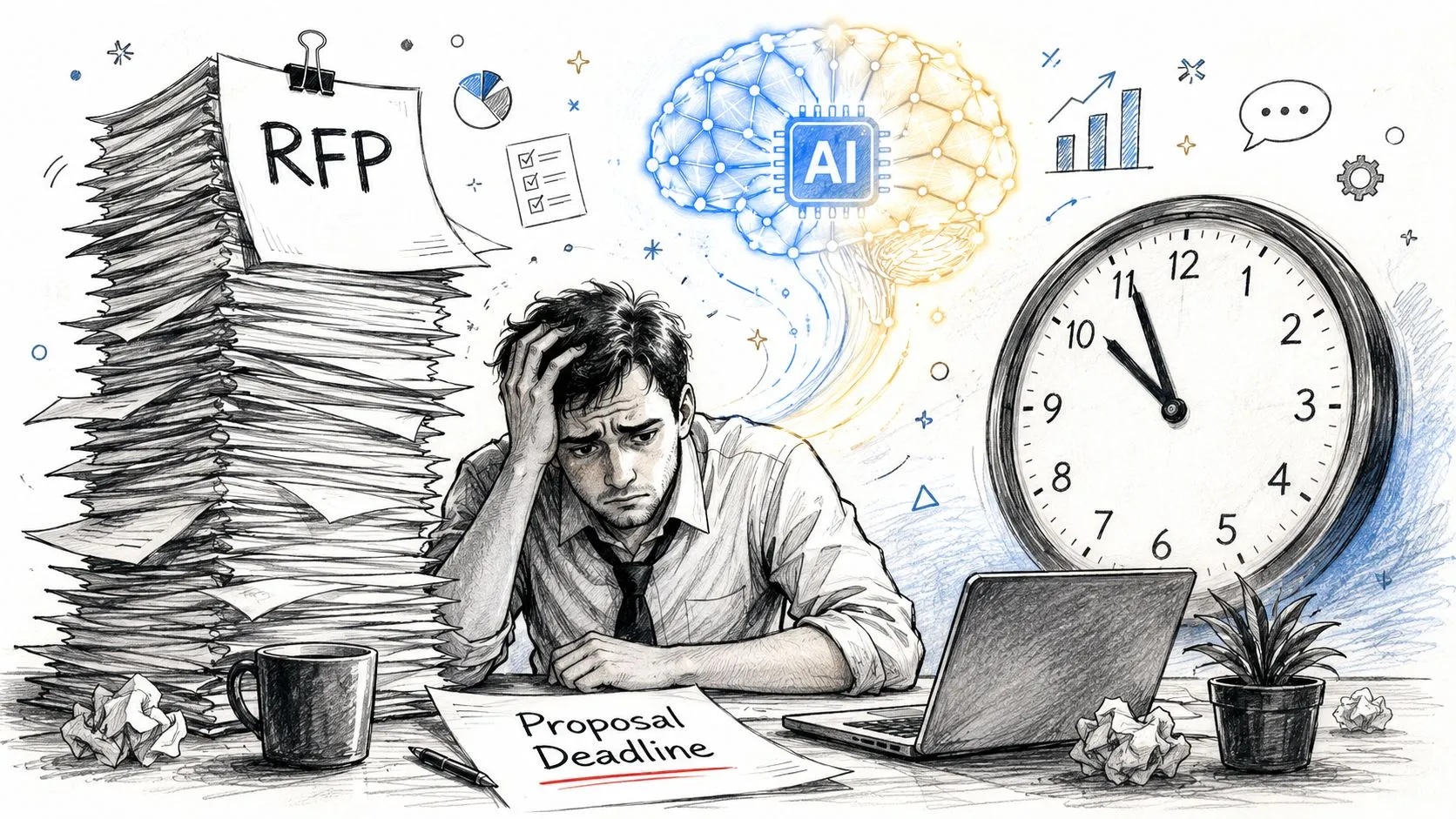
The deadline is tight, the RFP is messy, and your best subject matter expert is already late on inputs. Meanwhile, the sales lead wants a polished first draft by tomorrow morning. That's the moment many organizations start looking at AI for proposal writing. Not because it's trendy, but because the old process breaks when volume rises and turnaround shrinks.
Used well, AI can give proposal teams breathing room. Used badly, it creates a different problem: faster drafts filled with weak positioning, stale proof points, inconsistent numbers, and language nobody is willing to sign off on. The hard part isn't getting words on the page. The hard part is building a system that produces drafts your team can trust.
That's where most advice falls short. Speed matters, but governance matters more. If you want AI for proposal writing to improve real outcomes, you need a reliable knowledge base, better prompts, clear review ownership, and an approval workflow that catches risk before it reaches the client.
Beyond the Blank Page How AI Changes the Game
Proposal teams usually adopt AI at the point of pain. A complex bid lands. The content library is chaotic. Three people start rewriting the same boilerplate in parallel. Someone pastes from an old response deck. Someone else hunts for the latest executive bio. Hours go by, and the team still hasn't framed the story.
That's why AI has moved into proposal work so quickly. It handles the ugly early-stage tasks that consume time but don't create much strategic advantage when done manually. In a 2024 survey summarized by Loopio, respondents reported using AI to summarize information like executive bios (61%), write a faster first draft (44%), and edit RFP responses (43%).
Those numbers match what I see in practice. The first wins rarely come from full automation. They come from speeding up summary work, extracting requirements, assembling first-pass content, and cleaning rough language before core proposal thinking begins.
Practical rule: If your team is still using AI only as a blank-page writer, you're underusing it. Its best early role is reducing retrieval and synthesis work.
Teams working across grants and bids can borrow a lot from adjacent workflows. If your work includes public funding applications, these AI grant proposal writing strategies are useful because they force the same discipline around evidence, reviewer expectations, and structured drafting. For teams that want to improve the writing side more broadly, this guide on AI for copywriting is also relevant because proposal writing often fails for the same reason copy does: vague inputs produce generic output.
Why adoption matters
The strategic risk isn't that AI writes perfect proposals. It doesn't. The risk is that competing teams use it to free up more time for pricing strategy, solution shaping, and executive review while your team is still buried in manual assembly work.
That shift changes capacity. When AI handles repetitive setup work, proposal managers can spend more time on pursuit strategy, evaluator concerns, and message hierarchy. That's where wins are decided.
Building Your AI Proposal Engine Foundation
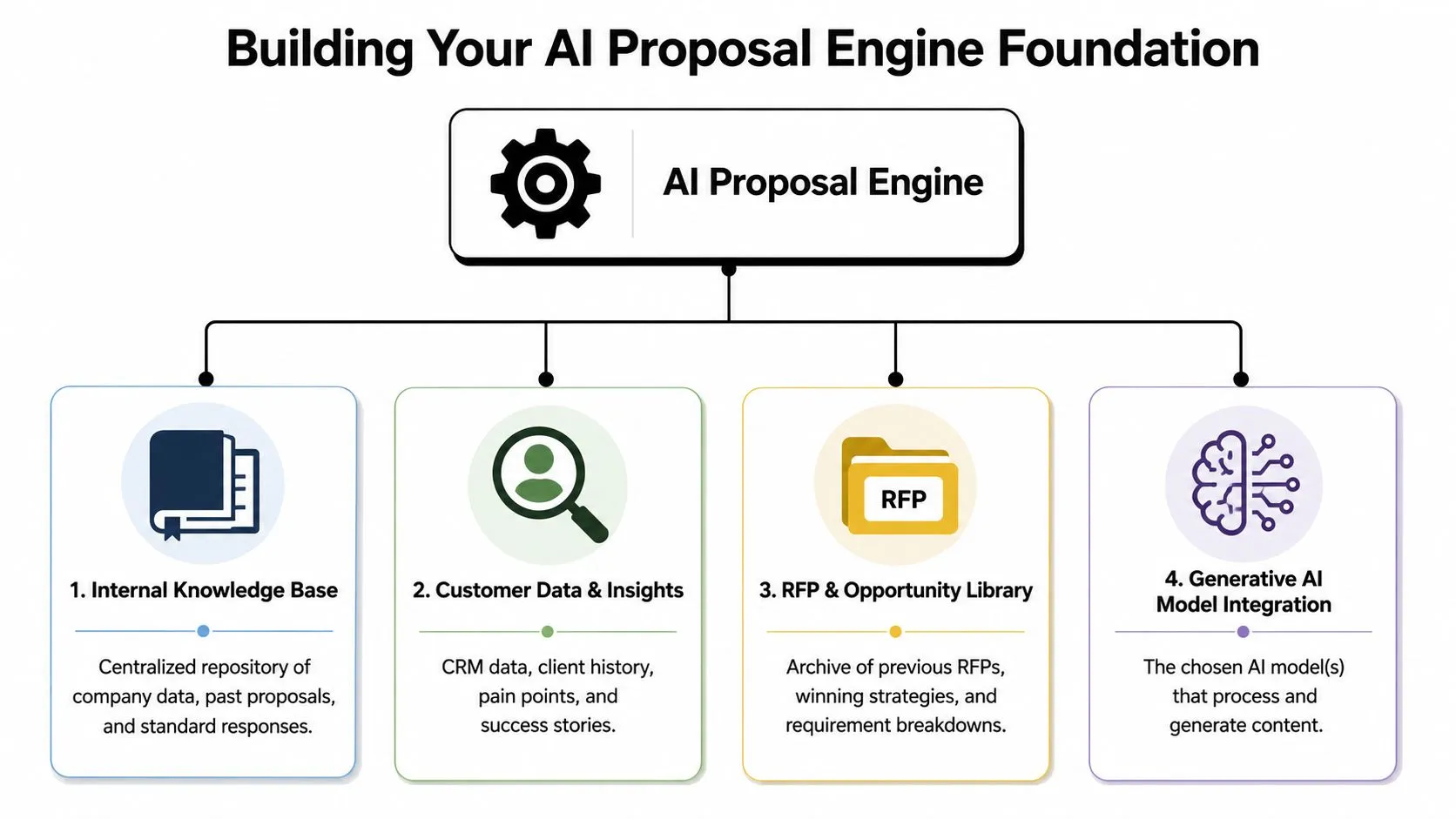
Most AI proposal failures start before the first prompt. The issue isn't the model. It's the source material. If your library is full of outdated resumes, conflicting capability statements, dead case studies, and pricing from three versions ago, the draft will look polished and still be wrong.
A workable system starts with a centralized knowledge base. DataGrid's guidance on proposal automation recommends building from past wins, approved content, and case studies, then tagging that content by industry and client type so retrieval-augmented generation can assemble client-specific drafts from structured sources instead of guessing from free-form prompts in its workflow overview.
Start with one source of truth
If content lives in SharePoint, personal drives, inbox attachments, slide decks, and old proposal folders, your AI tool won't solve the problem. It will amplify the mess.
Your source of truth should hold only content your team is willing to reuse. That means removing near-duplicates, archiving obsolete material, and marking what is approved versus what is just legacy text.
A strong repository usually includes:
- Past winning proposals: Not every proposal you've ever submitted. Keep the ones that reflect your current positioning and strongest structure.
- Approved content blocks: Service descriptions, implementation methods, onboarding language, security responses, and standard differentiators.
- Proof materials: Case studies, client outcomes, team bios, certifications, and objection responses.
- Commercial content: Standard pricing language, assumptions, rate card references, and approved contract language where appropriate.
Tag content so AI can retrieve, not guess
Often, teams stop too early by uploading files, adding a chatbot, and then expecting relevance. Retrieval only works when the content is tagged in a way that matches how proposals are won.
Use tags that mirror actual proposal decisions. Industry. Proposal type. Buyer segment. Geography if relevant. Capability area. Approval status. Date updated. Product line. Delivery model. If a response is valid only for one market or one service bundle, tag it that way.
A proposal library should behave like a controlled system, not a dumping ground with search.
This principle also matters outside proposal teams. Resources on scaling your AI workforce are useful here because they focus on creating a shared company brain instead of isolated AI use by individuals. Proposal teams feel the pain of fragmented knowledge faster than most departments, so they benefit early from that discipline.
What belongs in the foundation
The easiest way to assess your setup is to ask one question: can the AI retrieve an approved answer with context, or does it have to invent one?
Here's a practical benchmark table:
| Content type | Keep it | Don't keep it |
|---|---|---|
| Executive bios | Current, approved versions tied to roles | Old bios copied from prior submissions |
| Case studies | Named, structured, approved proof points | Anecdotal stories nobody validated |
| Pricing text | Current standard language and assumptions | Old pricing pages with unclear status |
| Compliance answers | Reviewed responses to common requirements | One-off answers from unusual bids |
| Proposal sections | Reusable methodology and delivery language | Generic filler with no win history |
The teams that get the most from AI for proposal writing aren't the teams with the fanciest model. They're the ones that did the boring work first. Clean content beats clever prompting every time.
From Requirements to First Draft with Prompts
Once the foundation is solid, prompting becomes much simpler. Good prompts don't rescue weak source material. They direct a strong system.
The mistake I see most often is one giant request: “Write a winning proposal response to this RFP.” That almost always produces generic structure, missed requirements, and polished language with thin substance.
Break the RFP before you write anything
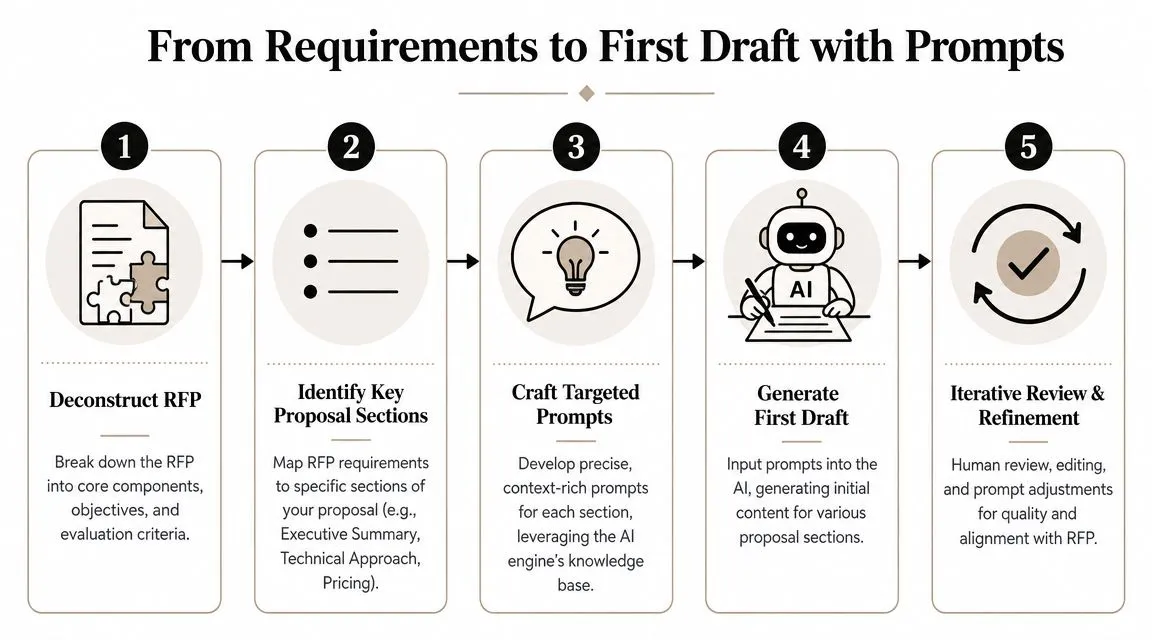
A better workflow starts with decomposition. Treat the RFP like a set of jobs, not a single document.
First, extract and separate:
- Submission requirements such as format, page limits, deadlines, attachments, and mandatory forms.
- Evaluation criteria so the team knows what the buyer is likely scoring.
- Scope requirements covering deliverables, milestones, staffing, and technical expectations.
- Compliance language including certifications, legal terms, security requirements, and declarations.
- Open questions where the RFP is ambiguous or your source material is missing.
That breakdown gives you the map for your prompts. If you want a better feel for prompt structure, Supagen for AI mastery has useful guidance on making instructions specific enough to produce stable output.
A practical prompt library for bid work also helps. This collection of ChatGPT prompts for RFPs is a useful starting point because it reflects the actual sections teams need to build, not just generic writing tasks.
Prompt patterns that actually help
The most effective prompts for proposal work contain five ingredients:
- Role: Tell the model who it is acting as, such as proposal manager, solution writer, compliance reviewer, or editor.
- Context: Include the buyer, opportunity, industry, and the exact section being drafted.
- Source boundaries: Tell it what materials it may use and what it must not invent.
- Output format: Specify bullets, table, draft section, summary, or compliance matrix.
- Success criteria: Define what good looks like for that output.
Here are prompt patterns that work.
Executive summary prompt
“Act as a senior proposal strategist. Using only the approved company content and the extracted RFP priorities, draft an executive summary for [client type/industry]. Focus on the client's likely business problem, our differentiators, implementation confidence, and measurable value stated qualitatively unless approved proof exists. Do not invent client pain points, results, or credentials. Structure the response in three short sections with clear headings.”
Technical approach prompt
“Act as a solution architect writing for evaluators. Draft the technical approach section using only the approved capability statements, implementation methodology, and scope requirements provided. Mirror the client's terminology where appropriate. Include assumptions that require validation instead of filling gaps with speculation. End with a short list of dependencies and client responsibilities.”
Compliance matrix prompt
“Review the solicitation requirements below and produce a table with four columns: requirement, source section, draft response status, and reviewer flag. Mark any requirement as ‘missing source' if the internal library does not contain approved language.”
Use staged drafting, not one giant prompt
Speed improves without sacrificing control. Draft section by section. Then ask the AI to evaluate the draft against the requirement list. Then ask it to tighten language. Then ask it to identify unsupported claims.
That sequence matters because generation and review are different tasks.
Here's a simple workflow comparison:
| Approach | What happens | Typical result |
|---|---|---|
| Single mega-prompt | One request for the whole proposal | Fast, broad, uneven |
| Section-by-section prompts | One task per proposal section | Better structure and traceability |
| Draft plus review prompts | Draft, then requirement check, then edit | Stronger compliance and cleaner revision |
This walkthrough can help if your team wants a visual explanation of the flow:
Ask the model to admit uncertainty. Proposal teams get into trouble when prompts reward confidence instead of evidence.
One more practical point. Don't ask AI to “make it persuasive” too early. First get a fact-bound draft. Then improve narrative strength. When teams reverse that order, they often get smooth language attached to weak proof.
Refining and Personalizing Your AI Generated Draft
The first draft is where AI saves time. The final draft is where proposals still get won.
That distinction matters because fast drafting can create false confidence. In a six-month comparison reported by Bidara, AI-assisted proposals were drafted 32x faster than human-only ones, but the AI-assisted workflow posted a 23% win rate versus 27% for human-written proposals. That's a 4 percentage-point gap. The speed is real. The persuasion gap is real too.
Speed wins attention, not deals
A first draft solves a production problem. It doesn't solve a buying problem.
Evaluators don't choose vendors because a response is tidy. They choose vendors because the proposal shows understanding, reduces perceived risk, aligns to priorities, and makes the buyer comfortable with the team behind the words. AI can imitate that shape, but it usually can't infer the deeper commercial logic without human judgment.
That's why I treat AI draft quality as a time-saving asset, not a decision-making asset. If the team saves hours on assembly, those hours should go straight into refinement.
Where human reviewers add the most value
Human review works best when it targets the parts of the proposal that move the decision.
Focus on these:
- Client specificity: Replace generic industry language with actual buyer context, terminology, and likely concerns.
- Value proposition: Tighten the link between your offer and the buyer's goals. Don't just describe services. Explain why this approach fits this client.
- Differentiation: Remove bland claims like “experienced team” unless you can support them and make them matter.
- Narrative flow: Make sure the proposal reads like one argument, not a stack of AI-produced sections.
- Executive voice: Add judgment, confidence, and restraint where needed. AI often overstates or overexplains.
A review pass should also remove what I call “credible nonsense.” That's language that sounds professional but doesn't help an evaluator make a decision.
For example, AI loves phrases like “customized, scalable, end-to-end solution.” Those words aren't wrong. They're just empty unless tied to the buyer's specific environment, constraints, and priorities.
The fastest draft in the room still loses if it sounds interchangeable.
One effective editing pattern is to assign reviewers by function, not by chapter. Let one person check buyer alignment, another check proof and examples, and another tighten tone and readability. That avoids the common trap where three people line-edit the same section while nobody strengthens the actual argument.
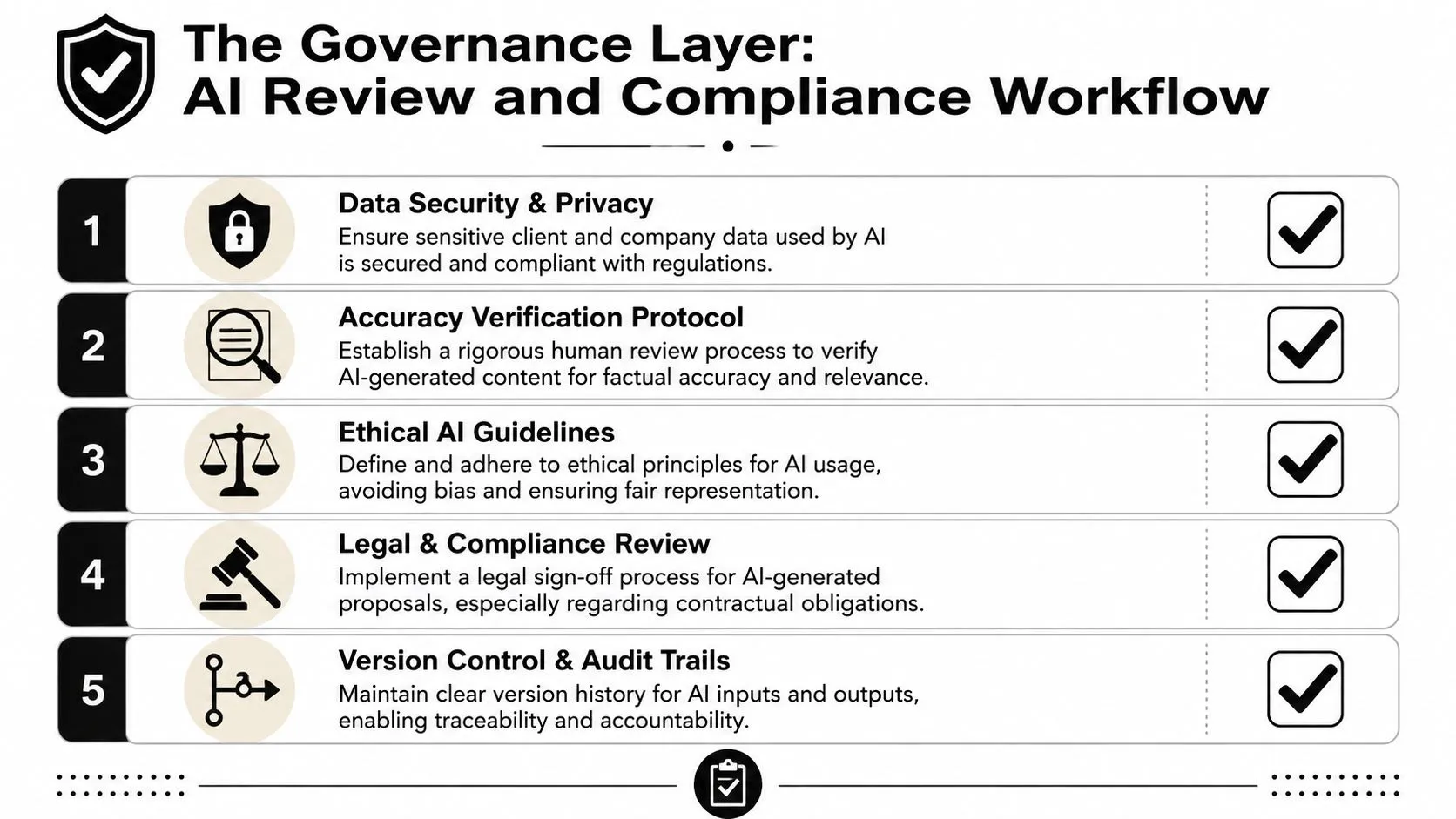
The Governance Layer Your AI Review and Compliance Workflow
Most content about AI for proposal writing stops at drafting. That's the easy part. The risk sits in what happens after the draft appears.
Unanet's discussion of AI in bids highlights a major gap in current advice: teams need practical workflows for human review, source validation, and compliance checks so AI-generated text stays auditable and safe for regulated bids in its governance-focused article. That's exactly the issue serious teams have to solve.
Build review into the process, not after it
Governance fails when it's treated as a final polish step. It needs to sit inside the workflow from the moment content is retrieved.
A practical review chain looks like this:
-
Source check before drafting
Confirm which library content is approved, current, and in-scope for this bid. -
Section owner review after generation
The person responsible for that section verifies claims, terminology, and relevance. -
Compliance review before consolidation Someone checks that requirements were answered, not just paraphrased.
-
Commercial and legal review before submission
Pricing language, assumptions, terms, and commitments get reviewed by the right owners. -
Final approval with audit trail
Keep a record of prompts, source documents, key edits, and approvals.
That process may sound heavy, but it usually saves time because it catches problems early. It's also where AI fact-checking discipline matters. Teams trying to tighten this layer should study practical workflows for AI fact-checking, especially when proposal language pulls from large internal libraries.
A practical governance checklist
Use this checklist on every AI-assisted proposal:
- Claim validation: Every credential, case study reference, capability statement, and timeline claim should map back to an approved source.
- Pricing accuracy: Verify rates, assumptions, optional items, and commercial terms against current approved documents.
- Version control: Confirm the team is editing the latest draft and the latest source files.
- Compliance fit: Check mandatory requirements, forms, page rules, and buyer terminology.
- Data handling: Make sure sensitive client information and internal material are handled within approved systems.
- Approval ownership: Name who signs off on legal, commercial, technical, and executive content.
What auditable teams do differently
The strongest teams don't just ask whether the text reads well. They ask whether each important sentence can be traced.
Here's the difference:
| Weak workflow | Strong workflow |
|---|---|
| AI drafts from mixed historical files | AI drafts from approved, tagged sources |
| Reviewers polish wording | Reviewers validate claims and commitments |
| Compliance check happens at the end | Compliance check starts during content assembly |
| No record of source text | Source and approval path are documented |
Governance sounds restrictive until you've had to retract a claim, correct pricing, or explain where a number came from. Then it becomes the part of the process everyone wishes had been stronger.
Automating the System and Avoiding Common Pitfalls
Once the core workflow works manually, then automate more of it. Not before.
Modern proposal platforms increasingly use a hybrid model. Xait explains that discriminative AI identifies relevant information from internal content libraries, while generative AI produces the draft. It also notes that this approach can cut turnaround times by up to 80% compared with traditional manual processes in its explanation of proposal AI software. That architecture matters because it reflects what is effective. Retrieval first. Generation second.
Automation works best when retrieval comes first
This is the right mental model for scaling AI for proposal writing. You're not trying to automate judgment. You're trying to automate content discovery, first-pass assembly, structure, and routine editing so humans can spend more time on strategy.
That means your system should gradually automate:
- Requirement extraction
- Content retrieval from approved libraries
- Section-level first drafts
- Compliance matrices
- Revision support and consistency checks
- Post-submission learning from feedback and outcomes
The last point gets neglected. Teams should feed win and loss insights back into templates, prompts, and approved content. If buyers keep asking the same question, your system should get better at answering it.
The mistakes that keep repeating
The common failures are predictable.
- Overtrusting the first draft: It looks complete, so the team stops pushing for stronger positioning.
- Neglecting the knowledge base: The system starts well, then drifts because nobody maintains source quality.
- Using generic prompts: Broad prompts produce broad proposals.
- Skipping review ownership: Everyone assumes someone else checked the risky parts.
- Automating too early: Teams add workflow complexity before they've defined a repeatable manual process.
Good automation doesn't remove humans from proposal writing. It removes low-value friction and makes expert review more focused.
If you want to build these skills without sitting through bloated theory-heavy courses, AI Academy is a practical option. It's built for working professionals who need fast, usable training on tools like ChatGPT, Claude, Perplexity, Midjourney, and dozens more. The lessons are short, current, and focused on real workflows, so you can apply what you learn to proposals, research, reporting, and daily team operations right away.