A metaphor is a figure of speech that directly compares two unlike things without using “like” or “as,” stating one thing is another to create stronger meaning and clarity. In today's workplace, that skill matters more because 71% of organizations now regularly use generative AI in at least one business function, which raises the value of plain-language explanations that help non-technical teams understand complex ideas quickly.
You've probably felt the problem already. You need to explain a new campaign strategy to sales, a reporting workflow to leadership, or an AI tool to a team that doesn't speak technical jargon. The facts may be right, but the explanation doesn't land.
That's where metaphor helps. It turns an abstract idea into something people can picture, feel, and remember. Instead of saying “our data process has multiple dependencies,” you say “our data pipeline has a bottleneck.” Instead of saying “the launch needs coordination,” you say “this project is an orchestra, and every section has to come in on time.”
Used well, metaphors aren't decorative. They're practical tools for teaching, persuading, presenting, and prompting AI. If you want a solid grasp of metaphor definition and examples, the most useful way to learn isn't through poetry first. It's through real communication problems at work.
What Is a Metaphor and Why It Matters at Work
A product manager is trying to explain a messy rollout plan. A marketer needs a sharper way to position a new offer. A team lead wants better output from ChatGPT but keeps getting vague, generic text. In each case, the problem is similar. The idea is hard to see.
A metaphor helps by giving the idea a shape.
At its simplest, a metaphor says one thing is another thing, even though they are not identical. “Our inbox is a battlefield.” “This launch is a relay race.” “Her feedback was a spotlight.” Those phrases pull meaning from a familiar image and apply it to a more abstract situation.
That is why metaphors show up far beyond literature classes. They are practical tools for explanation. Instead of listing every detail, you give people a model they can grasp quickly. The image does some of the explanatory work for you.
At work, that changes how people understand your message. A manager can frame a strategy as a roadmap. A marketer can describe a brand as a bridge between a customer problem and a desired outcome. A data team can explain an AI system as a junior analyst with speed but no judgment unless guided well.
Metaphors help people see structure, not just hear words.
This is especially useful when your audience needs to act, not just listen. Clear metaphors can shorten meetings, sharpen presentations, and make cross-functional conversations easier. They also improve prompting. If you tell a generative AI tool to “write like a careful editor” or “structure this memo as a decision tree,” you are using metaphor-like framing to reduce ambiguity and guide output. For more examples of that kind of framing, see these ChatGPT prompts for business writing.
Why professionals rely on them
You use metaphors whenever you need to make a fuzzy idea concrete, such as:
- Simplifying complexity: “Our CRM is the single source of truth” gives people a clearer mental model than a long systems description.
- Aligning a team: “We need one playbook, not five side projects” creates direction people can remember.
- Guiding AI output: “Write this onboarding email as a concierge, not a policy manual” sets tone and role fast.
- Persuading stakeholders: People often remember the image after they forget the slide title.
The broader point is simple. Work increasingly depends on translating between specialists and non-specialists, humans and AI tools, strategy and execution. Metaphors help you do that translation with less friction and more clarity.
How Metaphors Create Meaning
A good metaphor feels quick, but there's structure underneath it. Once you understand that structure, metaphor definition and examples become much easier to use and analyze.
The basic structure
Traditional metaphor analysis often uses two terms: tenor and vehicle. The tenor is the thing being described. The vehicle is the image used to describe it.
If someone says, “I'm drowning in work,” the tenor is the workload. The vehicle is drowning. The metaphor transfers the urgency, pressure, and helplessness of drowning onto the experience of too much work.
A third idea also helps. Many teachers call it the ground, meaning the shared quality between the tenor and the vehicle. In this case, the ground is being overwhelmed.
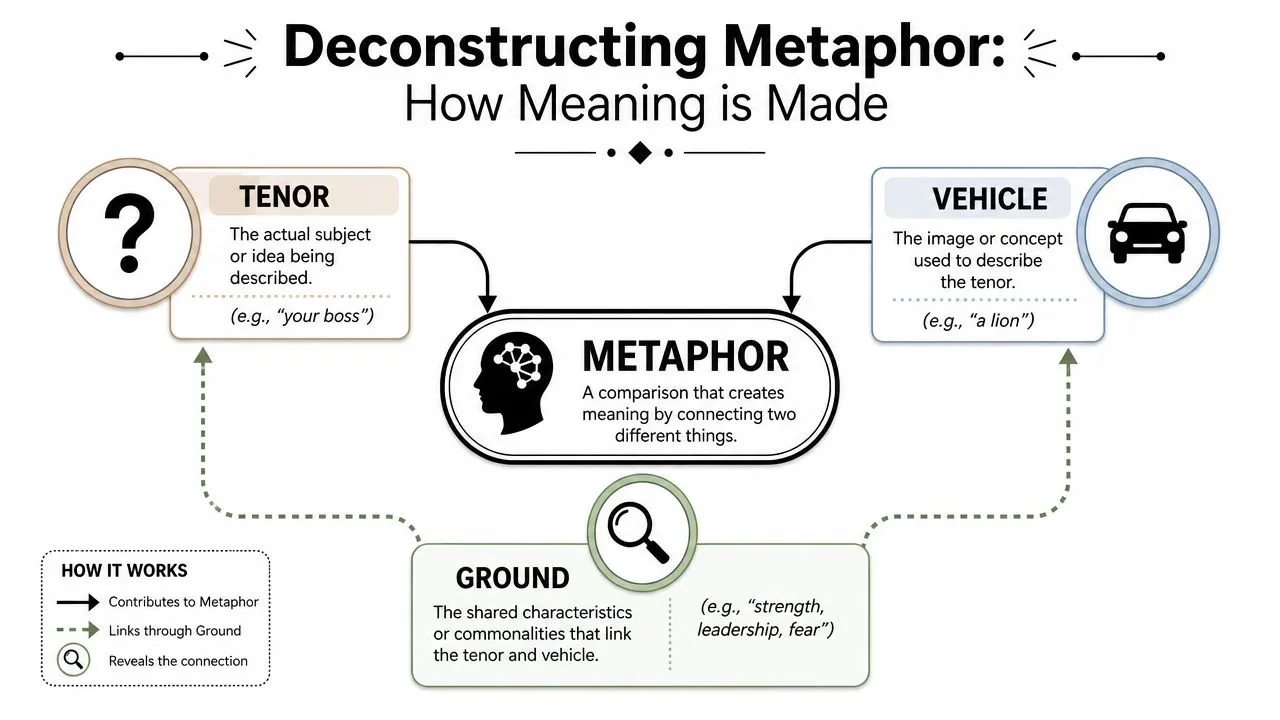
Here's the same pattern in a few workplace examples:
| Expression | Tenor | Vehicle | Shared idea |
|---|---|---|---|
| “This project is a marathon” | The project | A marathon | Long effort, pacing, endurance |
| “Our brand voice is a compass” | Brand voice | A compass | Direction, guidance, consistency |
| “The inbox is a firehose” | Incoming messages | A firehose | Volume, force, hard to control |
Why the brain likes metaphor
Metaphor works because people understand new things by connecting them to known things. Educational research describes metaphor as a target-to-source transformation model that helps novices understand unfamiliar concepts by transferring meaning from a familiar domain to an unfamiliar one (Frontiers in Education article on metaphor in learning).
You can think of it this way:
- Target domain: the idea you want to explain
- Source domain: the familiar thing you borrow from
If you say “time is money,” time is the target and money is the source. That single phrase imports a whole set of assumptions. Time can be spent, wasted, saved, invested, or budgeted. The metaphor doesn't just decorate the sentence. It organizes how people think about time.
Practical rule: The stronger the source image, the faster the audience understands the target idea.
This is why metaphors show up in teaching, onboarding, product explanations, and strategy decks. They compress complexity. They also create consistency. If your team keeps using the same source domain, such as navigation, sports, or building, people start to share a mental model.
A weak metaphor, by contrast, gives the listener extra work. If the image is too obscure, too dramatic, or only meaningful to one department, people stop decoding the message and start decoding the wording.
Metaphor Simile and Analogy Explained
A manager says, “Our product launch is a rocket.” A colleague replies, “It's more like a marathon.” Then someone in the meeting explains the full comparison, step by step, to show why pacing matters more than speed. All three are using comparison, but they are not using the same tool.
That difference matters because each one guides the audience in a different way. In business writing, the wrong choice can make a message feel too dramatic, too soft, or too long. In AI prompting, the choice affects how much structure the model receives.
The fastest way to tell them apart
A metaphor states one thing is another.
A simile says one thing is like another.
An analogy builds a longer comparison to explain a system, process, or relationship.
Here is the simple test:
- If the sentence uses like or as, it is usually a simile.
- If it states identity directly, it is usually a metaphor.
- If it maps several shared features to teach how something works, it is an analogy.
This is less about grammar than about function. A metaphor creates a fast mental picture. A simile keeps a little distance. An analogy slows down and teaches.
Comparison table
| Type | Definition | Example |
|---|---|---|
| Metaphor | A direct comparison that states one thing is another | “Our onboarding process is a maze.” |
| Simile | A comparison that uses “like” or “as” | “Our onboarding process is like a maze.” |
| Analogy | A longer comparison used to explain how something works | “Our onboarding process works like a maze. New hires face turns, dead ends, and signs, so we need clearer markers at each stage.” |
Now compare how the same idea changes by form:
- Metaphor: “Her calendar is a battlefield.”
- Simile: “Her calendar is like a battlefield.”
- Analogy: “Her calendar works like a battlefield because every meeting competes for territory, attention, and timing.”
The metaphor has the most punch. The simile sounds more cautious. The analogy does the most teaching.
Readers who confuse these terms usually understand the sentence but miss its job. That is the key distinction. A metaphor is built for compression. A simile is built for comparison without full commitment. An analogy is built for explanation.
This becomes practical fast at work. A brand strategist might choose metaphor for a headline because it sticks. A people manager might choose analogy to explain a new workflow. A prompt writer might use analogy to give an AI model a clearer pattern to follow, especially in tasks like presentation writing. For example, you can ask the model to “structure this pitch like a three-act story with rising stakes and a clear resolution,” which gives more guidance than a short metaphor alone. This is the same principle behind strong ChatGPT prompts for presentations.
Careful distinction also helps with interpretation. In poems, speeches, and brand language, changing a metaphor into a simile can soften the force of the original. Stretching a metaphor into an analogy can add clarity, but it can also flatten tone. For a useful example of how to preserve meaning while rewording figurative language, this guide to ethical poem paraphrasing is a good resource because it shows how comparison and tone can shift when language gets flattened.
Powerful Metaphor Examples in Action
Examples make the concept stick. The best way to learn metaphor definition and examples is to see how the same device works in casual speech, marketing, and business language.
Everyday speech
Everyday conversation is full of metaphors, even when people don't notice them.
Take these familiar examples:
- “I'm drowning in work.” Workload becomes water. The feeling transferred is overload.
- “That comment was a dagger.” A remark becomes a weapon. The meaning is emotional sharpness.
- “Her smile was sunshine.” A smile becomes sunlight. The meaning is warmth and uplift.
- “He's a rock.” A person becomes stone. The meaning is steadiness or reliability.
These work because the source image is easy to picture. Nobody stops to ask whether the person is actual stone or the comment is actual metal. The brain jumps to the shared trait.
Marketing and branding
Marketers use metaphors because metaphors help a message travel. A strong metaphor gives shape to a promise.
A slogan such as “Red Bull gives you wings” isn't literal. It transfers the idea of lift, energy, and performance. “The world is a stage” is older and broader, but it does the same thing. It turns social life into performance and roles.
Here's how marketing teams often use metaphor well:
- To position a product: “Your financial co-pilot” suggests assistance, judgment, and guidance.
- To frame a customer problem: “Content bottleneck” makes a workflow issue visible.
- To express transformation: “Turn your spreadsheet into a command center” upgrades the user's mental picture of the tool.
If you present campaign ideas often, these ChatGPT prompts for presentations can help you turn rough concepts into sharper messaging. Metaphor is one of the easiest ways to make presentation language less flat.
Business and technology
Professional language depends on metaphor more than is commonly acknowledged.
Consider these common terms:
| Phrase | What it helps explain |
|---|---|
| Data pipeline | Information moving through stages |
| Information silo | Teams or systems cut off from one another |
| Bottleneck | A point where flow slows down |
| Flywheel | A system that gains momentum through repeated input |
| Bridge the gap | Connection across a missing link |
None of these are literal. But each gives people a mental model.
When a manager says, “We have a bottleneck in approvals,” people don't need a technical diagram first. They understand restricted flow. When an operations lead says, “Sales and support are working in silos,” people understand separation and poor visibility.
A useful habit is to ask two questions whenever you hear a metaphor at work:
- What is the actual subject?
- What qualities are being imported from the image?
That habit makes you a better reader and a better speaker.
A metaphor earns its place when it reduces explanation instead of adding another layer to explain.
Crafting Effective Metaphors for Professional Use
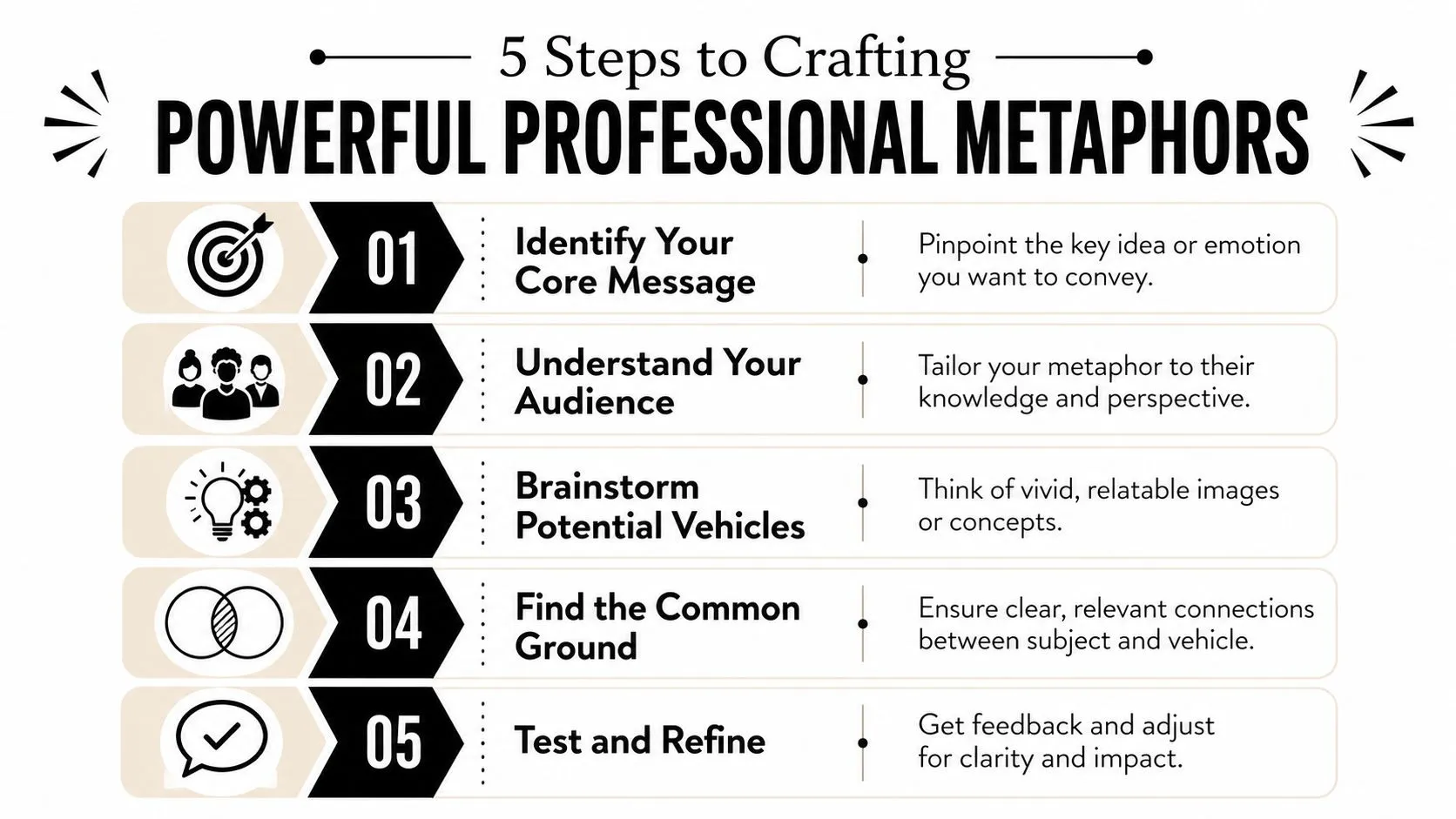
A useful metaphor isn't random. It's chosen. When professionals struggle with metaphors, the problem usually isn't creativity. It's fit.
What makes a metaphor work
Start with the point, not the image. Ask yourself what you need the audience to understand.
If you want people to see complexity, you might choose a maze. If you want them to feel steady progress, you might choose a staircase. If you want them to understand coordination, you might choose an orchestra.
A strong professional metaphor usually does five things:
- It fits the audience. Finance may respond to portfolio language. Product teams may respond to roadmap or system language.
- It highlights one core trait. Too many imported meanings make the message muddy.
- It uses a familiar source domain. People shouldn't need a specialist hobby to decode your sentence.
- It matches the tone. “This spreadsheet is a monster” may work in conversation but not in a board memo.
- It can stretch a little without breaking. If you need one follow-up line, the metaphor should still make sense.
For example, if you're explaining a customer journey to new hires, “Our funnel is a guided path” may be more useful than “Our funnel is a battlefield.” One creates clarity. The other creates drama.
What to avoid
Mixed metaphors are a common failure point. Conceptual-metaphor theory notes that metaphors break down when their source domains conflict logically (Merriam-Webster's entry on metaphor and conceptual mapping). If you say, “Let's plant the seed and hit the ground running so this ship can take off,” you've stacked farming, racing, sailing, and flying into one sentence. The listener has nowhere stable to stand.
Watch for these problems:
- Mixed imagery: Don't switch source domains mid-thought.
- Clichés: If the metaphor feels dead, the message often feels lazy.
- Overdramatization: Not every missed deadline is a five-alarm fire.
- Private metaphors: If only your team understands the image, the message won't travel.
If you create video scripts or campaign assets, this article on how to improve your brand video content is useful because cliché language weakens metaphor fast.
A lot of weak business writing comes from stale metaphors. “Game changer,” “silver bullet,” and “move the needle” may still function, but they rarely make anyone see something new.
Here's a simple fix. Before you keep a metaphor, test it with two questions:
- Can a new hire understand it immediately?
- Can I extend it for one more sentence without confusion?
If the answer is no, replace it.
A broader resource on sharpening AI-assisted writing can help here too. This guide to AI for copywriting is relevant because metaphor quality often determines whether AI-generated copy sounds generic or sharp.
A short video can also help you hear the rhythm of figurative language in practice:
Using metaphors to steer AI
The topic becomes particularly practical. AI models respond to framing. If you prompt them with a metaphor, you give them a mental model for tone, structure, and emphasis.
Compare these prompts:
- “Explain our pricing model.”
- “Explain our pricing model as a gym membership system.”
- “Explain our pricing model as a restaurant menu with tiers, add-ons, and premium service.”
The second and third prompts are far more usable because they provide a source domain. That helps the model choose vocabulary, organize the explanation, and stay accessible.
Try templates like these:
- For onboarding: “Explain our workflow as if it were an airport, where each team handles a different stage of passenger movement.”
- For strategy: “Describe our market position as a chessboard. Identify our strongest pieces, vulnerable squares, and likely next moves.”
- For operations: “Turn this process into a kitchen metaphor. Show the ingredients, steps, tools, and where delays happen.”
- For customer education: “Explain this software feature as a personal assistant handling repetitive tasks.”
- For executive summaries: “Frame this project as building a bridge between two departments. Explain the supports, risks, and load points.”
When you use this approach, keep the source domain consistent. If the model starts in a kitchen, keep it in the kitchen. That consistency helps both humans and AI produce cleaner explanations.
Start Using Metaphors to Communicate Clearly
Metaphors aren't fluff. They're one of the fastest ways to make an idea understandable, memorable, and usable.
At work, that can mean the difference between a report people skim and a report they act on. It can mean the difference between an AI prompt that returns generic text and one that returns an explanation your team can use.
The good news is that metaphor is a skill, not a talent badge. You can practice it. You can test it. You can get better at it quickly if you focus on familiar source images and clear shared meaning.
The best metaphor doesn't sound clever first. It makes the idea easier to carry.
Metaphor practice prompts
Use these exercises with your own work this week:
- Describe your team's mission: Write one metaphor using travel, one using construction, and one using sport. Then choose the clearest.
- Explain a messy process: Turn your approval flow into a physical image such as traffic, plumbing, or a kitchen.
- Rewrite a flat sentence: Replace “We need better collaboration” with a metaphor that shows what's wrong now.
- Train an AI model more clearly: Prompt a tool to explain your product “as a teacher,” then “as a mechanic,” then “as a tour guide.” Compare the outputs.
- Audit your clichés: Review your last presentation and replace tired metaphors with fresher ones that your audience will immediately understand.
If your team wants to practice this together, structured communication exercises help. This resource on how to boost productivity through communication training is a practical place to start because metaphor works best inside broader habits of clear speaking and writing.
Keep one standard for yourself. If a metaphor helps people understand faster, keep it. If it only makes the sentence sound fancy, cut it.
If you want hands-on help using metaphors in prompts, presentations, and everyday business writing, AI Academy offers practical lessons for working professionals who want faster, clearer results with ChatGPT, Claude, Midjourney, Perplexity, and other AI tools.