You're probably in one of two seats right now. Either you've inherited an oil and gas project and everyone around you speaks in acronyms, gate reviews, and contractor jargon. Or you're a capable manager from another industry who's been told to “bring structure” to a project where the technical details feel like a foreign language.
That's more common than people admit.
Oil and gas project management looks intimidating because the engineering is specialized, the projects involve significant risks, and the number of parties involved can be absurd. But a non-technical leader doesn't need to design a well, size a separator, or approve a drilling program line by line. Your real job is to control decisions, timing, cost visibility, stakeholder alignment, and risk escalation before small issues become expensive ones.
The useful way to think about it is this. You're not there to be the smartest engineer in the room. You're there to make sure the room produces clear decisions, uses current information, and doesn't drift into avoidable delay, rework, or governance confusion.
The broader market tells you why this discipline matters. The Project Management in Oil & Gas Market is valued at $21.4 billion in 2024 and is projected to reach $35 billion by 2035, with a 4.5% CAGR from 2025 to 2035, according to WiseGuy Reports on the oil and gas project management market. That growth reflects a simple truth: these projects are too capital-intensive and too operationally exposed to run on loose coordination.
The Oil and Gas Project Lifecycle Explained
A remote city built in stages
The easiest way to understand oil and gas project management is to stop thinking of it as “one project.” It's closer to building a small industrial city in a remote, hostile place, then running it safely for years, then shutting it down without leaving a mess behind.
That journey usually moves through five core phases: Identify & Assess, Select & Define, Execute, Operate, and Decommission. A project can't be managed well if people on the team are using the same words for different moments in the lifecycle. If one person says “we're almost there” and another thinks that means “ready for operations,” while the project team means “ready for detailed engineering,” trouble starts immediately.
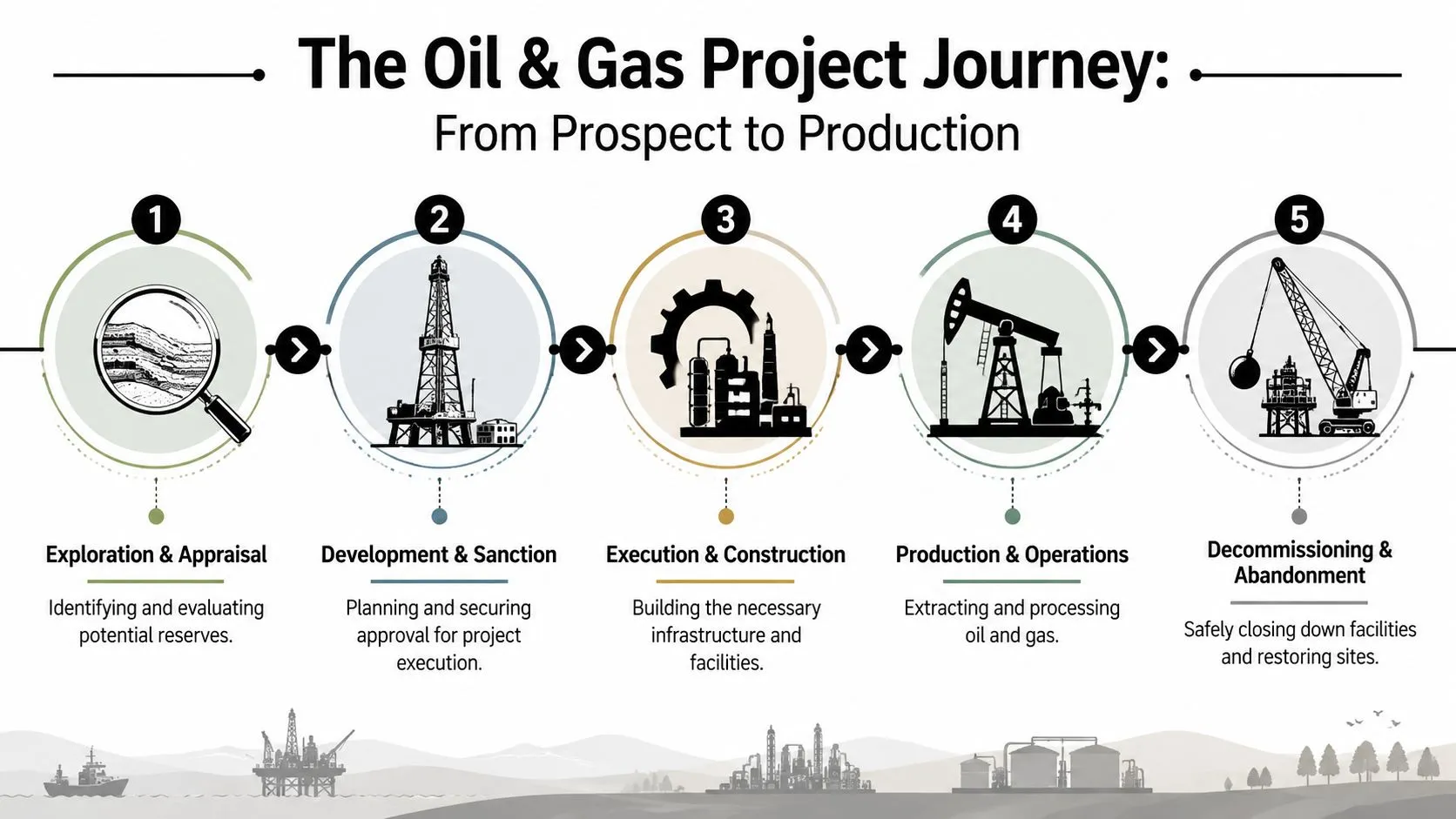
Here's the practical map.
| Phase | What's happening | What management should ask |
|---|---|---|
| Identify & Assess | Teams evaluate whether a resource or opportunity is worth pursuing. | Is this opportunity real enough to justify more spending? |
| Select & Define | The project scope, concept, commercial frame, and execution basis get shaped. | Do we actually know what we're building, why, and under what constraints? |
| Execute | Engineering, procurement, construction, installation, and commissioning move into action. | Are work packages, contractors, interfaces, and decisions staying aligned? |
| Operate | The asset produces, processes, or transports product under operating controls. | Is performance stable, safe, and supportable? |
| Decommission | Facilities are shut down, dismantled, secured, and the site is restored as required. | Are closure obligations planned with the same discipline as startup? |
The Select & Define phase is where non-technical managers often underestimate their influence. This stage is like creating the full architectural blueprint and funding logic before pouring a single slab. If the scope is fuzzy here, execution becomes a series of expensive arguments.
Practical rule: If a team can't explain the current phase in plain language, it probably can't govern it well.
What a non-technical manager should watch
During Identify & Assess, don't chase every promising idea. Push for clarity on the decision criteria. A weak opportunity with strong enthusiasm still becomes a weak project.
In Select & Define, you're watching for three things: scope discipline, decision ownership, and interface clarity. That includes who approves changes, who owns contractor boundaries, and what assumptions are still open. This is also where adjacent disciplines matter. If you want a grounded example of cross-functional coordination in heavy industry, this guide to managing industrial electrical projects is useful because it shows how execution complexity often hides in interfaces, not in the headline scope.
During Execute, the project turns from theory into invoices, field constraints, and sequencing pressure. Coordination failures then become visible. Procurement delays, drawing revisions, permit dependencies, access restrictions, and contractor handoffs all start hitting each other.
For Operate, many managers mentally declare victory too early. They shouldn't. Startup is where design assumptions meet reality. A facility that is mechanically complete but operationally unstable is not a success.
Then comes Decommission, which too many teams treat like a distant administrative issue. It isn't. Closure planning affects permitting, cost assumptions, stakeholder expectations, and environmental accountability long before the final years of asset life.
Navigating Project Governance and Stakeholders
Who actually holds the pen
A lot of confusion in oil and gas project management comes from people assuming the org chart tells the full story. It doesn't. Formal reporting lines matter, but project authority usually sits in a web of operator decisions, contractor obligations, commercial controls, regulatory approvals, and community expectations.
It resembles a chain of command where different people hold different keys.
The operator usually owns the project outcome and carries the main decision burden. Engineering contractors translate concept into design packages. Procurement teams control what can be bought, when, and from whom. Construction contractors turn approved scope into physical progress. Government bodies and regulators control whether work can proceed legally. Local communities may not sign contracts, but they can affect access, reputation, and continuity in very real ways.
A non-technical manager has to know not just who attends the meeting, but who can stop the work, who can release funds, who can change scope, and who can create delay by withholding information.
How stage gates protect the project
The most useful governance tool in this industry is the stage-gate process. Leading firms use formal checkpoints where each project phase must satisfy defined technical and financial criteria before moving forward, according to Bain's analysis of large project management in oil and gas.
That matters because oil and gas projects have a bad habit of drifting into the next phase on momentum alone. A gate stops that drift. It asks, in effect, “Do we have the key to open the next level, or are we just hoping the door opens?”
A practical gate review should test:
- Decision readiness: Is there enough evidence to approve the next phase?
- Scope maturity: Are major assumptions still open, or is the work basis stable?
- Commercial realism: Have cost and schedule implications been challenged hard enough?
- Risk visibility: Are major exposures named, owned, and tied to action?
- Execution capacity: Do the people, suppliers, and systems exist to support the plan?
A gate is not a calendar event. It's a quality filter.
When gates are weak, teams carry unresolved issues forward. That usually shows up later as rework, over-engineering, or disputes over what was “understood” but never approved.
For non-technical managers, the discipline is simple. Don't ask whether the team is “on track.” Ask whether the decision basis is complete enough to justify release into the next phase.
One more practical point. Governance gets faster, not slower, when decision rights are clear. Ambiguity feels flexible in the moment, but it creates serial delays. If your reporting and decision process still relies on static slide decks and fragmented updates, it's worth studying modern AI best practices for managers to tighten how information flows into approvals.
Mastering Schedule and Cost Control Techniques
A project can look healthy right up to the moment it misses a key delivery date, burns through contingency, and forces leadership into reactive decisions. In oil and gas, that usually starts much earlier. The root problem is weak control structure.
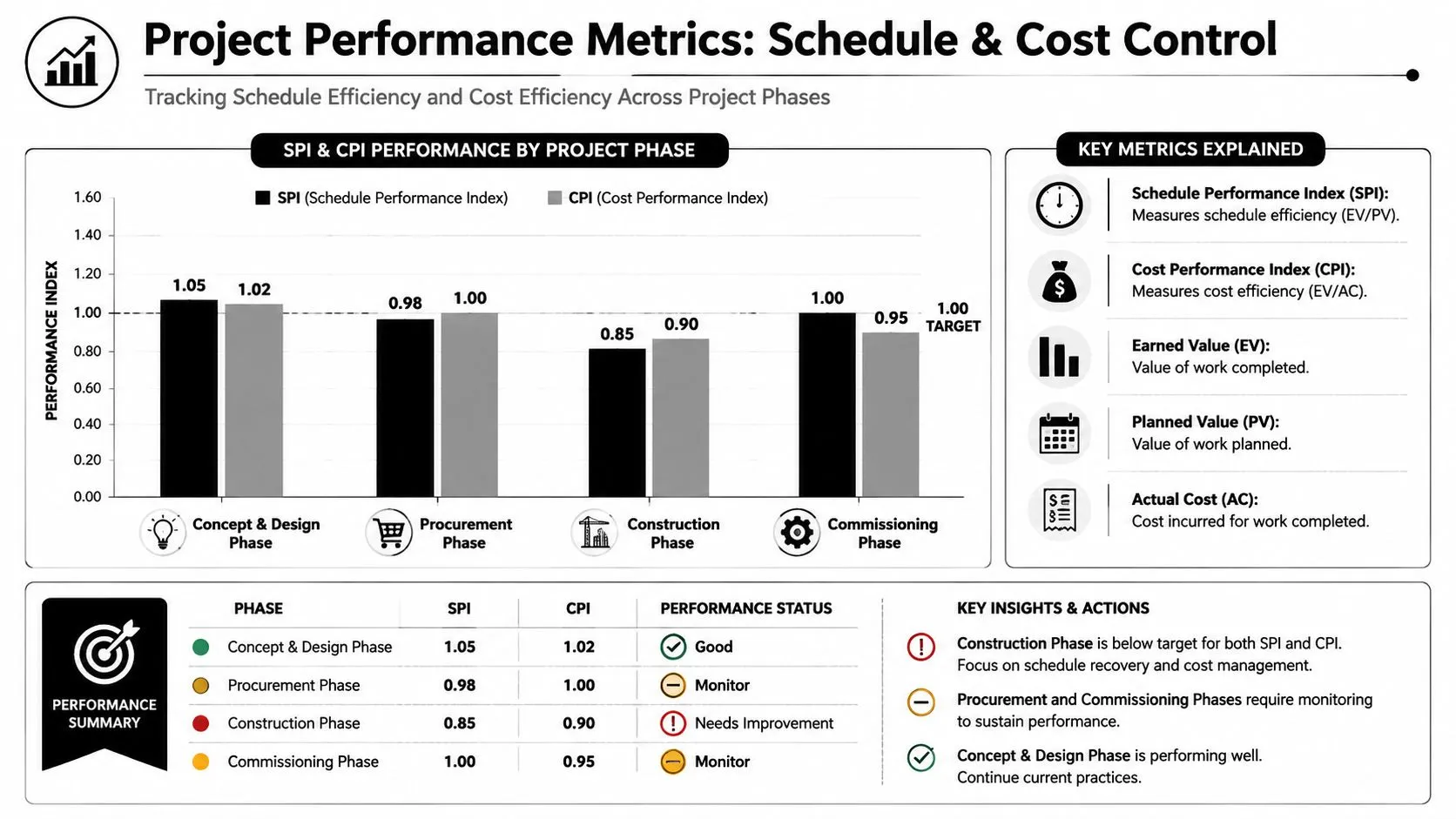
In oil and gas project management, Work Breakdown Structures (WBS) divide the project into measurable financial components, and Earned Value Management (EVM) helps teams track cost and schedule performance early enough to take corrective action, as described in this overview of project management in oil and gas.
For a non-technical manager, WBS works like the level map in a video game. If the whole project is shown as one giant mission, you cannot tell which gate is blocked, which resource is missing, or which team is slowing everyone else down. Break it into work packages, and the control points become visible.
That is the point. WBS is less about engineering detail and more about management visibility.
A useful WBS should let you answer four questions fast:
- What is the package? Procurement lot, construction area, system, or deliverable group.
- Who owns it? One accountable manager.
- What was approved? Budget, timing, scope basis, and assumptions.
- What changed? Design revision, vendor delay, access issue, or sequence conflict.
If those answers are fuzzy, cost reviews turn into storytelling. Storytelling is expensive.
How EVM becomes your early warning system
EVM gives management a disciplined way to compare plan, progress, and spend. I have seen it work well on large capital programs because it forces teams to stop speaking in impressions and start speaking in measurable variance.
Here is a simplified version:
| Metric | Plain-English meaning | Management use |
|---|---|---|
| Planned Value (PV) | The value of work you expected to complete by now | Baseline reference |
| Earned Value (EV) | The value of work completed | Real progress signal |
| Actual Cost (AC) | What you've spent to achieve that progress | Cost reality check |
| SPI | Schedule efficiency | Are we moving faster or slower than planned? |
| CPI | Cost efficiency | Are we spending more or less than progress justifies? |
If EV is below PV, the package is behind schedule. If AC is above EV, spending is outpacing progress. Those are management signals. They tell you where to challenge assumptions, where to demand a recovery plan, and where to test whether the baseline still reflects the work on the ground.
This video gives a useful visual explanation before you apply the method in live project controls.
The trap for non-technical leaders is relying on a red-amber-green dashboard with no drill-down behind it. A package can show as amber for weeks while the issue shifts from productivity loss to scope growth to contractor underperformance. If the team cannot explain the driver, they do not control the package yet.
Digital reporting helps here. A good workflow ties schedule updates, committed cost, progress measurement, and change logs into one view, so you can spot whether the problem started in planning, execution, or approval lag. If your reporting discipline is still manual, building industry regulation compliance checklists for project controls and reporting can tighten review cycles and reduce avoidable misses.
One more practical point. Review trends, not isolated reporting periods. A single bad week may come from weather, access restrictions, or an awkward handoff between contractors. Three weak reporting cycles in a row point to a management problem that needs intervention.
Ask direct questions:
- What changed since the last report?
- Is the variance caused by quantity, productivity, sequencing, or scope?
- Who owns the recovery plan?
- What decision from leadership is holding up progress?
- Does the forecast still reflect current reality?
That is how schedule and cost control becomes useful to non-technical managers. You do not need to calculate every index by hand. You need a control system that shows where the project is drifting, an operating rhythm that surfaces the cause early, and the discipline to act before overruns harden into the final outcome.
Managing Risk HSE and Regulatory Compliance
A permit is waiting on one desk, a contractor wants to start work before first light, and the field team says the job can be done safely if one isolation is clarified. This is the point where non-technical managers either protect the project or create the next incident review.
HSE and compliance sit inside daily management decisions. They determine whether work should start, stop, or be resequenced. In oil and gas, poor safety performance usually points back to weak planning, blurred ownership, rushed interfaces, or contractor controls that looked acceptable on paper and failed in the field.
Research on oil and gas project success factors highlights risk management as a core discipline alongside time, cost, scope, communications, and integration, and notes the use of safety KPIs such as LTIF in project oversight, according to the SSRN paper on critical success factors in oil and gas projects. For a manager, the practical message is simple. Safety metrics matter because they reveal whether the project is being run with control.
Teams notice what leaders inspect. If leadership only asks whether the audit pack is ready, crews learn to perform for the audit. If leadership asks who owns the permit, what changed in the work front, which barrier is weak, and whether stop-work authority was used, people start managing the job instead of decorating it.
The strongest HSE systems show up in routine behaviors, not slogans:
- Clear work ownership: One person authorizes. One person executes. Interfaces are named, not assumed.
- Pre-job hazard review: The team checks what changed since the last shift, not just what was written in the original plan.
- Fast escalation: Concerns from the field reach decision-makers before the window to prevent harm closes.
- Contractor control: Safety rules, reporting expectations, and intervention thresholds are built into supervision and contract follow-up.
- Visible learning: Near misses, permit deviations, and procedural drift are reviewed quickly enough to change the next job.
I have seen projects with polished dashboards and weak field discipline. They are the dangerous ones. A quiet site with consistent permit control and supervisors who stop work early is usually in better shape than a site that talks constantly about culture while accepting workarounds.
Risk management follows the same rule. A risk register works like a level gate in a video game. You do not pass until the key is in hand. If the project carries a permitting risk, the "key" might be an approved submission, a stakeholder meeting, or a design clarification. If nobody can name that key, the risk is still unmanaged.
A useful register gives management five things they can act on:
- A specific threat: Say "compressor delivery may slip because the vendor has not released fabrication drawings," not "procurement risk."
- A cause: Capacity limits, missing approvals, scope ambiguity, weather exposure, labor access, interface mismatch.
- An impact path: What gets hit first. Cost, schedule, safety, quality, or regulatory standing.
- A single owner: One accountable name, not a department.
- A live response: What is being done this week, what decision is pending, and when the team will know if the action worked.
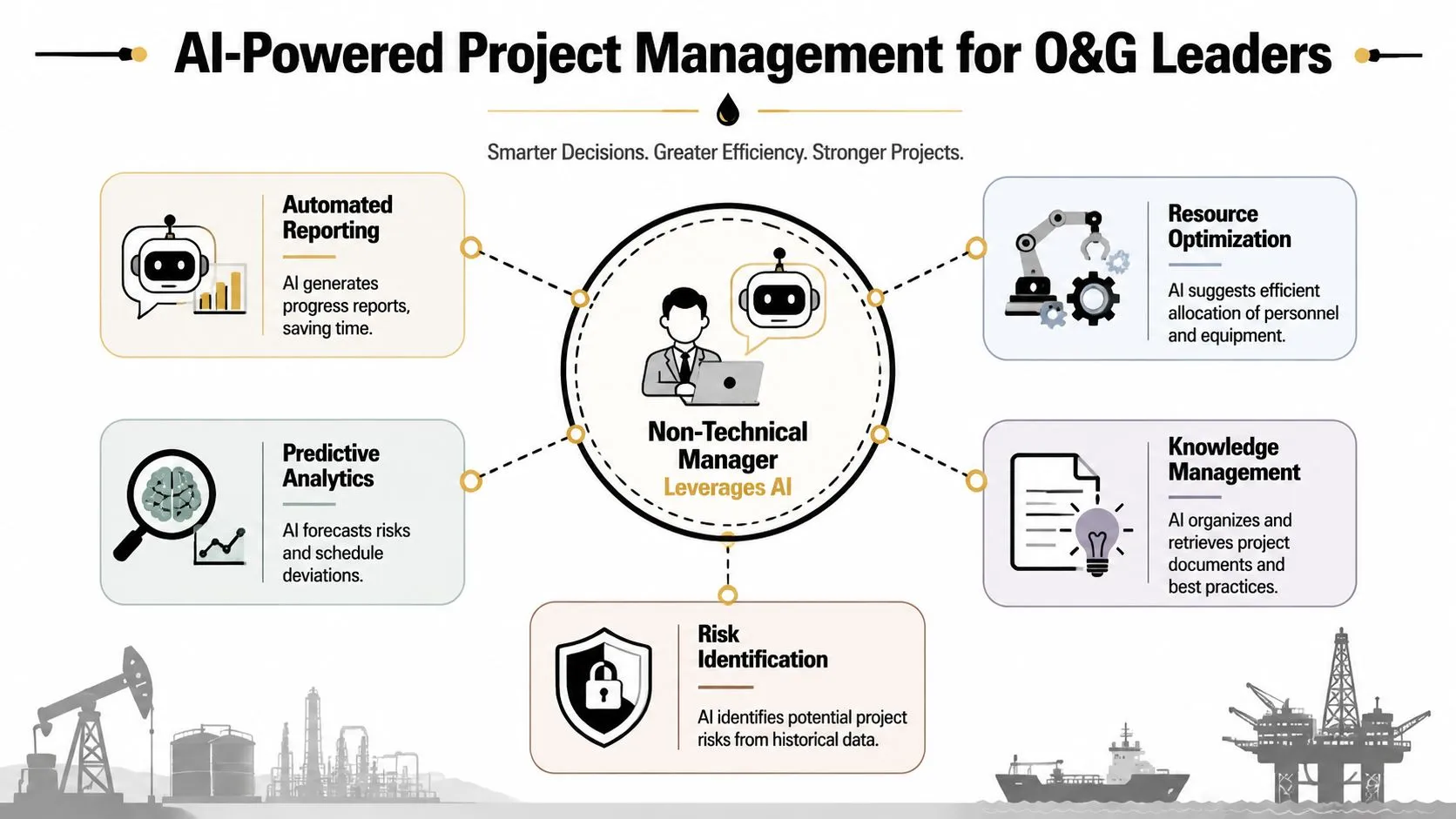
This is where digital workflows help non-technical leaders. A good system links permits, incident trends, action tracking, contractor observations, and regulatory milestones in one view so you can see whether risk is rising because of execution pressure, poor document control, or slow approvals. AI can help sort recurring issues, flag overdue actions, summarize permit bottlenecks, and draft leadership updates without asking you to read every technical note yourself.
Compliance needs the same treatment. Manage it as a running condition of work, not a file to assemble at the end. If your team needs more structure, use creating compliance checklists for industry regulations to turn broad obligations into named actions, review points, and evidence trails a manager can monitor.
The same principle applies to equipment reliability and utility packages that support safe execution. If your project depends on water handling or pump uptime, external maintenance guidance such as Purecowater pump solutions can help frame inspection and upkeep conversations with vendors and site teams.
Ask hard questions early:
- What condition must be true before this work starts?
- Which barrier is weakest today?
- What permit, approval, or isolation is still open?
- Who owns the corrective action, and by when?
- What would force us to stop the job?
- If a regulator visited this afternoon, what would be hardest to defend?
That is how non-technical managers stay in control. You do not need to master drilling physics or process engineering. You need a management system that turns hazards, compliance duties, and field signals into clear decisions before the cost is paid in injury, delay, or loss of license to operate.
Common Challenges and Mitigation Strategies
The talent problem is now a role design problem
One of the least discussed realities in oil and gas project management is that the talent shortage isn't just a staffing issue. It's changing the shape of the role itself.
Experienced oil and gas project managers are in their shortest supply ever, and companies are increasingly combining Subject Matter Expert and Project Manager responsibilities to bridge the gap, as noted in Worldwide Recruitment Solutions on hiring oil and gas project managers globally.
That means many teams no longer have the luxury of a clean split between “technical expert” and “project lead.” The project increasingly depends on hybrids who can validate technical risk while still driving schedule, commercial follow-up, and stakeholder communication.
For non-technical leaders, that creates two practical responses:
- Build paired leadership: Match a commercially strong manager with a respected technical lead and define the split clearly.
- Use structured decisions: Don't rely on heroics from rare individuals. Use gates, action logs, and escalation paths that survive personnel gaps.
- Create transfer routines: Lessons learned, assumptions, vendor history, and risk logic must be documented while people are still on the job.
- Promote translators: Reward the engineers who can explain trade-offs clearly, not just the ones with the deepest technical detail.
The failures that travel through the whole project
The most damaging project problems aren't always dramatic at the start. They travel.
A delayed procurement package can hold construction sequencing hostage. A vague scope note can become a contract argument months later. A local content commitment can look manageable on paper, then become a bottleneck when the local supplier base can't support the required quality or timing. A maintenance oversight on rotating equipment can undermine startup readiness. In adjacent industrial settings, practical maintenance guidance like these Purecowater pump solutions can be a reminder that reliability problems often begin with ordinary equipment discipline, not exotic failures.
Here's a useful pre-mortem view.
| Challenge cluster | What it looks like early | Smart mitigation |
|---|---|---|
| Stakeholder misalignment | Different leaders repeat different priorities | Force a written decision basis and update it after every major approval |
| Scope creep | “Small” additions with no baseline reset | Route every change through cost, schedule, and risk review |
| Supply chain surprises | Long-lead items discussed loosely | Track critical packages separately and review alternatives early |
| Local execution friction | Compliance is treated as procurement admin | Involve legal, supply chain, and field leadership together before commitments are locked |
| Role overload | A few people carry technical and managerial burden | Pair roles, simplify governance, and reduce reporting noise |
Most project blowups don't start as crises. They start as tolerated ambiguity.
The common management mistake is to react only when the issue becomes visible in the master schedule. By then, the problem has usually spread. Strong mitigation starts earlier, at the point where ownership, assumption quality, and decision clarity still can be corrected cheaply.
AI Workflows for Non-Technical Managers
At 6:30 a.m., before the weekly review, three different updates hit your inbox. The contractor says piping is on track. Procurement says two tagged items may miss delivery. The site team mentions access restrictions that were never raised in the schedule note. This is the moment non-technical managers get buried, not by engineering complexity, but by fragmented reporting.
That is why spreadsheets and late-night slide decks break down as projects scale. They can store information. They cannot enforce one version of the truth.
To make a Cloud Control Tower useful for real-time risk control, companies need standard data capture and people who maintain data quality. Linked with 5-D BIM, that setup can support quality checks and contract administration while reducing manual reporting effort, as noted in McKinsey's work on capital project performance in oil and gas. The management lesson is simple. The dashboard is only as good as the reporting discipline behind it.
If field teams log progress one way, contractors report another way, and procurement uses its own language, AI will summarize noise faster. It will not clean up the underlying mess for you.
A better approach is to treat AI like a junior controls analyst who works fast but needs clear instructions and checked inputs. It is good at compressing, comparing, and spotting patterns. It is weak at context, accountability, and judgment. In oil and gas, that trade-off matters because a polished summary can still hide a bad assumption.
Use a simple workflow that a non-technical manager can run without turning into the project systems owner:
-
Standardize the intake Use fixed templates for daily progress, procurement status, risk updates, RFIs, and action logs. Keep the fields consistent across contractors and internal teams. A project phase works like a locked level in a video game. If the input key is missing, you do not pass cleanly to the next review.
-
Assign one owner for the summary layer Put an analyst, project controls lead, or PMO coordinator in charge of consolidating the core feeds. That person checks completeness, chases missing inputs, and tags contradictions before they reach leadership. Without this role, the reporting pack becomes a recycling bin for unverified updates.
-
Use AI for three jobs only Start with summarization, exception spotting, and conflict detection. Those are high-value tasks for managers who need signal, not another software rollout.
A practical prompt looks like this:
Review these daily reports and produce:
- the top three project changes since the last report,
- the top five risks that need manager attention,
- any conflicting updates between contractor, field, and procurement notes,
- a short executive summary in plain English for a non-technical sponsor.
Run a second workflow for procurement. Export open purchase orders, expediting notes, delivery commitments, and comments on critical packages. Ask the AI tool to flag wording that suggests delay risk, approval bottlenecks, vendor uncertainty, incomplete documentation, or repeated scope clarification. That gives you a focused watchlist before those issues surface in a red schedule milestone.
The same method works for meetings. Feed in the last action log, current risk register, and new progress notes. Ask the tool to identify decisions that were promised but not closed, actions with no owner, and risks that have changed but were never escalated. For a non-technical leader, digital workflow bridges the gap. You do not need to interpret drilling data or read complex drawings. You need a clean way to see what changed, what slipped, and what needs a decision now.
If you are building this discipline from scratch, this guide on AI workflows for project management teams is a useful starting point.
One rule from the field should stay in place. AI can draft the briefing. It cannot own the call. Keep people responsible for verification, escalation, and approval. In this business, fast reporting is helpful. Traceable decisions are what protect budget, schedule, and reputation.
Your Actionable O&G Project Management Checklist
Use this at every review cycle
A good project checklist should do one thing above all else. It should force clarity before optimism takes over.
This one is built for a non-technical manager who needs to run tight reviews, ask the right questions, and avoid getting buried under engineering detail.
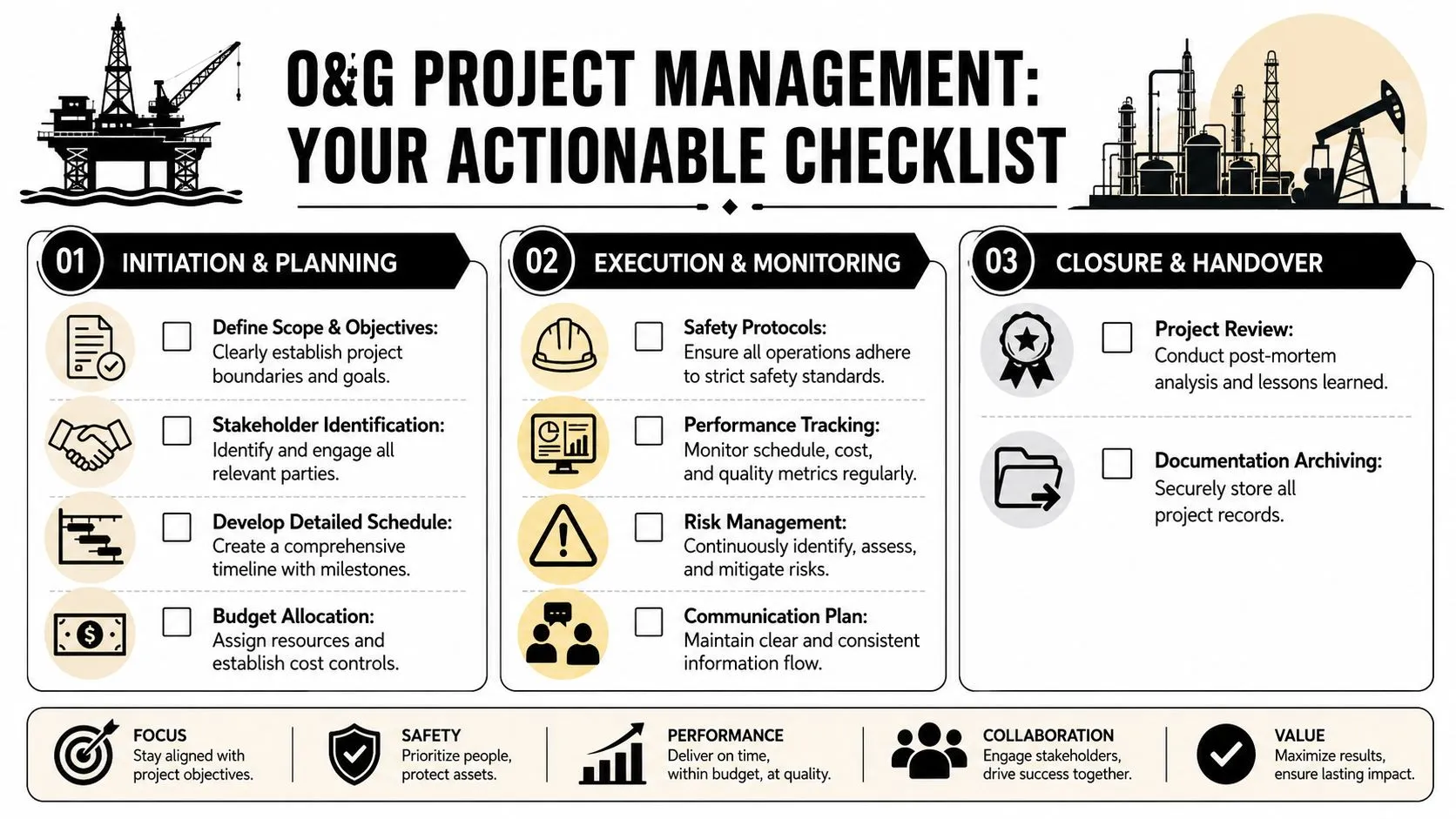
Use it at kickoff, before major approvals, and during weekly control meetings.
Project phase checklist
-
At opportunity and definition stage
- Is the scope written plainly enough that commercial, technical, and field teams read it the same way?
- Have the key stakeholders been identified, including regulators, contractors, and affected local parties?
- Is there a current risk register with named owners?
- Do decision-makers agree on what must be true before the next gate is passed?
- Are assumptions documented, or are people relying on meeting memory?
-
At execution stage
- Is every critical work package tied to one accountable owner?
- Are schedule updates reflecting real field status rather than hopeful forecast language?
- Are cost and progress being reviewed together, not in separate conversations?
- Have scope changes been converted into formal decisions?
- Are contractor interfaces creating hidden delay or rework?
-
At startup, handover, or closeout
- Is the asset ready to operate, not just physically complete?
- Have open actions, punch items, and compliance obligations been assigned and tracked?
- Are lessons learned being captured while the team still remembers the logic behind decisions?
- Is document handover complete and usable?
- If closure work is involved, is decommissioning or restoration being managed as a project, not an afterthought?
A simple weekly update format
Most weekly updates are too long, too vague, or too technical for the people who need to act on them. A better format fits on one page and answers the questions executives have.
Use this structure:
| Section | What to include |
|---|---|
| Progress this week | What moved, what finished, what slipped |
| Top risks | Only the risks that could change outcome or require attention |
| Key decisions needed | Approvals, trade-offs, or unresolved issues |
| Cost and schedule view | Current trend, not raw data dump |
| Safety and compliance | Incidents, concerns, audits, permit status |
| Next-week focus | What the team will do before the next review |
Keep the language blunt. Replace “ongoing engagement continues” with “permit comment still unresolved.” Replace “minor schedule pressure” with “vendor drawing approval is holding release.” Precision lowers noise.
Manager's test: If a sponsor reads your weekly update and still asks, “What exactly needs my decision?”, the update failed.
Track a tight set of KPIs and don't let the list sprawl. For this field, keep your eye on SPI, CPI, and LTIF, then add project-specific measures only when they drive action. More metrics often create less control.
The strongest oil and gas project management habits are boring on purpose. Clear ownership. Clean reporting. Controlled changes. Timely escalation. Repeated gate discipline. That's how difficult projects stay manageable, even when the technical environment is far from simple.
If you want to build the kind of AI skill set that helps with reporting, workflow design, summarization, and decision support, AI Academy is a practical place to start. It's built for working professionals, especially non-technical managers, and focuses on short, job-ready lessons you can apply immediately instead of theory you'll never use.