You may already be the person people turn to when a new AI tool shows up at work.
Maybe you work in marketing and someone wants to use ChatGPT for customer emails. Maybe you sit in HR and a vendor promises faster screening with AI. Maybe you're an analyst and a team starts using Claude, Perplexity, or a custom chatbot to summarize reports. The tool works well enough to get adopted, but nobody's fully clear on what rules should govern it, what data should stay out of it, who checks outputs, or what happens if the system makes a harmful decision.
That gap is where an AI Governance Professional becomes valuable. This role isn't only for lawyers, engineers, or data scientists. It's also a strong path for thoughtful non-technical professionals who know how to manage risk, write policy, ask hard questions, and coordinate across teams.
Why Every Company Needs an AI Governance Professional Now
A marketing lead uploads customer notes into a new AI writing tool to speed up campaign drafts. An HR manager tests AI screening on job applications. A support team connects a chatbot to internal documentation. None of these choices look dramatic on their own. Together, they create a real governance problem, because the company is now using AI across sensitive data, customer interactions, and employment decisions without one shared set of rules.
That gap is getting harder to ignore. According to IBM's Global AI Adoption Index 2023, companies are already reporting barriers tied to data complexity, limited transparency, and governance concerns as they put AI into real business processes. This creates a need for governance because AI risk rarely stays inside the technical team. It shows up in brand claims, hiring fairness, privacy handling, audit trails, and executive accountability.
For non-technical professionals, this is the opening.
If you come from marketing, HR, operations, compliance, or business analysis, you have probably already done parts of this work. You have written policies people can follow, spotted process gaps before they became expensive, managed stakeholders with different priorities, and asked the practical question technical teams sometimes miss: what could go wrong when this meets real customers, real employees, or real data?
Trust shapes adoption just as much as model quality. A company can have a powerful AI tool and still fail to get approval from legal, buy-in from employees, or confidence from customers. Teams using assistants, copilots, and AI tools for knowledge system design often need someone who can turn scattered experiments into a controlled process with ownership, review points, and clear boundaries.
A helpful comparison is building safety. The architect and builders create the structure, but inspectors, codes, and sign-off processes determine whether people can use it safely at scale. AI works the same way inside a company.
Practical rule: AI governance starts when someone asks, “Should we use this system this way?” and requires a clear, documented answer.
That is why companies need an AI governance professional now. They help teams move from quick adoption to responsible adoption, especially in organizations where AI use began department by department instead of through one coordinated plan.
What Is an AI Governance Professional
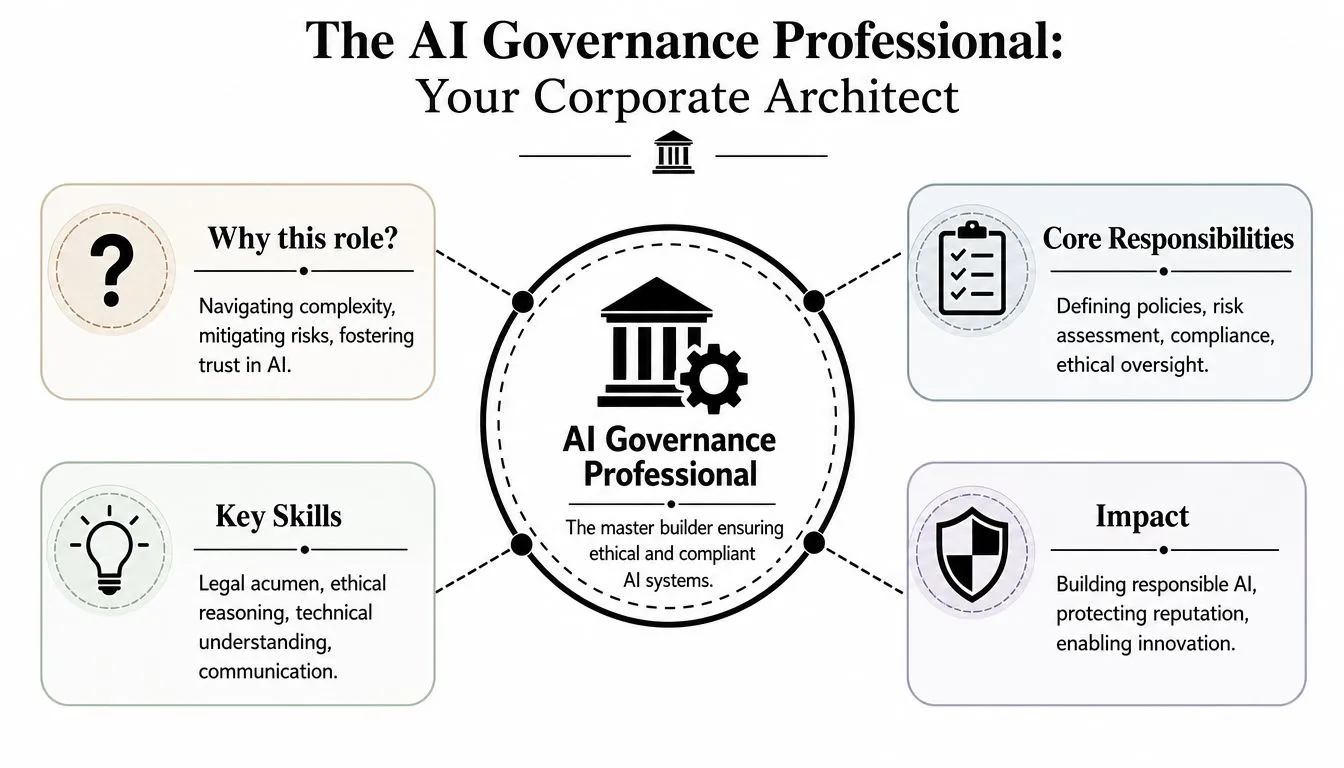
An AI Governance Professional is the person who helps an organization use AI responsibly, legally, and consistently. The simplest way to think about the role is this: they are a corporate translator between technical teams, legal teams, business leaders, and the people affected by AI decisions.
They usually don't spend the day building models. They spend it asking better questions, setting rules, documenting decisions, reviewing use cases, and making sure AI systems align with business goals and organizational values.
The six domains that define the role
A strong AI Governance Professional should understand the six domains defined around ISO/IEC 42001: AI Fundamentals, Governance Frameworks, Regulatory Environment, Risk Management, Ethical Considerations, and Operationalising AI Governance, as outlined in this ISO 42001 certification overview.
Here's what those domains look like in plain language:
- AI Fundamentals means you understand what a model does, what training data is, what generative AI can and can't do, and why outputs can be wrong.
- Governance Frameworks means you can help create rules for approval, oversight, accountability, and review.
- Regulatory Environment means you can track which laws, standards, and company obligations matter in a given use case.
- Risk Management means you identify where harm could happen before the system scales.
- Ethical Considerations means you ask whether the use is fair, explainable, and respectful of people.
- Operationalising AI Governance means you turn all of that into workflows, forms, approvals, and monitoring that people follow.
What the work looks like day to day
A marketing chatbot is a good example. The technical team may focus on speed and integration. Legal may focus on disclosure. Brand may focus on tone. The AI Governance Professional connects those concerns and turns them into operating rules.
They might ask:
- What information can this bot access?
- Can it make claims that require human review?
- Who checks for harmful or misleading outputs?
- What happens when the model drifts or starts producing lower-quality responses?
The role is less about controlling innovation and more about making innovation survivable inside a real business.
This is why global institutions keep shaping AI governance policies around accountability, human oversight, and shared principles. Inside a company, someone has to convert those broad ideas into practical routines. That person is often the AI Governance Professional.
Essential Skills for AI Governance You Already Have
A lot of people assume this role belongs to coders. That assumption blocks strong candidates.
In practice, job descriptions show that “regulatory instincts” and “ethical reasoning” are transferable skills from compliance, legal, and policy roles, and one career analysis notes that 40% of new AI governance entrants are expected to come from non-technical backgrounds, while training materials remain 80% focused on technical risk assessments in this AI governance specialist career write-up. If you work in marketing, HR, operations, analysis, or project management, that should get your attention.
Your non-technical superpowers matter
You may already do governance work without calling it that.
If you're in marketing, you probably review claims, protect brand tone, and think about audience harm. That translates well into reviewing AI-generated copy, approval workflows, and disclosure standards.
If you're in HR, you likely handle fairness, consistency, sensitive data, and high-stakes decision processes. That's directly relevant when AI tools touch hiring, performance, or employee monitoring.
If you're an analyst, you already question data quality, define metrics, document assumptions, and spot anomalies. Those habits are essential when evaluating AI outputs, escalation rules, and usage boundaries.
Here's a simple translation table you can use for your resume or portfolio.
| Your Current Skill/Experience | How It Applies in AI Governance | Example Role |
|---|---|---|
| Policy interpretation | Turning broad company rules into practical AI usage guidance | HR Business Partner |
| Risk review | Identifying where AI use could create legal, brand, or process issues | Compliance Analyst |
| Stakeholder communication | Aligning legal, operations, and technical teams around one policy | Project Manager |
| Content review | Checking AI outputs for harmful, misleading, or off-brand responses | Marketing Manager |
| Audit mindset | Documenting approvals, exceptions, and review trails | Internal Auditor |
| Data questioning | Testing whether outputs are reliable enough for business use | Business Analyst |
| Fairness judgment | Spotting uneven treatment in hiring or customer interactions | People Operations Lead |
| Vendor evaluation | Asking what a tool stores, learns from, and exposes | Procurement or Operations Manager |
You need literacy, not deep engineering
You don't need to build a model from scratch. You do need enough technical literacy to ask competent questions.
That means being comfortable with concepts like:
- Model limitations so you don't treat generated text as guaranteed truth
- Training data concerns so you can ask whether data rights and consent were addressed
- Monitoring so you know an approved system still needs review after launch
- Human oversight so important decisions don't become fully automated by accident
A useful standard is this. If an engineer says, “The model is fine,” you should be able to ask, “Fine for what use, under what controls, with what fallback when it's wrong?”
Career advice: Don't frame your background as “non-technical.” Frame it as “risk-aware, policy-literate, and cross-functional.”
That's often exactly what a company needs when AI moves from experiment to operational reality.
Key Frameworks and Regulations You Must Know
A marketing lead approves an AI copy tool. An HR manager pilots AI screening. An analyst starts using a model to summarize customer feedback. Then someone asks a simple question: who decided what rules apply?
That question sits at the center of AI governance.
You do not need to read every law line by line to answer it well. You need a map that helps you sort what matters first. For people coming from marketing, HR, operations, or analysis, this part of the job often feels less like coding and more like policy translation. You are turning broad expectations into business rules that teams can follow.
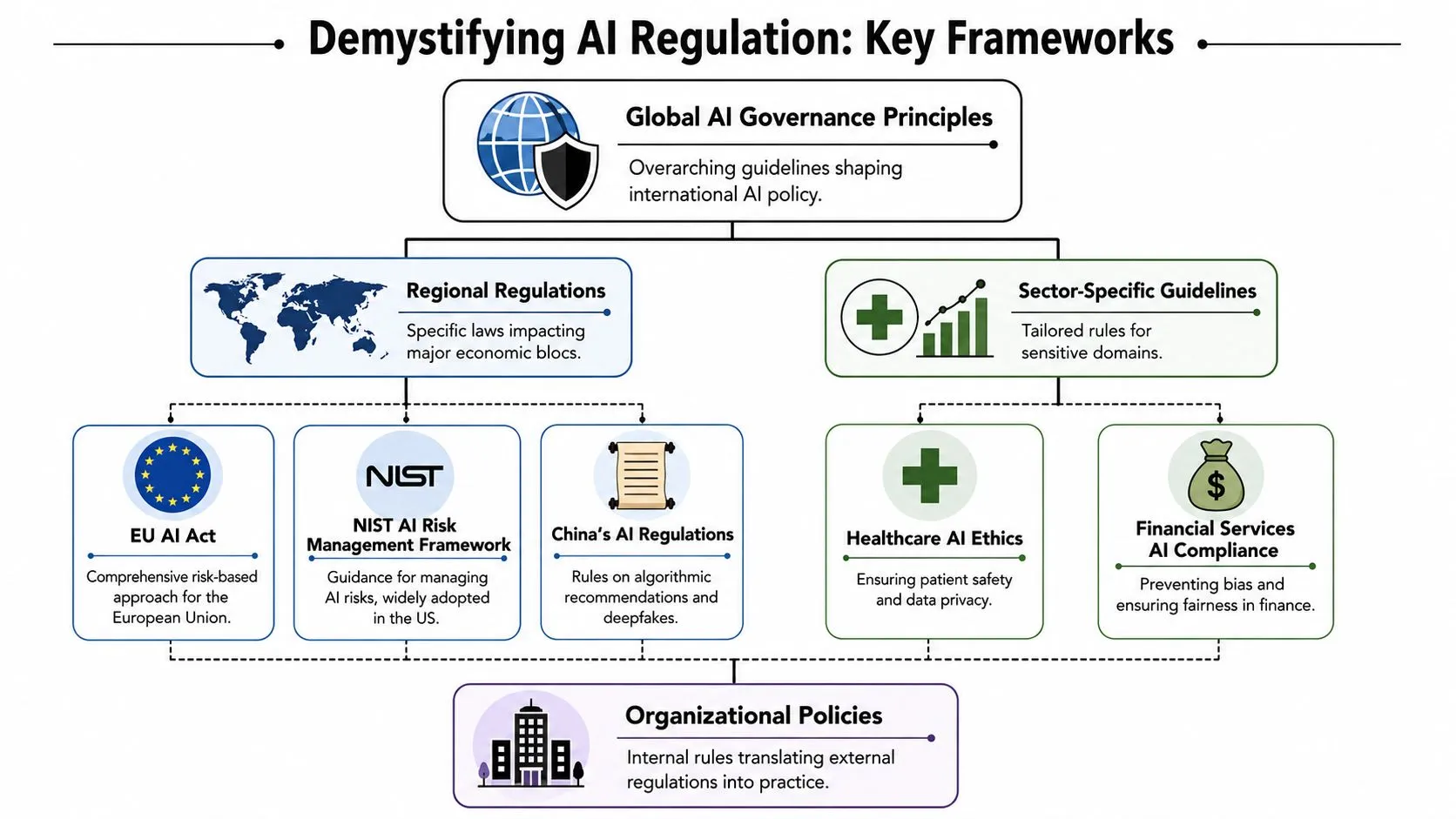
A useful way to organize the field is with three layers. Global principles set the direction. Laws and regulatory models create obligations. Internal standards turn both into repeatable company practice.
Global principles that shape the field
Start with the OECD AI Principles, which the OECD presents as a baseline for trustworthy AI and responsible stewardship across countries. They give you a shared language for questions that sound abstract at first but become very practical in meetings: Is this system fair? Is it transparent enough? Can we explain who is accountable if it causes harm?
If your background is in HR, this can feel similar to applying workplace values to a new tool. If your background is in marketing, it is close to brand governance. A company already has standards for claims, tone, approvals, and customer trust. AI principles do the same kind of work, but for model use, oversight, and risk.
The point is not memorization. The point is pattern recognition. When a team proposes an AI use case, these principles help you spot whether the idea needs stronger review before anyone presses launch.
Regional rules and practical business impact
Principles tell you what good looks like. Laws tell you what the organization may be required to do.
The legal picture changes based on where the company operates, where users live, what data the system touches, and whether the AI affects high-stakes decisions such as hiring, lending, insurance, or access to services. An internal chatbot for drafting first-pass notes raises one set of issues. A hiring model that ranks applicants raises a very different set.
For non-technical entrants, this is often where your prior experience becomes valuable. HR professionals already understand documentation, fairness concerns, and adverse-impact sensitivity. Marketing professionals already know disclosure, claims review, and consumer trust. Analysts already ask whether a method is reliable enough to support a decision.
In practice, your review questions often sound like this:
- Data use: Are we using personal or sensitive data in a way the company can justify and document?
- Risk level: Does this use case belong in a higher-risk category because it affects people's opportunities, rights, or safety?
- Transparency: Should users, employees, or candidates be told they are interacting with AI or being evaluated with AI-supported output?
- Ownership: Which team approves the tool, monitors it after launch, and pauses it if something goes wrong?
If you need help converting those questions into internal rules, this practical guide for AI policies shows how companies can turn governance ideas into workable policy language. It pairs well with these AI best practices for teams, which connect policy decisions to everyday use.
Operational standards inside the company
This layer is where governance stops being a slide deck and becomes a management system.
ISO/IEC 42001 matters because it gives organizations a structured way to assign responsibility, document decisions, review risk, and improve controls over time. If global principles are the values and regulations are the rules, ISO/IEC 42001 works like the operating manual. It helps a company decide who reviews what, how exceptions are handled, and what evidence should exist if leadership or regulators ask questions later.
That structure is especially helpful for professionals entering from non-engineering roles. You may not build the model, but you can help build the process around it. Many companies fail here, not because nobody cares, but because approval steps, ownership, and monitoring are scattered across teams.
Use this learning order:
- Learn the principles so you can recognize trustworthy and untrustworthy uses.
- Learn the obligations so you can tell which use cases need legal, privacy, or risk review.
- Learn the operating model so you can turn policy into approvals, documentation, and follow-up checks.
If you can translate a vague concern such as "this feels risky" into a clear review step, a named owner, and a documented control, you are already doing the work of an AI governance professional.
Typical Career Paths and Salary Expectations
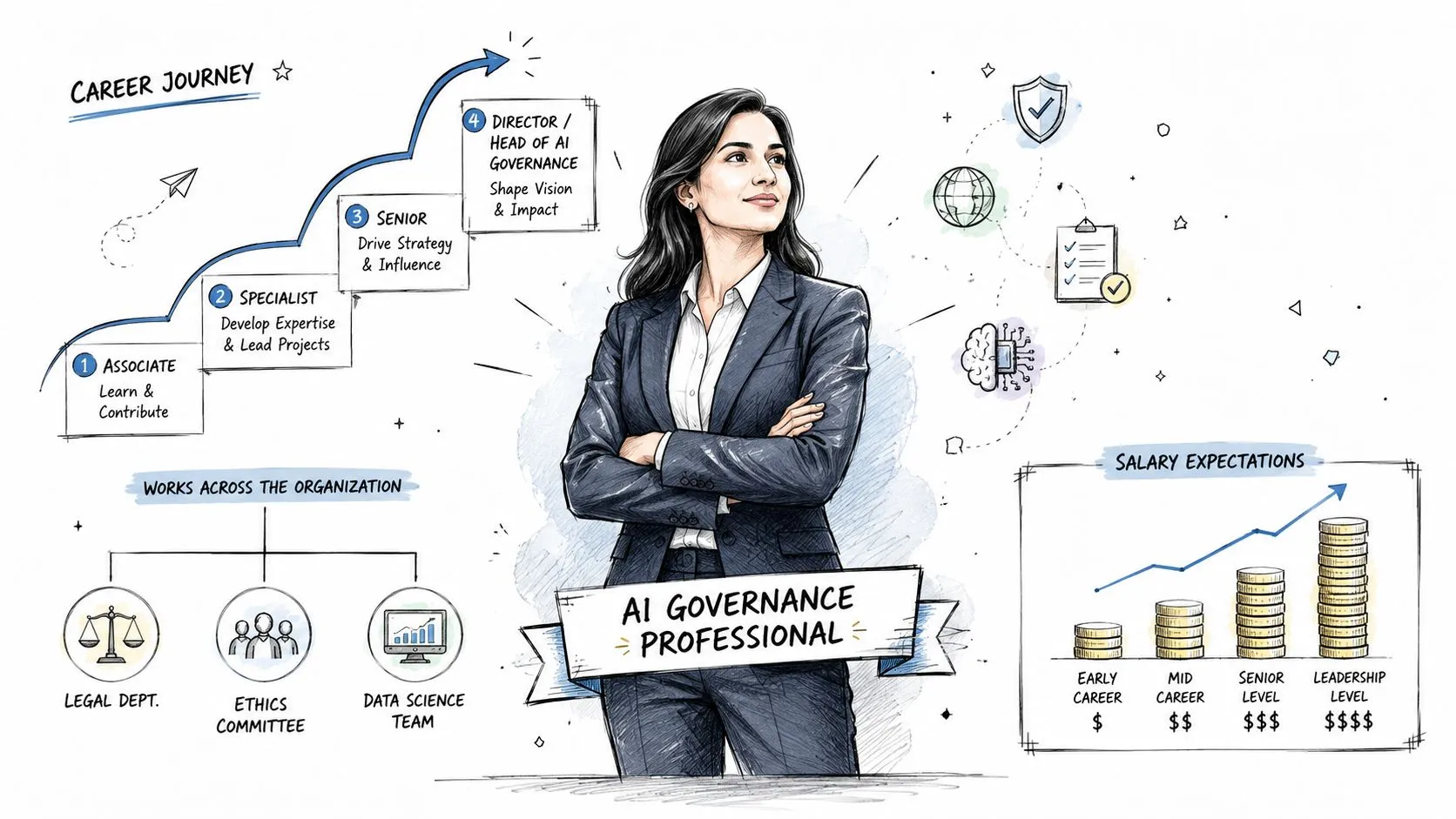
This career becomes easier to pursue once you can see where the role lives inside a company. In smaller organizations, AI governance may sit inside legal, privacy, compliance, risk, or data governance. In larger firms, it may become a dedicated function or part of a broader responsible AI office.
That placement changes the daily emphasis. A legal-led team may focus more on regulatory interpretation. A product-led team may focus more on use-case review and launch approvals. A risk-led team may focus more on controls, monitoring, and escalation.
Where this role usually sits
Common reporting lines include:
- Legal or privacy teams when AI governance is treated as a regulatory and accountability issue
- Enterprise risk or compliance teams when the business wants stronger control systems
- Data or digital transformation teams when AI programs are expanding quickly across departments
- A dedicated responsible AI office when AI is a strategic priority across products and operations
This variety is good news for non-technical entrants. You don't need to enter through one narrow doorway. Your best path often depends on where your existing strengths already fit.
What a career ladder can look like
Titles vary, but the progression often looks something like this:
- AI Governance Analyst handling inventories, documentation, policy support, and risk intake
- AI Governance Manager coordinating reviews, stakeholders, training, and control design
- Senior AI Policy or Responsible AI Lead setting governance direction across multiple teams
- Director or Head of AI Governance owning enterprise strategy, standards, and oversight
Salary expectations are hard to pin down cleanly because titles, seniority, geography, and company type vary a lot. What we can say with confidence is that demand is growing alongside the market. The global AI governance market is projected to grow from USD 309.01 million in 2025 to USD 5,883.90 million by 2035, a nearly 19-fold increase, according to this AI governance market forecast. A market expanding at that pace tends to create more specialized roles and stronger compensation competition for qualified professionals.
If you're thinking long term, this is also part of a broader strategy to future-proof your career. Governance work ages well because organizations keep needing people who can align new tools with durable standards.
Your 90-Day Onboarding Roadmap to Become an AI Pro
The fastest way into this field is to stop waiting for a perfect course sequence and start building visible evidence of judgment. You need vocabulary, a few frameworks, and practical artifacts you can show in a conversation or interview.
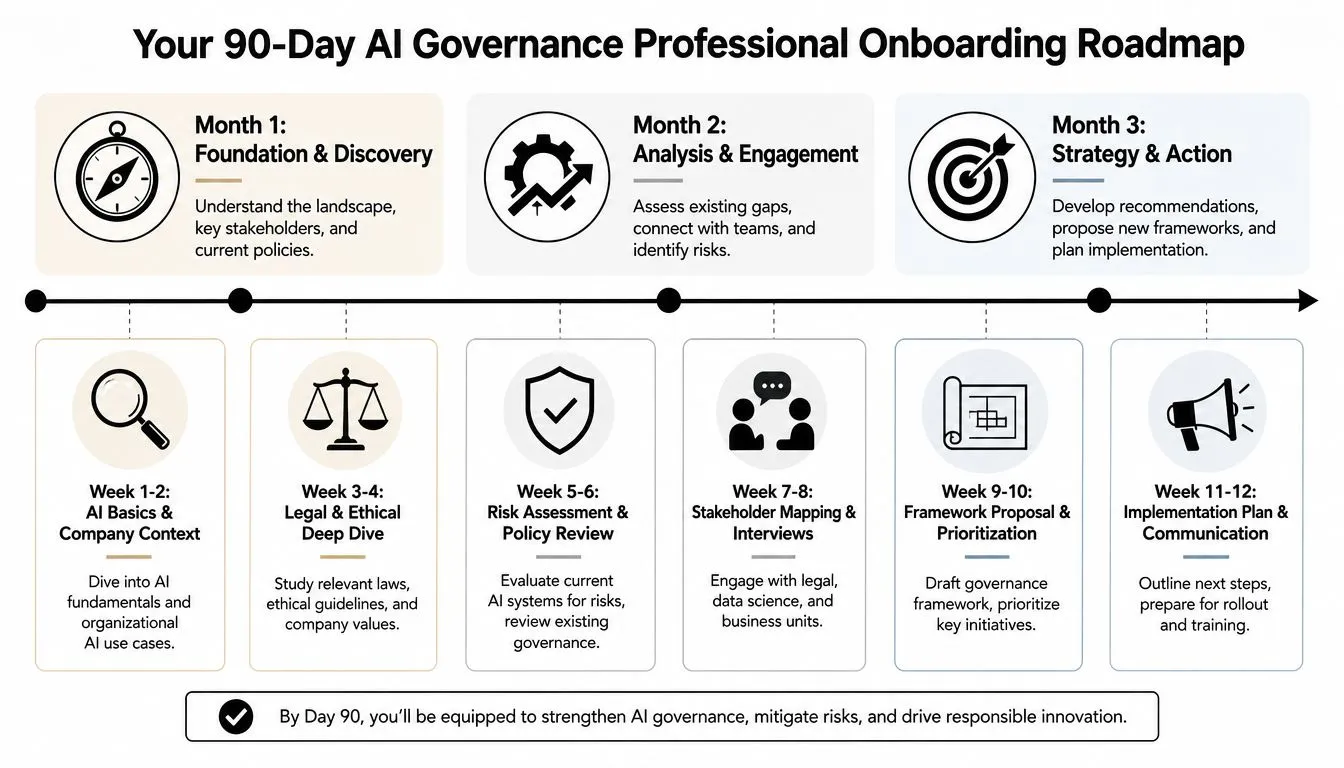
Days 1 to 30 build your foundation
Use the first month to understand how AI shows up in business settings.
Focus your reading and note-taking around:
- AI basics including model outputs, hallucinations, training data, and human review
- Business use cases in your own field, such as hiring, content, support, forecasting, or internal search
- Governance language including accountability, transparency, bias, documentation, and oversight
Then do one practical exercise. Create a simple AI use-case inventory for your team or industry. List the tool, who uses it, what it helps with, what data it touches, and what could go wrong.
A short message to a manager can create momentum:
I've been mapping where our team is using AI and where the risks or policy gaps may be. I'd like to share a one-page review and suggest a lightweight approval process for higher-risk uses.
That kind of message shows initiative without sounding alarmist.
Days 31 to 60 turn concepts into practice
Now move from reading to creating.
Build two small portfolio pieces:
- A draft internal AI usage policy for a team you understand well
- A lightweight risk review template with prompts such as intended use, human oversight, sensitive data, user disclosure, and escalation path
You can strengthen both by studying how operational controls work in adjacent fields. This overview of an operational risk management framework is useful because AI governance often succeeds or fails at the process level, not the slogan level.
Your policy draft doesn't need legal language. It should be clear enough that a team lead can use it. Good sections include approved uses, restricted uses, review requirements, data handling expectations, and what to do when outputs seem unreliable.
Here's another practical move. Interview one person from legal, one from operations, and one heavy AI user in your company or network. Ask what worries them most and what would make AI use easier to trust.
Days 61 to 90 choose a lane and prove readiness
By this stage, pick a specialization area that matches your background.
Examples include:
- HR and talent AI if you come from people operations or recruiting
- Marketing and content AI if you know campaign workflows and brand controls
- Vendor and procurement governance if you often assess tools and third-party risk
- Analytics and decision support if your background is reporting, measurement, or business operations
Later in this phase, it helps to understand what formal certification looks like. One visible option is the AIGP certification exam, which includes 100 multiple-choice questions completed over 150 minutes, and certified holders must maintain the credential with 20 Continuing Privacy Education credits annually, as described in this AIGP certification overview.
Before you pursue any credential, make sure you can already do three things well:
- Explain one AI risk clearly to a non-expert
- Write one policy recommendation that a manager could implement
- Facilitate one cross-functional conversation without getting lost in jargon
This video is a helpful companion if you want a more visual orientation while building your roadmap.
A strong 90-day outcome isn't mastery. It's proof that you can think like an AI Governance Professional before anyone gives you the title.
Common Questions About AI Governance Careers
Is AI governance just another name for data privacy
No. Privacy is part of it, but AI governance is broader. It includes model behavior, human oversight, fairness, accountability, approval processes, and operational controls. Privacy professionals often make strong candidates because they already think in terms of risk and obligations.
Do I need a law degree to get hired
No. A law degree can help in some roles, but plenty of governance work depends on policy writing, stakeholder coordination, process design, training, and review discipline. If you can translate rules into workable routines, you have relevant value.
Do I need a certification before I apply
Not always. A certification can strengthen your profile, especially if you're changing fields, but it isn't the only proof point. A thoughtful portfolio can matter just as much. A draft policy, a risk review template, and a documented AI inventory often show more practical judgment than generic enthusiasm.
What's the best first step if I work in marketing, HR, or analysis
Audit how AI is already being used around you. Don't start with abstract theory. Start with real workflows, real tools, real approval gaps, and real stakeholder concerns. Then document what you find in plain language.
What makes someone stand out in this field
Clear writing, calm judgment, and the ability to ask useful questions across teams. Companies need people who can reduce confusion, not add more of it.
If you want a practical place to build those skills, AI Academy is a strong next step. It's built for working professionals, especially non-technical roles, and focuses on short, applied lessons that help you become the person who can use AI well and govern it responsibly.