A team lead reviews three versions of the same client update. One sounds polished and on-brand. One buries the key point. One uses language that would make legal nervous. None of the problems are dramatic, but together they slow approvals, create rework, and make quality feel random.
That's the kind of mess an AI homework checker can help fix.
The phrase often brings to mind students scanning math worksheets. But the underlying idea is much more useful than the label suggests. An AI homework checker is really a system for comparing work against a rubric, spotting gaps, and returning fast feedback in a consistent format. In a business setting, that can mean reviewing onboarding assignments, auditing marketing drafts, checking report quality, or flagging missing steps in internal documentation.
The appeal isn't just speed. It's consistency. Human reviewers get tired, rush, or focus on different things. A well-designed AI checking workflow applies the same standard every time, then escalates judgment calls to a person. That's a powerful model for managers, marketers, analysts, and L&D teams that want better quality control without turning every review into a bottleneck.
Introduction Beyond the Classroom
A manager in a growing company usually doesn't have a quality problem. They have a consistency problem.
One new hire writes strong prospecting emails. Another misses the offer. A third uses the right structure but the wrong tone. The manager can fix all of this manually, but that means reading every draft, repeating the same comments, and hoping the team internalizes the pattern. Over time, review becomes a hidden tax on leadership.
That's why the idea behind an AI homework checker is so practical outside school settings. In education, the tool checks work against expected answers or a grading rubric. In business, the same logic can check work against a brand guide, a reporting template, a policy standard, or a training scorecard.
The shift matters because many teams still treat AI as a content generator first. They ask ChatGPT or Claude to draft something, then scramble to verify the output afterward. A checking workflow flips that pattern. It treats AI as a reviewer before it acts as a writer. For non-technical professionals, that's often the safer and more valuable entry point.
A good checking system doesn't replace judgment. It reduces the number of obvious things your team has to catch by hand.
That's also why this topic belongs to managers and operators, not just teachers. If you run onboarding, marketing review, internal training, proposal QA, or recurring reports, you already use rubrics whether you call them that or not. You have standards. You have recurring mistakes. You have feedback loops that are too slow.
An AI homework checker gives that process structure. It turns “please make this better” into “these four elements are missing, this claim needs support, this section doesn't match our tone, and this should go to a human reviewer.” That's a much more usable system for real work.
Understanding the AI Homework Checker Framework
An AI homework checker is easiest to understand if you stop thinking about homework.
Think of it as a specialized QA analyst that never gets bored. You give it a piece of work and a standard to compare against. It checks whether the work meets the standard, explains what's off, and records patterns across many submissions.
Why the framework matters
This isn't fringe technology anymore. The global market for AI in assessment and grading tools reached approximately USD 3.2 billion in 2023, with annual growth rates exceeding 25%, and a 2023 EDUCAUSE survey found that 35% of U.S. higher education institutions already used AI-based tools for automated grading or feedback on at least some courses, according to this market and adoption summary.
That matters for professionals because it shows the model already works at scale in environments where consistency, volume, and auditability matter.
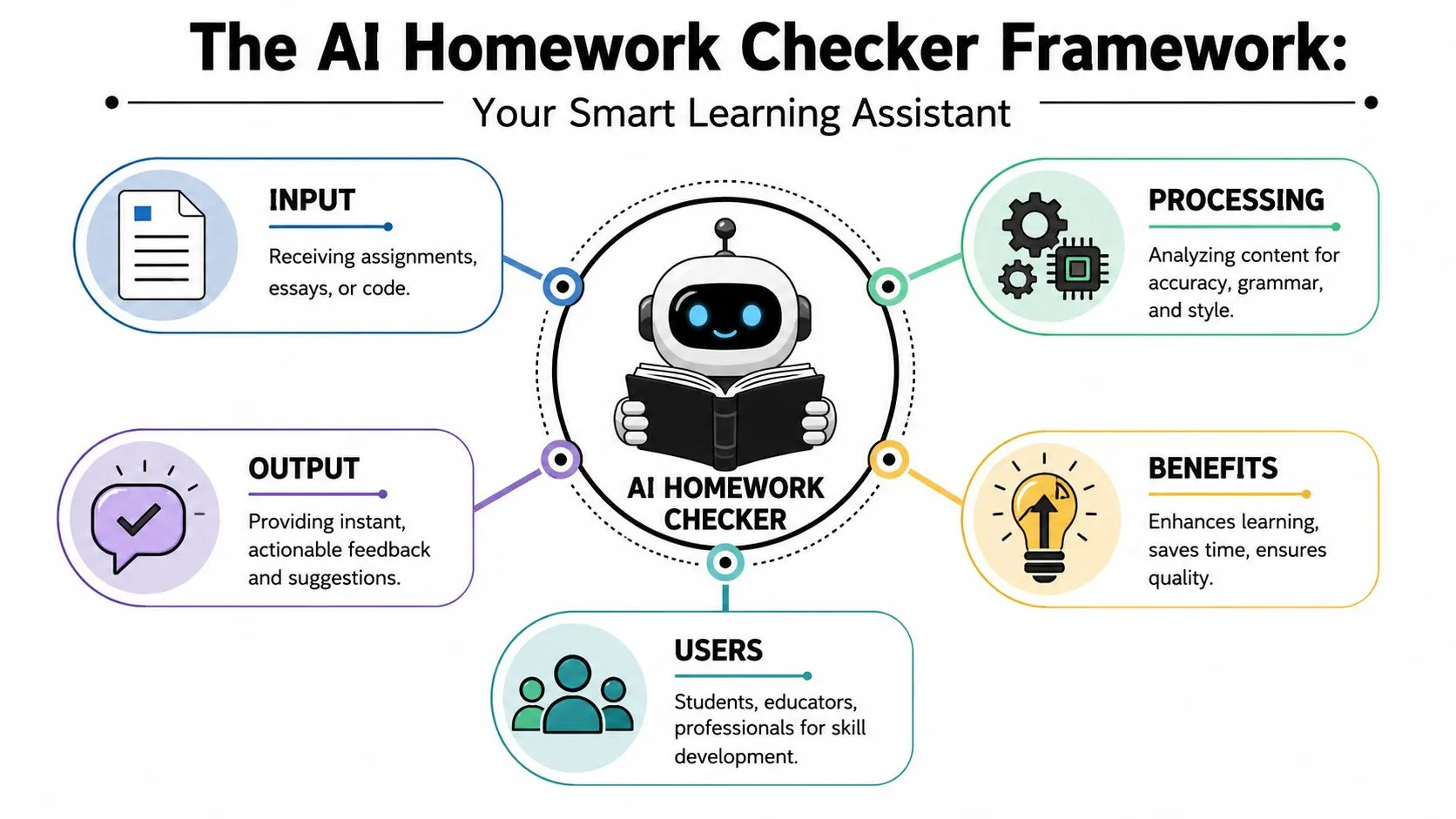
The business translation is straightforward. Instead of grading essays or statistics homework, the checker can review:
- Sales drafts that need to follow a template
- Marketing content that must match tone and compliance rules
- Internal training submissions that should demonstrate understanding
- Operational reports that require consistent structure and terminology
The three business functions
Most AI checking systems do three jobs. Each one maps cleanly to workplace needs.
-
Automated verification
This is the simplest layer. Did the draft include the required sections? Did the analyst use the approved terms? Did the trainee answer every part of the assignment? Verification doesn't need deep creativity. It needs rule-following and consistency. -
Feedback generation
The system's utility in this phase far exceeds that of a mere static checklist. It doesn't just say something is missing. It explains what to fix and often suggests how to fix it. That makes it useful for coaching, not just policing. -
Performance analytics
Over time, repeated checks show patterns. A manager may discover that new hires often miss objection handling in sales practice, or that content writers repeatedly violate the same style rule. That turns review data into training data.
Practical rule: If the work can be judged against a clear rubric, an AI checker can probably assist with it.
Readers often get confused here and assume the checker must know the “right answer” in advance. Not necessarily. In business, the “answer” is often a quality standard, not a single correct response. That's why these systems fit so well with rubrics, templates, and exemplars.
How the Technology Translates Work into Feedback
The technical side sounds intimidating until you picture it as a digital assembly line. Each stage has a simple job. Together they turn messy inputs into usable comments.
A digital assembly line
Modern systems commonly use a multi-stage pipeline that combines preprocessing, problem classification, model inference, and verification. For image-based or scanned inputs, that often starts with OCR. Then the system classifies the task and routes it to a model suited to that domain. Benchmarks show that domain-specific fine-tuned models can improve answer correctness by 15–30% compared to generic chat-style models, especially for symbolic notation and multi-step reasoning.
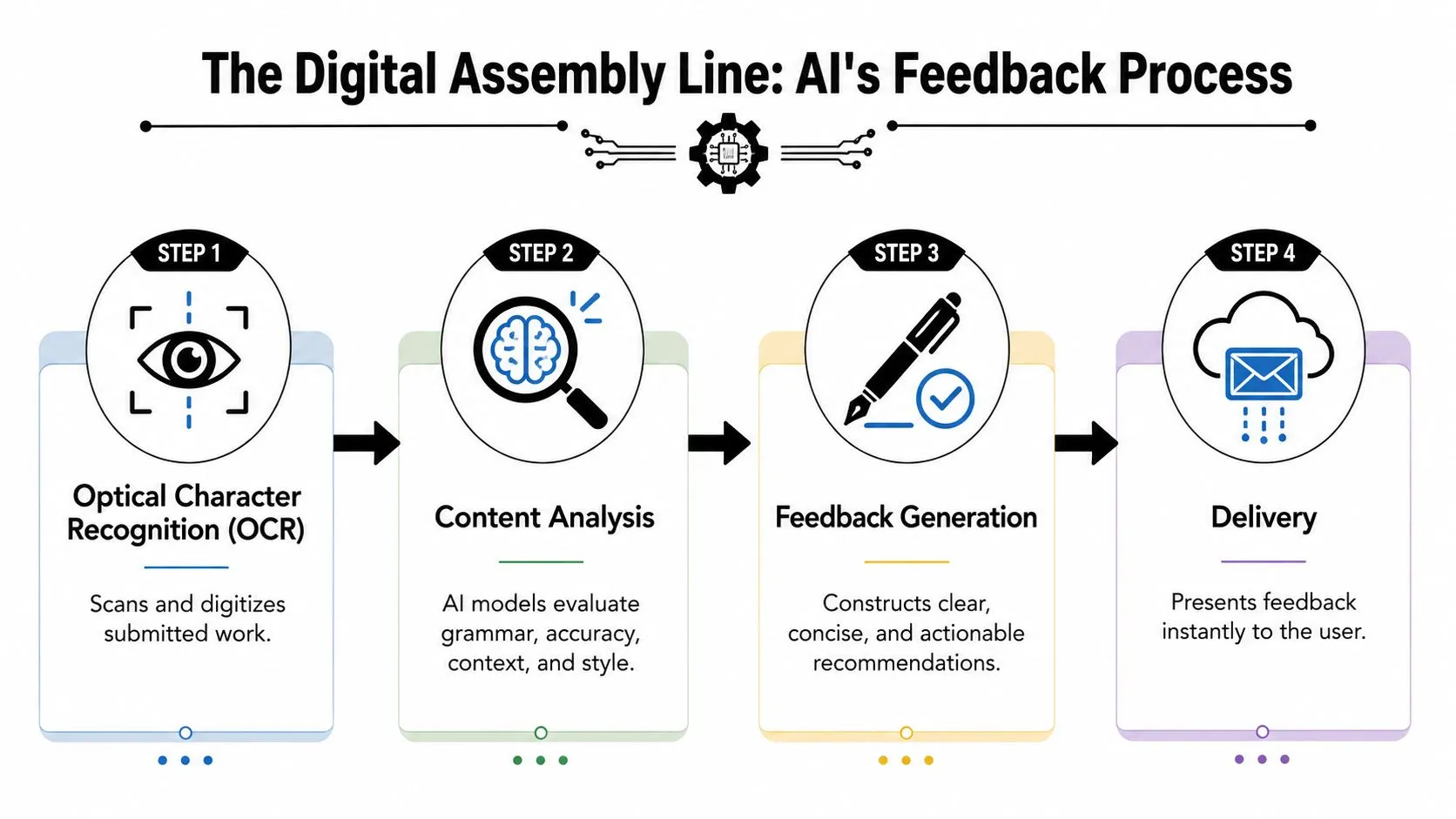
Here's what that means in plain language:
- Intake: The system receives a document, screenshot, pasted text, or photo.
- Conversion: OCR or parsing tools turn that input into machine-readable text.
- Classification: The system decides what kind of task this is. A sales email, a report summary, a spreadsheet explanation, a free-response answer.
- Evaluation: A model compares the content against rules, examples, or rubrics.
- Verification: The workflow checks confidence, flags uncertainty, and may send edge cases to a human.
If you've looked at AI marking features, you've seen this logic in action. The useful idea for business teams isn't just automated scoring. It's structured review against criteria that can be repeated across many submissions.
Why specialization matters
A generic chatbot can review almost anything. That's also the problem. It often applies broad, fuzzy standards unless you constrain it carefully.
A sales email and a quarterly analyst summary shouldn't be reviewed the same way. One needs brand tone, objection handling, and a clear CTA. The other needs consistent labels, correct terminology, and complete coverage of required points. Different work needs different rubrics.
That's why prompt design matters so much. If you want a useful checker, you need to tell the model what “good” looks like, what errors matter most, and how feedback should be structured. This is the same discipline behind strong prompt design more broadly, and this guide on what prompt engineering is is a good primer if you want to understand why small wording changes produce very different review outputs.
A simple way to understand this:
| Stage | What the system asks |
|---|---|
| Intake | What did the user submit? |
| Task type | What kind of work is this? |
| Rubric match | What standard should apply? |
| Feedback | What should the user fix first? |
When professionals struggle with AI reviewers, the issue usually isn't the model alone. It's that the rubric is vague, the task types are mixed together, or the output format is too loose to be usable.
Benefits and Limitations in a Professional Context
Managers should look at AI checking systems the same way they'd evaluate any quality-control process. Where does it create advantage, and where does it create risk?
Where it helps immediately
The clearest benefit is scale. A person can review a handful of drafts with care. A system can review large volumes using the same criteria every time. That's useful for onboarding cohorts, content queues, certification exercises, or recurring internal reports.
Consistency is the second advantage. Human reviewers often disagree, especially when guidance lives in someone's head instead of in a rubric. AI checking forces standards to become explicit. Even if the first rubric is imperfect, teams usually discover that writing the standard down improves quality by itself.
A third benefit is visibility. Because the system logs errors and patterns, managers can see where teams struggle.
- Training gaps surface faster: If multiple new hires miss the same product message, onboarding needs revision.
- Review comments become reusable: Teams stop rewriting the same feedback on every draft.
- Escalation gets cleaner: Senior reviewers focus on nuanced issues instead of formatting and checklist misses.
Where managers need safeguards
The limitations matter just as much. AI models can achieve approximately 90–95% accuracy on standardized problems, but that drops by 10–25 percentage points on open-ended questions requiring critical thinking, which is why human review remains necessary for high-stakes workflows.
That pattern maps directly to business work. Structured tasks like template checks, required elements, terminology consistency, and format validation are a good fit. Nuanced tasks like legal interpretation, executive messaging, hiring evaluation, or sensitive client communication need tighter oversight.
Here's a simple way to weigh the tradeoff:
| Benefit (Why You Would) | Limitation (What to Watch For) |
|---|---|
| Faster first-pass review | Can miss nuance in ambiguous work |
| Consistent rubric application | Rubric quality determines output quality |
| Better training feedback loops | Teams may over-rely on AI comments |
| Cleaner escalation for managers | High-stakes work still needs human approval |
There's also a behavioral risk. If people receive polished corrections without having to think, they may improve the document without improving their judgment.
The most useful checker doesn't just give answers. It asks for reasoning, highlights tradeoffs, and forces a human to make the final call on gray-area issues.
That's one reason hallucination control matters in professional review systems. When you're designing prompts and workflows, it helps to borrow tactics from broader LLM quality assurance. This practical piece on reducing LLM hallucinations is helpful because it focuses on controls such as grounding, constraints, and validation steps rather than blind trust.
An AI homework checker is strongest when it handles the obvious, the repetitive, and the rule-based. It gets weaker as the task becomes political, contextual, or strategically sensitive.
From Homework to Workflows Real Business Use Cases
The fastest way to understand this technology is to stop thinking about classrooms and look at daily work.
Sales onboarding reviews
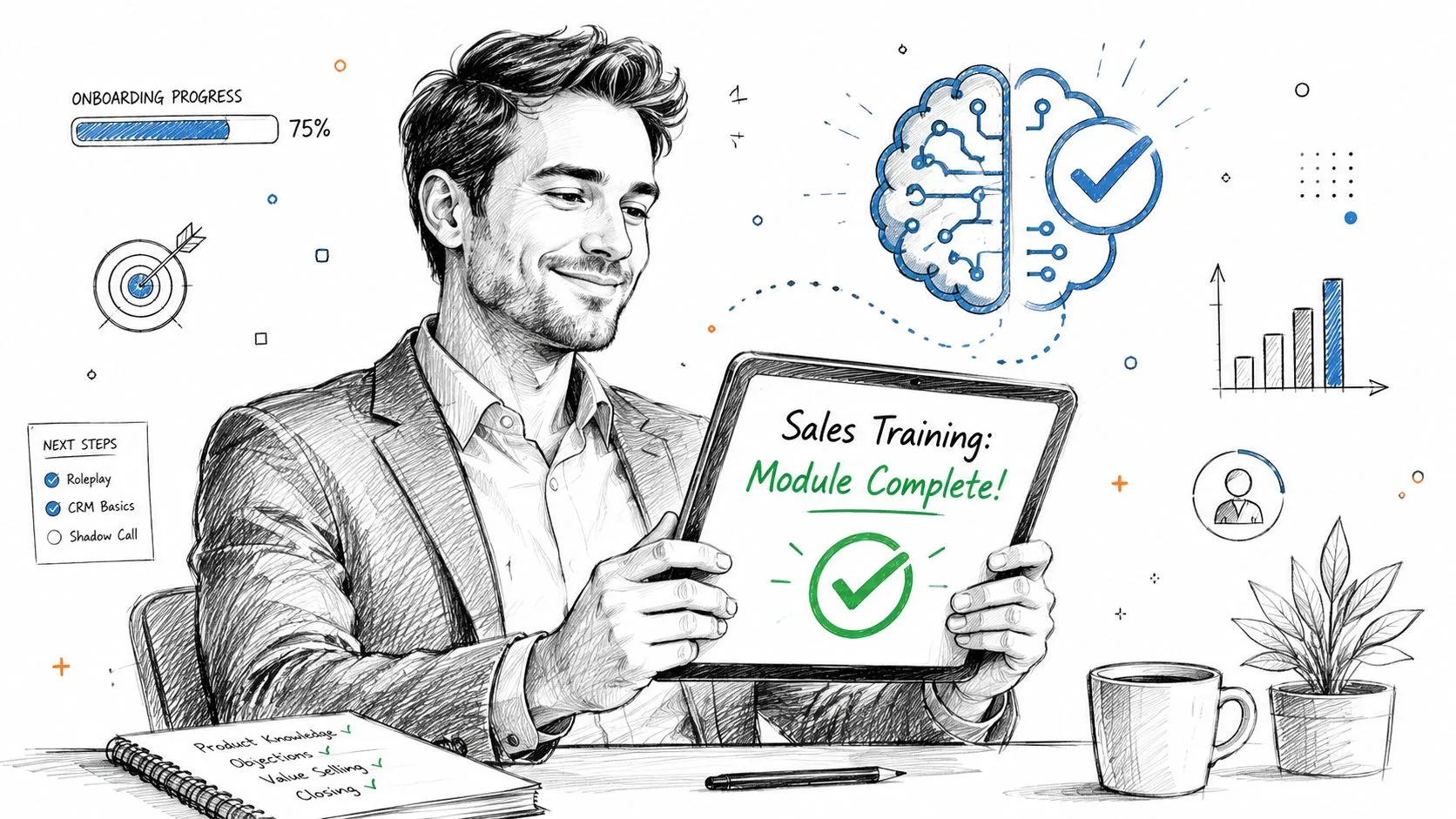
A sales manager asks new reps to submit mock outbound emails during onboarding. Often, review is manual. One manager cares most about tone. Another focuses on structure. A third notices only factual mistakes. New hires get uneven coaching.
An AI checker can standardize the first pass. It can review each draft against a rubric such as:
- Opening relevance: Did the rep connect to the prospect's context?
- Value proposition: Did the email explain the offer clearly?
- Brand tone: Does the message sound helpful rather than pushy?
- CTA quality: Is the ask specific and low-friction?
The manager still reviews final submissions, but now they spend time on positioning and judgment instead of repetitive notes like “shorten this intro” or “state the benefit earlier.”
Content marketing audits
Content teams often run into a different issue. Drafts are decent, but they vary too much. One writer forgets internal links. Another uses claims the compliance team will question. A third misses the brand voice entirely.
A checker built on homework-style logic can review draft blog posts against an editorial rubric. It can flag missing structural elements, unsupported claims, tone mismatches, overlong introductions, or prohibited language. It can also return feedback in a format the writer can act on quickly, such as “must fix before review” and “optional improvements.”
This use case works especially well because content teams already have hidden rubrics. They live in editorial docs, Slack threads, and the preferences of senior editors. Converting those rules into a consistent AI review layer gives the team a shared standard.
Teams often say they want faster content production. What they usually need first is more predictable content review.
Analyst quality control
Junior analysts produce recurring reports, summaries, and update decks. The logic may be sound, but formatting drifts, terminology changes, and required sections disappear when deadlines get tight.
A checking system can catch those issues before a senior analyst sees the work. It can verify that the document follows the reporting template, uses approved labels, includes required commentary, and doesn't omit standard components. If something falls outside the rule set, the system flags it for human review rather than guessing.
The educational roots of the technology are especially useful. In education, AI tools already support automated checking and feedback at very large scale. By 2023, China's Smart Education initiative reported that its AI-based assignment and feedback systems had reached over 180 million students, and in the United States 21% of college faculty reported using algorithm-based tools to check assignments or provide feedback, according to this overview of AI homework checking adoption. For business leaders, the takeaway isn't the classroom context. It's that the underlying review model is mature enough to operate across massive volumes.
These examples share one pattern. The AI doesn't replace the expert. It clears routine review work so the expert can focus on exceptions, coaching, and final judgment.
A Practical Guide to Building Your AI Checking System
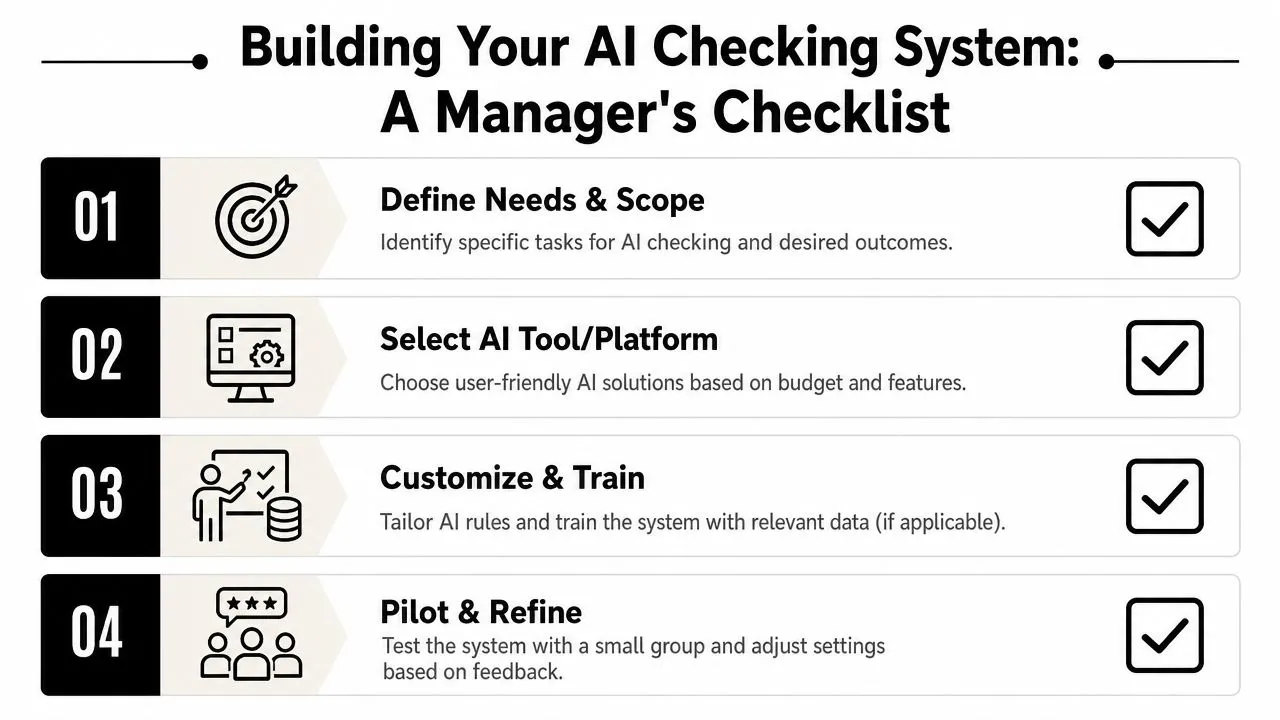
You don't need a custom platform to start. Teams can generally build a useful first version with a strong rubric, a reliable model, and a basic review workflow.
Start with a rubric
The first mistake teams make is asking the AI to “review quality.” That's too vague.
Instead, define a rubric with clear checks. For a sales email, that might include audience relevance, offer clarity, tone, CTA, and compliance language. For a report, it might include required sections, terminology consistency, and summary completeness.
Write the rubric in plain language. If a human reviewer can't apply it consistently, the AI won't either.
Choose the workflow and prompt
Some teams use general-purpose models with structured prompts. Others use dedicated review tools. The right choice depends on whether you need flexibility or standardization.
Your master prompt should include:
- The role the AI should play
- The rubric it should apply
- The output format you want back
- Escalation rules for uncertain cases
A simple pattern looks like this:
Review the submission as a quality-control assistant. Score it against the rubric below. Identify missing elements, unclear phrasing, and policy risks. Return feedback in three sections: must fix, should improve, and approved elements. If the draft involves ambiguity or sensitive claims, mark it for human review.
If you want reusable examples to speed this up, a curated AI prompt library can help you adapt proven prompt structures instead of starting from a blank page.
Pilot before scale
Start with low-stakes work. Internal training assignments are ideal. So are draft reviews that still go through a manager before approval.
Use a small test set. Compare AI feedback with human feedback. Tighten the rubric where the system is too vague, too harsh, or too lenient. The workflow is often improved by refining the rules, not by endlessly changing models.
A useful rollout sequence looks like this:
- Phase one: Practice tasks and onboarding exercises
- Phase two: Internal drafts with human approval
- Phase three: Higher-volume workflows with clear escalation paths
This isn't an untested concept. Large education systems have already shown that automated checking can operate at broad scale, which is why the model translates so well to structured business review environments.
Ethical Guardrails for AI-Assisted Quality Control
The technical setup is only half the job. If you're using AI to evaluate employee work, even informally, you need rules people can trust.
Transparency fairness and privacy
Start with transparency. Employees should know when AI reviews their submissions, what criteria it uses, and whether a human makes the final decision. Hidden evaluation systems create defensiveness fast.
Fairness matters just as much. A rubric can encode bias without anyone noticing. If your checker penalizes certain writing styles, cultural expressions, or role-specific communication patterns unfairly, you haven't improved quality control. You've automated inconsistency.
Privacy is the third guardrail. Teams need to think carefully before pasting client data, employee information, or sensitive internal material into external systems.
- Tell people what's being checked: No one likes surprise surveillance.
- Audit the rubric itself: Bad standards create bad feedback.
- Set data boundaries: Sensitive material needs stricter handling.
Governance at the team level
Many organizations still don't have mature AI governance. A 2025 UNESCO policy brief noted that over 60% of national education policies mention AI, but implementation guidance on auditing AI-assisted work remains superficial, according to this UNESCO policy summary. That gap doesn't stay inside education. It shows up in companies too.
So managers often need to create practical team rules before the company catches up. Those rules don't need to be legalistic. They need to be clear. What can the checker review? What needs human approval? What data is off-limits? How should people challenge bad AI feedback?
For leaders working through HR and governance questions, this guide on preventing human capital risks with AI ethics is useful because it treats ethics as an operational risk issue, not just a philosophy topic. It pairs well with a broader set of AI best practices for teams if you're building policy from the ground up.
Responsible use is what makes an AI homework checker valuable at work. Without guardrails, it feels like surveillance. With them, it becomes a coaching and quality system people can use.
If you want practical help building workflows like this, AI Academy is a strong place to start. It's built for working professionals, not engineers, and focuses on short, hands-on lessons that show you how to use tools like ChatGPT, Claude, Midjourney, and Perplexity in real business tasks. You'll get prompt templates, structured learning paths, and up-to-date tutorials that make it easier to turn AI from a curiosity into a repeatable part of your job.